Danielle Solzman
Season 2 of Light & Magic follows Industrial Light & Magic (ILM) as the company enters the revolutionary dawn of the digital era in visual effects.
Among the challenges that have come during the digital age include creating the first fully CG character and figuring out digital water. But despite whatever setbacks there have been, Industrial Light & Magic has managed to reach the incredible heights of digital innovation. Whether its Jar Jar Binks, Yoda, Davy Jones, explosions, tornadoes, or hurricanes, they have truly changed the game in what can be done during the filmmaking process.
Joe Johnston takes over the director’s chair from Lawrence Kasdan during the second season. I hadn’t been expecting another season of Light & Magic but there was no doubt that there was more to the story, given the company’s rich history. After all, this is the same company that birthed Pixar once upon a time! People can say what they will about George Lucas but ILM was pivotal in creating the technology that has made it possible for so much of today’s digital effects.
If anything, I wasn’t expecting so much time to be spent discussing Jar Jar Binks. I’m not upset or anything–again, there’s a rich history of ILM–but characters like Jar Jar Binks and CG Yoda were revolutionary as far as what was going to be possible in the future of filmmaking.
The work accomplished by ILM has been nothing short of remarkable–Light and Magic does a beautiful job in further capturing the story in the three-part second season. What follows below is an in-depth breakdown of each part.
Are We Ready for This?
Optical effects and practical effects were all that existed before Star Wars. Filmmaker J.J. Abrams notes how the George Lucas took everything to the next level. All of this is covered during the first season of the documentary series. There’s so much in the history of ILM that I guess we more or less knew that there would be more to tell about the ILM story.
“I had a kind of religious experience with ILM,” filmmaker Steven Spielberg says of working with Industrial Light & Magic. “I suddenly saw that everything was gonna change. It was gonna change everything for all of us and for audiences everywhere. And we were never gonna go back.”
Lucas had been out of the world of making Star Wars movies following the conclusion of Return of the Jedi in 1983. He decided to make his return to the saga in 1994. The old analog technology had been pushed as far as possible at ILM. Making the prequels would require digital technology. The technology didn’t existence and it took a decade to create what was necessary to make the films.
EditDroid was one of the first pieces of technology that allowed for the advances in digital technology. The films utilizing the technology were among those released in the late 1980s and early 1990s. It all came to a head with the release of Jurassic Park in 1993. I cannot say enough just how much the Steven Spielberg film changed my life. I mean, I’m not doing what I do without it! It’s a reason why I am patiently awaiting the release of Jurassic World Rebirth.
“Digital effects took on a momentum that you really just couldn’t stop,” says Jim Morris, who was the Industrial Light & Magic president during 1994-2005.
The work on 1996’s Dragonheart began to show that Industrial Light & Magic’s work had reached the level to where they could make the prequels. The costs of visual effects were going to be expensive to produce. Both Lucas and Rick McCallum reflect on what was happening during this time.
John Knoll used some of the newer technology while working on some of the Star Trek movies in the mid-1990s. This led to Knoll working on the Star Wars special editions. Lucas and company would never stop tinkering on the original trilogy. “We did the work quite a bit cheaper than we could have done in any other way,” Knoll recalls.
Doug Chiang had been schooled by studying Joe Johnston’s concept work. Chiang had submitted his portfolio and didn’t get a call for a long time. McCallum later called him to say that Lucas wanted to meet with him. Chiang talks about the original meetings with Lucas and what the filmmaker wanted in the upcoming films. His first day on the job came in January 1995 and he started drawing what would become known as Battle Droids. It’s not an understatement to say that Chiang placed himself under so much pressure so as to not let Lucas down.
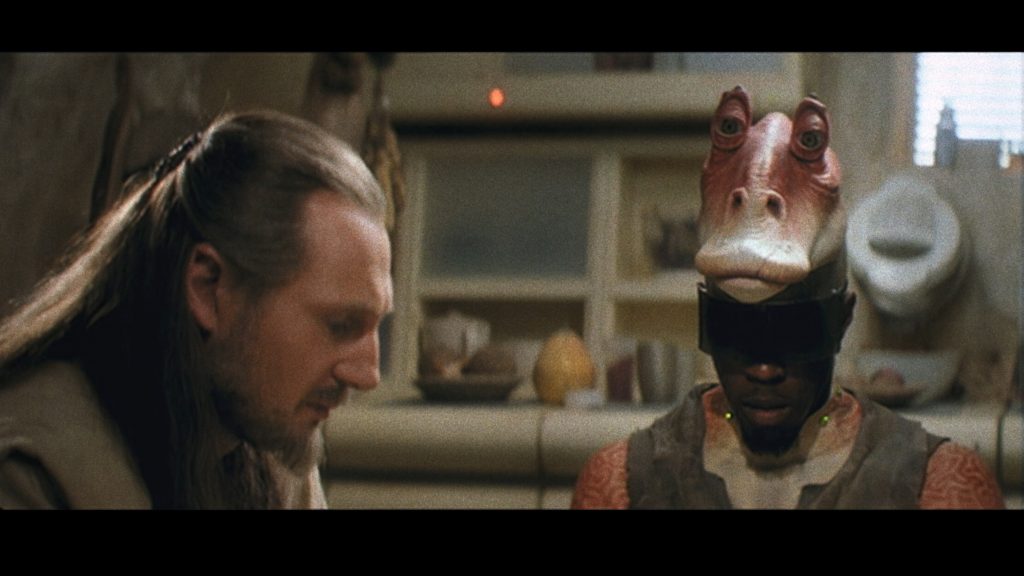
One of the synthetic CG characters that Industrial Light & Magic created for the film was a Gungan, Jar Jar Binks, modeled after Buster Keaton. The digital character had to act with actors, have a personality, and be included in hundreds of shots. They went through various designs of Jar Jar Binks before settling on a final design. “If Jar Jar didn’t work, it was going to ruin the whole thing because he was a key character in this whole story,” Chiang said.
They spend a lot of time discussing Jar Jar Binks, probably more than they should. It makes sense to discuss the creation of Jar Jar Binks and what a synthetic CG character means to the evolution of work at Industrial Light & Magic. But at the same time, there are so many other characters and films to discuss. Actor Ahmed Best recalls his first time meeting to discuss the character and what George Lucas was looking for in the performance. Best was together with Liam Neeson for most of the time. The work in the film is reminiscent of live-action characters interacting with animation in Mary Poppins.
They had Best perform in a motion capture bodysuit. In doing so, they were able to capture an outline that they could use in building his character. Lucas said “dare to be dopy” to Rob Coleman but didn’t say the same thing to Best. Meanwhile, the work on Men in Black paled in comparison to The Phantom Menace with some 200 shots to 2,000+ shots.
Following the discussion of Jar Jar, the next thing discussed is the pod race on Tatooine. Lucas had an idea of how he wanted the crashes to appear on screen. How does one bring the aesthetic to the screen when objects are moving at 800 miles per hour? It meant utilizing invisible blocks of foam during the design process and never rendering them.
There Must Be a Better Way…
In the second part of the three-part second season, Light & Magic tackles digital water and creating a digital Yoda. But first, The Phantom Menace was finally opening in theaters. Rob Coleman was asked to take part in the press tour. He was very proud of his work but press were not exactly a fan of Jar Jar Binks.
“They couldn’t imagine a goofy character like that,” Lucas said about the film’s reviews. “You’ve got to remember in the original Star Wars, people hated 3PO.”
Johnston couldn’t remember people hating C-3PO. Lucas had to remind him of Johnston’s original designs for the Ewoks. Anyway, Coleman mentions that people praised the effects work, just not Jar Jar Binks.
Ahmed Best opens up about the negative reviews and how it impacted him:
“It really was just draining, you know, just constantly have to defend the work. Because that point cloud is so representative of my performance and it almost is a physical signature, even if you’re talking about the character, you’re talking about me. But it wasn’t just me as Jar Jar. We were Jar Jar. ILM was Jar Jar. George was Jar Jar. I’m the face of it, but it was all of us. We all hurt because of it. And I felt as if I let everybody down. I felt it was my fault. I was 26. What should have felt like the beginning of something quite wonderful felt like the end.”
Best was on the outside of the Brooklyn Bridge, thinking to himself, “I’ll show every single one of them what y’all did to me. I’m going to make every one of you feel what you did to me.” You get the sense of how much the criticism hurt him. At one point, the wind blows and he lost his balance. Reality hit back to life and then he was like, “what am I doing out here.” He was scared and happy to be afraid.
“I think the lesson that was learned from everyone who does CGI characters now is to talk about the actor…and not just the character as if the actors don’t exist,” Best said.
Best did motion capture performance in the years before Andy Serkis did the same for Peter Jackson’s The Lord of the Rings saga or the later work on the Planet of the Apes reboot. There is so much that has changed in this time. I love how he was applauded for the 20th anniversary panel at Star Wars Celebration Chicago 2019. Unfortunately, I didn’t have a ticket to attend the panel but I was very pleased. I felt the same way when he made a live-action appearance in The Mandalorian.
After spending so much time talking about The Phantom Menace, it’s a breath of fresh air to go back in time to the work on Twister. Dennis Muren and Habib Zargarpour discuss the work that Industrial Light & Magic performed on the Jan De Bont film. Muren describes the work as “groundbreaking.” Zargarpour was working on the film at the same time his wife was expecting. Interestingly, the rendering was done before a script was written. The work on Twister paved the way for The Perfect Storm.
We were creating revolutionary new technology, just so we could digitally drown George Clooney,” recalls Masi Oka, a visual effects artist who later starred on Heroes.
Water works differently than tornadoes. Droplets stick together. Zargarpour mentions how they rendered blobbies and water coming apart. There’s no doubt that it was very tough to create, made worse by having to work on a deadline. According to Oka, they would need 90 days to do one second of waves. It was the first time that Industrial Light & Magic was at risk of not delivering a film on time. It was unacceptable for Industrial Light & Magic standards. The work on The Perfect Storm later paved the way for films like A.I. Artificial Intelligence and Pearl Harbor.
When it came time to working on Attack of the Clones, Lucas shot the entire thing on digital. Not only did they change how they made movies but how movies were exhibited. But before they could even make the film, they needed a digital camera–none of them existed. One requirement was that they needed a camera that could shoot at 24 frames a second. Every department had to go through a learning curve because of how digital filmmaking differed from shooting on film.
Rather than have a gazillion extras dressed as clone troopers during the Battle of Geonosis, they decided to use motion capture performance in bringing the work digitally to the screen. It’s an interesting decision because this makes a film even more expensive in terms of visual effects. Frank Oz’s work as Yoda was initially puppet-based in the first prequel. The reality was that it didn’t look like Yoda. The outtakes are hysterical though–you can see just how much work it was. Initially, acting scenes would be puppet and action scenes would be digital. Coleman thought that after Watto and Jar Jar, they could handle an all-digital Yoda.
Frank Oz had sent a nice letter to the staff of Industrial Light & Magic. There’s a big difference between using a puppet and digitally bringing a character to the screen. By going the digital route, all Oz had to do was record lines. At the end of the day, the digital artists stayed true to the character. One of the lines in the script speaks for itself: “In a fight that defies description, Yoda and Count Dooku battle.”
Ahmed Best volunteered his services to perform Yoda in motion capture. It was a 6-month process in coming up with how the fight would work. But once things got moving, they quickly animated things in a period of three weeks. Anyway, the fight was also key in showing the difference between Yoda, Obi-Wan Kenobi, and Anakin Skywalker in terms of their mastery of the Force. When I first bought the film on DVD, this was the first scene that I watched. It’s still amazing to watch all these years later. To say that the Industrial Light & Magic artists crushed it is not an understatement.
There’s No Going Back
Industrial Light & Magic is no longer the only VFX company in town. In order to withstand the competition, it means changing the game yet again.
John Knoll mentions how the building was rundown because all the dollars were going towards what appeared on screen. If having a rundown building means that the visual effects are going to be top-notch, that sounds fine to me.
The start of the third part focuses on adapting the Pirates of the Caribbean theme park ride to the screen.
“I love making a movie that’s not supposed to work,” says Pirates of the Caribbean: Curse of the Black Pearl filmmaker Gore Verbinski. “That’s the magic. The adventure is, like, we don’t know what’s going to happen.”
Verbinski described it as a punk-rock Western. It’s this aspect that grabbed him as the genre was non-existent. Knoll loved the opportunity that Pirates presented with shooting with water tanks. Interestingly, both Verbinski and Knoll’s fathers knew each other from their work as physicists. Talk about a small world!
Hal Hickel mentions how Captain Barbossa’s transition real to digital is the first shot that they worked on. This shortly segues into Hickel’s origins in becoming a visual effects artist. His background was in stop-motion animation thanks to the likes of Ray Harryhausen. Anyway, they shot actors in their picture costumes and matched the work as closely as they could. Some of the was performed in motion-capture on the Industrial Light & Magic stages.
Meanwhile, back to Star Wars, they had to work with digital stunt doubles to push the envelope for Revenge of the Sith. There are more lightsaber battles in the closing film of the prequel trilogy than any of the other films. They used a digital head for Ian McDiarmid–he wasn’t a great swordfighter and his stunt double didn’t look like him. All in all, 2,500 VFX shots on Revenge of the Sith. Mustafar was another instance where they pushed the envelope. Knoll pitched Mustafar as a miniature based on previous Methocel work utilized on Frank Marshall’s adaptation of Congo.
Things got quiet at Industrial Light & Magic, forcing layoffs. An opportunity came up to purchase a spot at the Presidio of San Francisco. They’ve managed to build up a beautiful campus. Unfortunately, the model shop was sold because of where things were going in digital filmmaking. It really was the end of an era.
Industrial Light & Magic used to be it–they set the gold standard. But then, other competition started joining in. Digital Domain worked on Titanic. Other companies tried poaching ILM talent. Knoll had some offers but nothing was the same as ILM. He mentioned how other companies “got to be really, really good, especially in the early 2000s.” Some of the companies included Manex Visual Effects, Digital Domain, The Orphanage/CafeFX, The Mill, and Wētā FX. Wētā is by far the biggest competitor. It helps that Joe Letteri used to work at ILM, but he wanted to bring Gollum to life.
As the Pirates series moved forward, Gore Verbinski looked to Davy Jones as his Gollum. Davy Jones was going to be a completely digital from the beginning. Rather than capture motion, they wanted to capture emotion. He wanted to get rid of the conflict between visual effects and actor. The IMocap suit was born as a result of the film, another pioneering achievement in visual effects.
When it came to the third film, they had to build one of the largest blue screens. Verbinski isn’t a fan of CG water but it was the only way to bring some of the scenes to the screen. One of Verbinski’s requests “broke John.” Knoll recalled the first render of the whirlpool looking terrible. Verbinski hated plan B, which forced them to come up with a plan C. Knoll worked it out again, turning the maelstrom into a pancake and then widening it. They worked on deadline and a number of sleepless nights but this was the version that worked.
For Steven Spielberg, visual effects need to make “emotional sense.” Spielberg told Doug Chiang that he was going to make War of the Worlds in eight months. They shot in December 2004 and released the film the following summer. Muren felt it made people be more creative. They used a mix of CG and real bridges and houses in bringing the film to life. You wouldn’t know it was made up of multiple elements from watching the film! Muren says that it’s his favorite film–he admits he couldn’t do anything better than that.
ILM turned down Avatar despite working many months on a screen test. Wētā FX ultimately got the job. What ILM subsequently did was their first digital feature, Rango, directed by Verbinski. It really became a team effort in shaping the film–seven artists working over a period of 18 months. The animators became a family through working on the film. It was a film that felt real even though it was stylized. In fact, Polly Ing said to use There Will Be Blood as a reference.
“It didn’t look like Pixar, didn’t look like Disney feature animation, didn’t look like Illumination, didn’t look like DreamWorks,” said Hal Hickel. “It was its own animal in every regard.”
The model shop stayed at the original location, even after Industrial Light & Magic moved to the Presidio of San Francisco. But in 2023–17 years after ILM moved–the original stages and model shop at Kerner closed their doors for good. It was the end of an era–so much history was made in the building. That’s where they filmed the last interview for the documentary.
Joe Johnston addressed the many artists that gathered at the old Kerner location:
“The work that was done here by all of you people and many who came before you…will live forever on movie screens and TV screens till the end of time. And this is indeed hallowed ground.”
How will AI impact visual effects going forward? This is the question of the hour.
“It’s hard to imagine that AI won’t play a massive role in digital effects,” says Habib Zargarpour. “It’s going to make a lot of work get approached in completely different ways than we’ve ever approached them before.”
To end the three-part season 2 of Light & Magic on John Knoll’s speech (and interview) accompanied by a montage sequence and classic John Williams Star Wars tunes is picture-perfect. It sent the right emotion home.
DIRECTOR: Joe Johnston
FEATURING: J.J. Abrams, Ahmed Best, Jean Bolt, Kim Bromley, Ben Burtt, James Cameron, Ed Catmull, Doug Chiang, Rob Coleman, Fon Davis, Rose Duignan, Chrissie England, Stefan Fangmeier, Jon Favreau, Scott Farrar, Bill George, Hal Hickel, Paul Hirsch, Ron Howard, Polly Ing, John Knoll, Joe Letteri, Janet Lewin, George Lucas, Frank Marshall, Rick McCallum, Jim Morris, Dennis Muren, Masi Oka, Lorne Peterson, Steven Spielberg, Gore Verbinski, Paige Warner, Habib Zargarpour, Robert Zemeckis
Disney+ released all three episodes of Light & Magic season 2 on April 17, 2025. Grade: 5/5
Please subscribe to Solzy on Buttondown and visit Dugout Dirt.