Danielle Solzman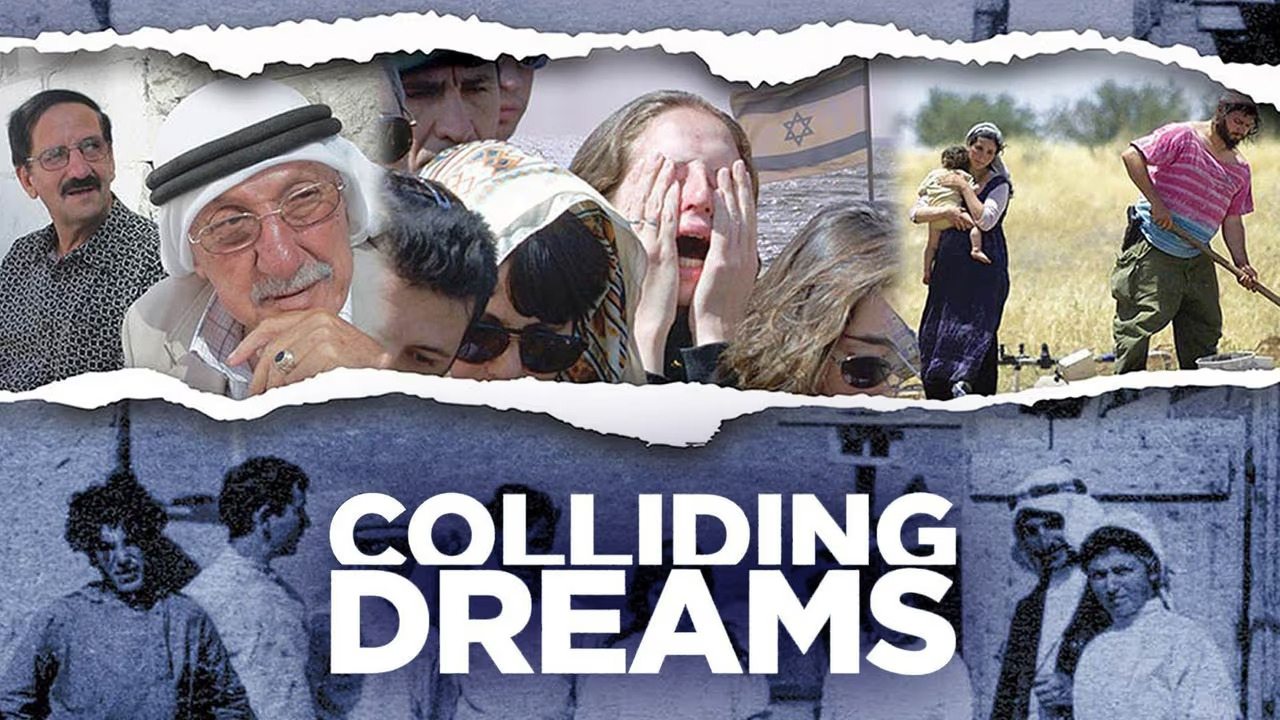
Colliding Dreams is a two-hour-plus documentary that takes an in-depth look at the history behind Zionism, while also touching on Israel/Palestine conflict.
Today marks Yom Ha’Atzmaut in the Hebrew calendar. Appropriately enough, Colliding Dreams showcases the transition from Yom HaZikaron into Yom Ha’Atzmaut–from Israeli Memorial Day to Israeli Independence Day. While I’m going to be spending the rest of May focusing on Jewish-American Heritage Month, I allowed myself this one day to review a documentary in connection with Yom Ha’Atzmaut.
Colliding Dreams is a documentary that comes off as educational, insightful, and informative. There’s a world where many of the protesters would watch this film and see why they are so wrong. Unfortunately, they won’t bother to educate themselves and will continue to view Israelis–and subsequently, all Jews living in the diaspora–as something they’re not. That’s a shame. The people that claim to have a problem with Zionism really have a problem with Kahanism. No matter how many times I try to educate them, it just falls on deaf ears. But maybe, just maybe, the white leftist antisemitism is just the medieval Christian anti-Judaism expressing itself in other ways.
Zionism was birthed by Theodor Herzl in response to many pogroms targeting Jews in the late 1800s, but especially the Alfred Dreyfus affair. Dreyfus was wrongly accused of treason and wouldn’t be pardoned until after two trials. But in short, Herzl was covering the Dreyfus affair and that’s when he first began to pursue then-Ottoman Palestine as a homeland for the Jewish people. It wasn’t until years later in which Britain took control from the Ottomans after World War I, splitting Ottoman Palestine into the British Mandate of Palestine and what would become the Hashemite Kingdom of Jordan. If I read correctly, the Ottomans viewed then-Transjordan as being part of southern Syria.
One of the things that filmmakers Joseph Dorman and Oren Rudavsky examine in Colliding Dreams is how Zionism is often distorted. The documentary was released a decade ago and it’s not an understatement to say that there are way too many people who simply don’t understand the basic concept of Zionism. At its basic core, it is the idea that Jews should have self-determination and that we should be able to govern ourselves in our ancient homeland, located in the State of Israel.
Colliding Dreams doesn’t ignore what’s been happening since 1967 and that’s where things understandably get complicated. If Kahanists had their way, Israel would annex all of the West Bank and not even bother to offer citizenship to the non-Jewish residents living within the borders. The fact that they–the Kahanists that I’ve challenged when the subject comes up–wouldn’t offer citizenship tells me everything I need to know about them. There were many Arab families that stayed within the Israeli borders after the War of Independence in 1948 and all of them were offered citizenship. That’s not to say that it’s been an easy road for them because it most definitely has not.
Colliding Dreams co-director Oren Rudavsky–who has been on the Jewish Film Festival circuit this year with a new documentary on Elie Wiesel–had been wanting to make this film since the late 1970s. Or at least a version of it. Rudavsky’s director’s statement describes the 2016 film as being “even more pressing now.”
Rudavsky further states:
“Because I think, what was once for many of us a point of pride, perhaps like the beginning of a love affair, has now become problematic, a difficult relationship. And yet, for me at least, it’s a relationship I’m unwilling to give up on.”
This is something that hasn’t gone unnoticed, even for proud liberal and centrist Jewish Zionists. We’ve seen how Benjamin Netanyahu has allowed far-right bigots into his coalitions. One of those bigots was the reason why there were protests outside of the Chabad headquarters in New York and to say that the protests got very ugly is not an understatement. There’s no place for racists like Itamar Ben Gvir–previously convicted of inciting racism–in Israeli’s governing coalition. He briefly quit, only to come back after Netanyahu resumed the war after Phase 1 of the ceasefire agreement.
There’s been a divide in recent years. There are many people who have never had the love affair with Israel because they grew up post-1967. The Soviet Union, which supported the Arab states in the 1950s and 1960s, no longer exists anymore, although Putin is allied with the likes of the Islamic Republic of Iran.
Joseph Dorman, who co-directs Colliding Dreams with Rudavsky, “thought it was vital at this moment to make a film about Zionism as an expression of the Jewish desire for self-determination because for too long people have conflated the State of Israel or its political leaders with Jewish nationalism itself.”
When we look at what Israel has become in recent years, Soul of a Nation makes for quite a companion documentary to Colliding Dreams. The difference between the two is that, again, this film explores Zionism as Jewish self-determination. It’s not looking at the State of Israel on the verge of civil war due to the judicial overhaul crisis.
Colliding Dreams explores Zionism and everything it entails, for better or worse. This documentary is worth checking out, especially in a world where too many people have redefined Zionism to be something it is not. But even then, Colliding Dreams still won’t be for everyone.
DIRECTORS/SCREENWRITERS: Joseph Dorman and Oren Rudavsky
NARRATOR: Alan Rosenberg
FEATURING: Steven Aschheim, Hanan Ashrawi, Samih Al-Qasim, Yariv Ben Aharon, Meron Benvenisti, Yoel Bin Nun, Geula Cohen, Aryeh Eldad, Jafar Farah, Ruth Gavison, Galia Golan, Moshe Halbertal, Hillel Halkin, Israel Harel, Yoram Kaniuk, Saman Khoury, Yossi Klein Halevi, Israel Lerner, Moshe Lerner, Motti Lerner, Avishai Margalit, Benny Morris, Walid Mula, Sari Nusseibeh, Chagit Ofran, Stav Shafir, Anita Shapira, Kobi Sharrett, Bambi Sheleg, Yehouda Shenhav, Khalil Shikaki, Gideon Shimoni, Said Zeedani
International Film Circuit released Colliding Dreams in theaters on March 4, 2016. Grade: 4/5
Please subscribe to Solzy on Buttondown and visit Dugout Dirt.