Danielle Solzman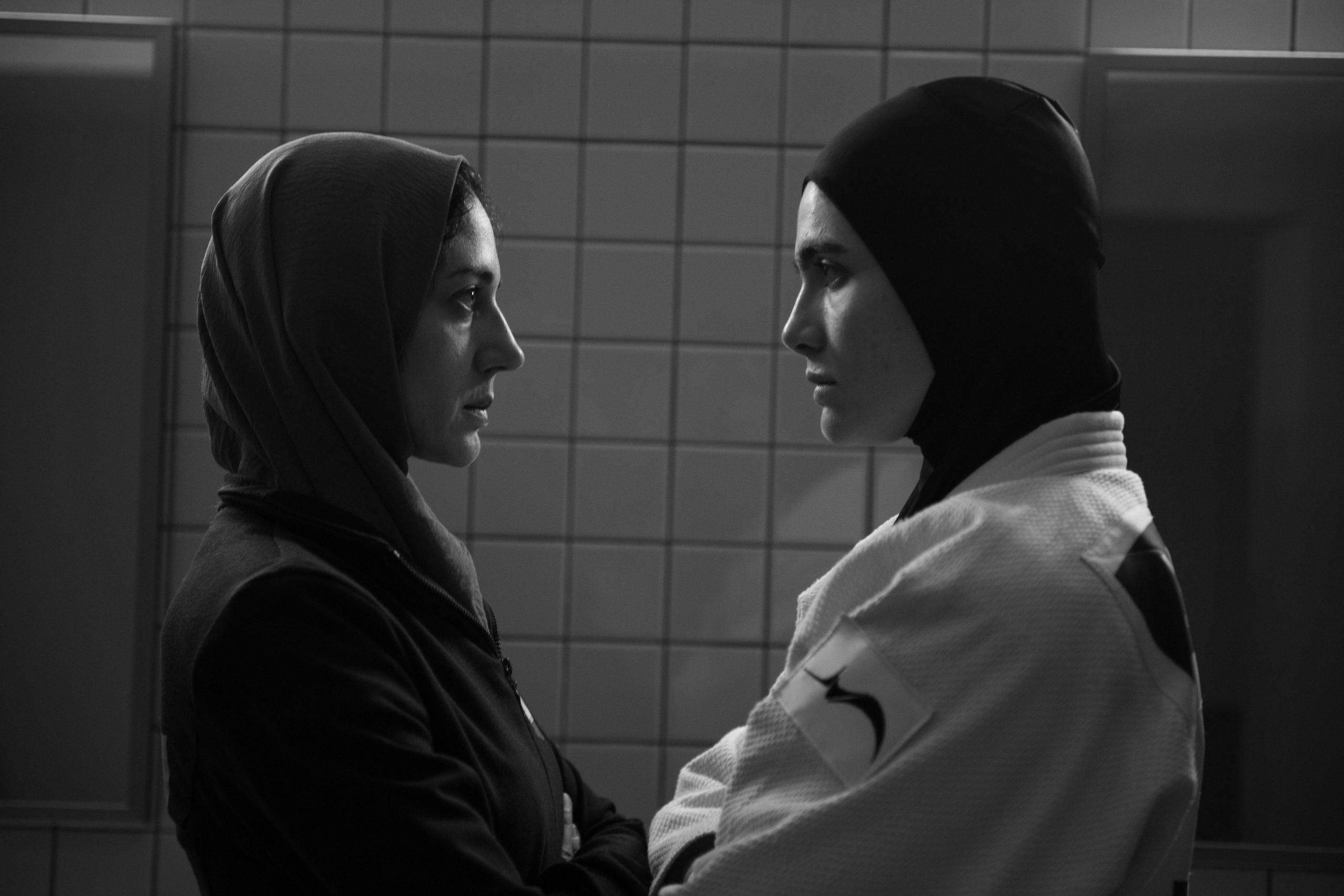
In bringing Tatami to the big screen, Guy Nattiv and Zar Amir have made history by being the first Israeli and Iranian filmmakers to co-direct a feature film.
It was a very different world when I first watched Tatami during the 2025 Miami Jewish Film Festival. I spoke with Nattiv and Amir on Monday. As I was transcribing my interview with them, I learned of Israeli prime minister Benjamin Netanyahu ordering preemptive strikes on Iran’s nuclear program. I want to stress this right now: Guy Nattiv and Zar Amir are not their government. They do not deserve to be the subject of boycotts for a film that is about friendship at the end of the day. Believe me, it’s very frustrating hearing that people are calling to boycott this film because of who the filmmakers are. As Nattiv said during our conversation, art heals.
Tatami follows Iranian female judoka Leila (Arienne Mandi) and her coach Maryam (Zar Amir). They are traveling to the World Judo Championships as Iran is hoping to bring home their first gold medal. If you’ve followed world competitions, you probably know what happens when an athlete from (insert country hating Israel here) is set to face off against an athlete from Israel in competition. They automatically forfeit, sometimes through faking an injury. It’s all rooted in antisemitism.
As the Championships each their halfway point, Islamic Republic of Iran officials warn that Leila must fake an injury or forever be branded a traitor. Whatever Leila decides to do doesn’t just have immediate consequences for her, but also her family. This is what it means to be living in Iran right now. If you so much as go against the Islamic Republic, there are serious consequences. Essentially, Leila has two choices: fake an injury and forfeit–which Maryam recommends–or compete for the gold. Tatami captures everything in its intensity.
The filmmakers spent time in Georgia with a mishmash of languages and culture as they filmed Tatami in a claustrophobic stadium from the 1950s. Despite what their government might have you think, the Israeli and Iranian artists working on the film have more in common than you think. Again, there’s something about art that has a way of bonding our humanity.
Things like art and sports have the power to heal, the power to make friendships, and that’s the message that Tatami is sending. Obviously, it’s a very intense film, more so in black and white. But right now? It’s a film that we could really use.
As Tatami rolls out in the US, it will open in New York on June 13, Los Angeles on June 20, and select theaters nationwide on June 27. It is so important that audiences turn out and show their support.
It’s so nice to meet you today. How are you doing?
Zar Amir: Good.
Guy Nattiv: We’re good. We met each other after a long time. We were separated, so it’s a good day.

Tatami is the first feature film in history to be co-directed by an Israeli and Iranian filmmaker. How did this happen?
Guy Nattiv: How did this happen? In 2020, in the pandemic, I saw this article about an Iranian judo fighter named Saeid Mollaei in Tokyo, who had the same story as Leila, basically. I wanted to write this story about it. I wrote a script, but because I’m not Iranian Persian, I decided to open myself to Iranian talent. I seen Zar’s tape that she sent to play Maryam and my jaw dropped.
I saw Holy Spider, the movie by Ali Abbasi that, that Zar won Best Actress in Cannes for. I said, I must, I must meet her. She came to LA to promote the film. We met and it was just an amazing meeting for me. I offered her to co-direct, cast the movie, produce it with me, and play Maryam obviously. Zar took a little bit of her time and after a while, she came back and said, I’m in. That opened up this beautiful collaboration.
I’ve read so many times about athletes choosing to forfeit rather than face Israeli athletes in competition. I feel like a film like Tatami is so timely and relevant, even today.
Zar Amir: It’s not only about the Iranian athletes. We had the same story this year in Paris, maybe Algeria. This is the way I think some totalitarian governments—I mean, it’s a political agenda for us, I think. We have more and more of these kind of examples everywhere.
Were either of you afraid of any pushback after deciding to make the film?
Guy Nattiv: Pushback from the government?
Yeah.
Guy Nattiv: Yeah. I mean, we both got warnings that we gotta shoot this movie in under the radar and not be so public about it. But we both have the same view about what’s going on. We both decided that this is important for our generation, for our kids, for our children, for our friends, for families. We decided to dedicate ourselves. Not every movie that we do is political, but we decided this is a good thing. This is a healing process for both nations.
In what ways did the script for Tatami change after Zar came on board?
Guy Nattiv: Oh, dramatically. Zar took the script and she said, Okay, now let’s work on that. The whole character of Maryam—everything became deeper, more authentic. She changed the dialogue. She changed a lot of stuff. In a way, I’m so lucky that Zar took a shift, but you can talk more about it.

Zar Amir: Yeah. In the beginning, the story was about Leila, and Maryam was part of her story, which was great. But when I read the script, I immediately just felt that this character, Maryam, is so complex. Maybe because she’s almost my age, because maybe I know this generation and their fears and that the whole thing around this decision that Maryam has made 10 years ago and the situation she faces today. The whole gap between these two generations, Maryam and Leila, was something that came to my mind.
I just told Guy and Elham, his co-scenarist, that I think we need to work on this character. At some point they became—this is what we see today. I think it made the whole thing deeper, this decision to make this character more profound. We worked a lot on the intensity—in terms of black and white and the way we decided to shoot the movie. I think every time you have to, again, work on the script, relate it to the condition of the shooting. It was a work of day by day, every day, 24 hours between all of us, with our DP, with our actors, Arienne, and us.
What led to the decision to shoot Tatami in black and white?
Guy Nattiv: Black and white is a canvas that has actually more of an abstract feel to it. You cannot really know what year it took place in, right? It could be in the 80s, 90s, 2000s, and 10 years from now.
I think that the environment of these women—of where they come from—they’re coming from a black and white world that you have no or yes and nothing in between. We felt that this is the atmosphere that we want to have.
It also kind of interacts with the paranoia films from the 70s, and films that we adore—the genre movies, the film noir—in a way, that gave another layer to the intensity of the film.
Zar, what are the challenges that come with both starring in and co-directing a film?
Zar Amir: Challenges are there, but I love it.
Guy Nattiv: She’s good at it as well.
Zar Amir: Maybe this is the way I learned how to do cinema. I started with filmmaking and then I continued my study in acting. It was in a very organic way from the beginning. I deal with it and it’s hard. You need to be very concentrated, especially. You need to take your distance every time you have to watch some actors, they can’t even watch themselves. But I have always luckily this distance with myself—I forget about myself, it’s the actor there.
Even in the editing process, it was funny because I always wanted to take myself out. Not everyone can do it, but it’s very inspiring being on both sides.
I imagine it’s somewhat easier when you have a co-director instead of acting in a film and you’re the only director.
Zar Amir: Yeah, of course. I had this chance to have Guy behind the camera.
Guy Nattiv: After every scene, Zar and I met at the monitor. We saw the playback, we looked at each other, and we said, yay or nay. It was kind of like our system.
What was the most challenging aspect of the production?
Zar Amir: Budget, time.
Guy Nattiv: Yeah, the budget was really low. The time that we had—
Zar Amir: Different cultures.
Guy Nattiv: Yeah, different cultures.
Zar Amir: Different languages.
Guy Nattiv: Yeah, different languages. We had Georgian, Persian, Hebrew, and English. It was like a mishmash of a lot of things.
But listen, we were locked in this stadium for almost a month. It’s kind of a Russian old stadium from the 50s so the walls are thick. We didn’t have air to breathe. The crew smoked. It was really hard and we felt that we are in this claustrophobic place.
But also, we were underground. We were supposed to be safe and not expose ourselves to anyone who wants to harm us and this movie not to be made.
When it came to casting Leila, how long did it take to find the right actress for the role?
Guy Nattiv: When we saw Arienne Mandi for the first time, it was it. I think she was the fifth or sixth actress that came to audition for us. She was so good. It was undeniable, in a way.
Were you prepared for her to do her own stunts?
Guy Nattiv: She’s a boxer in real life. She’s very physical. She had to take judo training for three, four months in Los Angeles and she nailed it. She had to compete versus real judo fighters. She was very strong. She gave it all. She was very authentic and she had a coach with her all the time.
How honored were you to premiere Tatami during Venice in 2023?
Zar Amir: I think it was a great beginning for this journey. It was wonderful.
Guy Nattiv: Yeah. Our first time in Venice. It’s your first time in Venice?
Zar Amir: Yeah.
Guy Nattiv: Okay. Yeah, it’s one of the best film festivals in the world and we felt the love. It was amazing screenings. We got an amazing—we were bought by many countries because of this film festival. France, Italy, Spain, all over the world.
I remember XYZ Films acquiring North American rights to Tatami in early 2024, and then I kept waiting for a release date to be announced. How much of the delay is because of October 7 and all the anti-Israeli protests?
Guy Nattiv: October 7 really took us by surprise and shock by what happened, but the movie is speaking about a different thing. We were waiting for the right time because we wanted to come out now when there’s not so many movies out there right now. It’s kind of a clean slate. We didn’t want to just disappear in the Oscar season. Because we were supposed to go last year, but we were waiting to wait for the right timing for us to shine.
I don’t think it’s relatively connected to what’s going on right now in the Middle East. I think that this movie speaks about a general idea of pursuit of freedom.
I was about to ask, what do you hope people take away from watching Tatami, but I think you just answered that.
Zar Amir: Friendship.
Guy Nattiv: Friendship, collaboration, and art heals. Make art, not war.
Zar Amir: Being open to—I think sometimes we are so afraid of just knowing each other. I think the first thing for me—I hate passing the messages with my movies, but this collaboration itself, there is this friendship statement in it.
The movie has been already released in France, and which was so interesting for me is this connection with the young generation.
Guy Nattiv: Especially women, right?
Zar Amir: Both. Women and men, teenagers. I think it opened the whole, especially in this situation of this world with this conflict and all the discussion in background. I think it became kind of a subject of discussion, this movie. This is what I really loved about this collaboration, and this movie itself. I hope even in the US, it’s gonna get this direction, to get more and more young generations of people into this discussion. We don’t have to be afraid of discussing about all these things.
Thank you so much. It’s been a pleasure.
Guy Nattiv: Thank you so much.
XYZ Films will release Tatami in theaters on June 13, 2025.
Please subscribe to Solzy on Buttondown and visit Dugout Dirt.