Danielle Solzman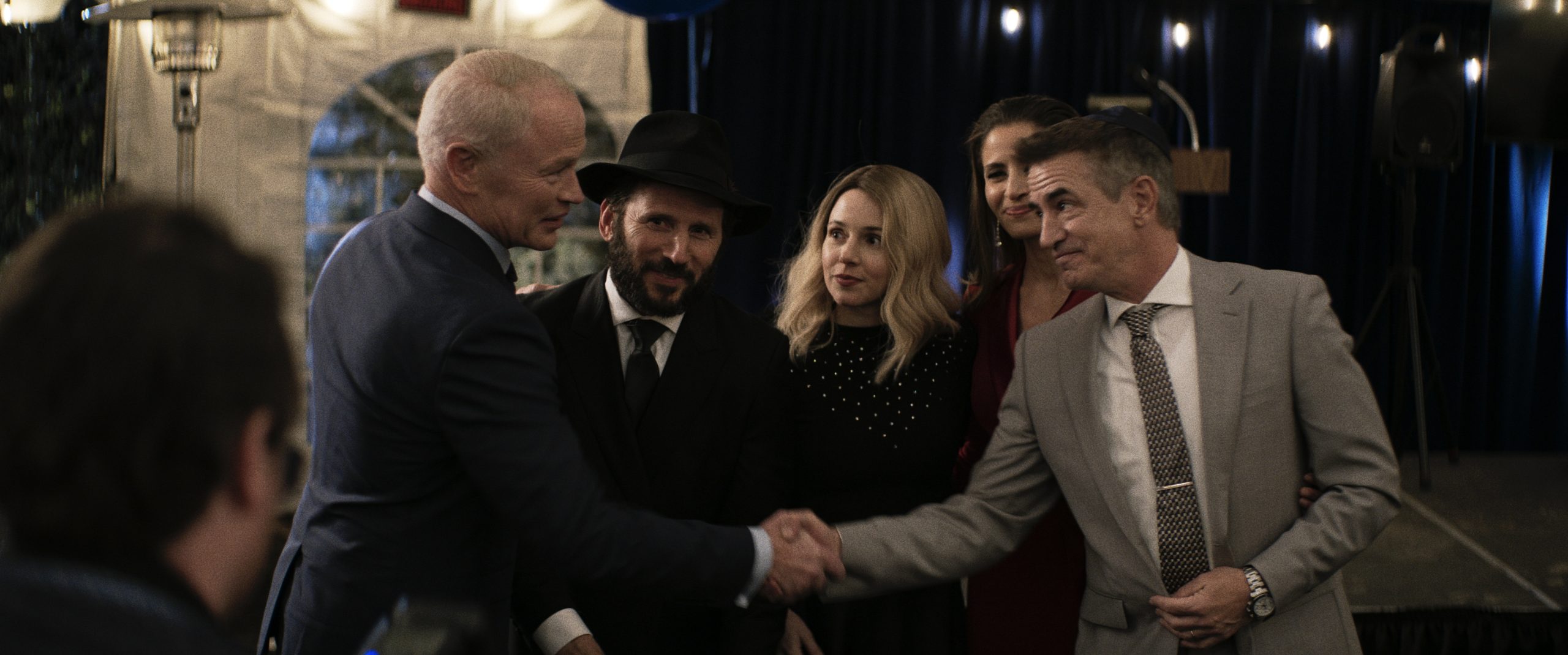
Written in response to the 2019 Poway shooting, neo-Western mystery thriller Guns and Moses arrives amid a global surge in antisemitism since October 7.
There is a message from director Sal Litvak that plays during the credits after a montage of photos taken at Shalom Grill.
The film first piqued my interest when it was announced as the Opening Night Gala selection of the 2024 Los Angeles Jewish Film Festival. I didn’t catch it until the 2025 Miami Jewish Film Festival earlier this year—but the kind of film that lingers long after the credits roll. Guns and Moses also screened at the 2025 Atlanta Jewish Film Festival, with its broader theatrical release arriving at a time when antisemitism is at its worst since the Holocaust. You’d be forgiven for thinking it was written in response to October 7. But no—Guns and Moses had already wrapped production before the terrorist attack.
In the remote desert town of High Desert, Calif., Rabbi Moses Zaltzman (Mark Feuerstein) is a revered Hasidic leader whose peaceful life is shattered when the High Desert Jewish Center’s annual fundraising gala is violently attacked, leaving honoree and solar farm entrepreneur Alan Rosner (Dermot Mulroney) dead. The police arrest a young white nationalist, Clay Gibbons (Jackson A. Dunn), who has a documented history of threats—but Rabbi Mo isn’t convinced they’ve caught the right person. With no one else willing to pursue the truth, Guns and Moses sees the rabbi step into the role of amateur detective.
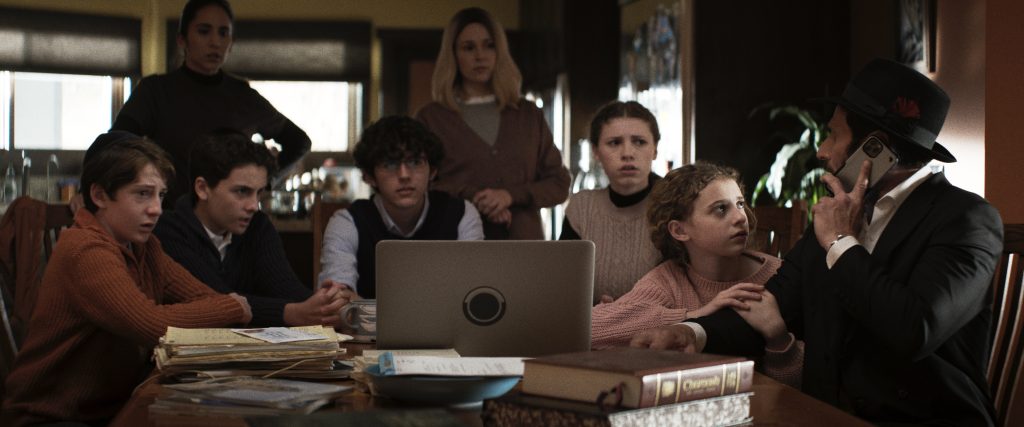
As the investigation grows darker and the bodies begin to mount, Rabbi Mo and wife Hindy (Alona Tal) are forced to arm themselves at security guard Brenda’s (Gabrielle Ruiz) insistence—mirroring director Sal Litvak‘s Magen Am training—and confront an enemy far more dangerous than they could have imagined. At its core, Guns and Moses explores the unlikely connection between a rabbi and an antisemite—and Rabbi Mo’s gnawing fear that, when the moment comes, he won’t be able to pull the trigger…or that he will.
If you know anything about America’s Jewish community, you know we’re overwhelmingly liberal or left-of-center—and many of us have long supported strong gun control laws. But in recent years, a growing number of Jews have chosen to arm themselves, particularly after the Pittsburgh synagogue shooting in October 2018. Another attack followed in Poway in April 2019, my own Chicago shul was hit with attempted arson that May, then a series of violent incidents in New Jersey and New York later that year. In January 2022, a rabbi and his congregants were taken hostage in Colleyville, Texas. And that’s not even accounting for the antisemitic protests outside synagogues, kosher supermarkets, restaurants, schools, and other Jewish spaces across the country.
Antisemitism isn’t confined to one side of the political spectrum—it exists on both the left and the right. Today, much of it is cloaked in the language of anti-Zionism: opposition to Israel’s very existence, not to Israeli policies as people would have you believe. Anyone who thinks anti-Zionism is simply about opposing Prime Minister Benjamin Netanyahu and his right-wing government is deeply misinformed. This has been one of the most frustrating and painful realities of the post–October 7 world. Zionism has always been a liberation movement for the Jewish people—about our right to self-determination in our ancestral homeland. For the vast majority of world Jewry, it’s a core part of our identity. That is not up for debate.
This past summer alone has seen domestic terrorism strike the Jewish community in both Washington, D.C. and Boulder, Colorado. Just before Memorial Day weekend, two young Israeli embassy staffers—soon to be engaged—were murdered in the name of the “Free Palestine” movement. As if that tragedy weren’t enough, an Egyptian national—again invoking the same cause—attacked a Run for Their Lives walk in Boulder, a gathering held in support of freeing the hostages. Hours before the start of Shavuot in June, he hurled a Molotov cocktail and used a makeshift flamethrower on peaceful demonstrators. Several people were injured; an 82-year-old Holocaust survivor later died from her injuries.
All that is to say that Guns and Moses is both timely and deeply relevant as it arrives in theaters. Nobody could have predicted the scale of hatred unleashed on the Jewish community since Sal and Nina Litvak first penned the screenplay for this neo-Western mystery thriller, filmed in just 20 days in Santa Clarita—a city long associated with classic Westerns. And yet, I cannot stress enough: real-world antisemitism has consequences.
After watching Mark Feuerstein for years on Royal Pains, it’s striking to see him embody Rabbi Mo Zaltzman—a role that hits differently in a post–October 7 world. Though he’s ultimately forced to take up arms, Rabbi Mo remains rooted in Jewish teachings, approaching the world with compassion and conviction. Where others might see a white nationalist suspect and rush to judgment, Mo believes there’s something deeper at play. Feuerstein delivers a performance that feels both urgent and nuanced—arguably the best work of his career. And in a fun Easter egg for longtime fans, Guns and Moses offers a mini-Royal Pains reunion between Feuerstein and avian expert Sid Barofsky (Paulo Costanzo)
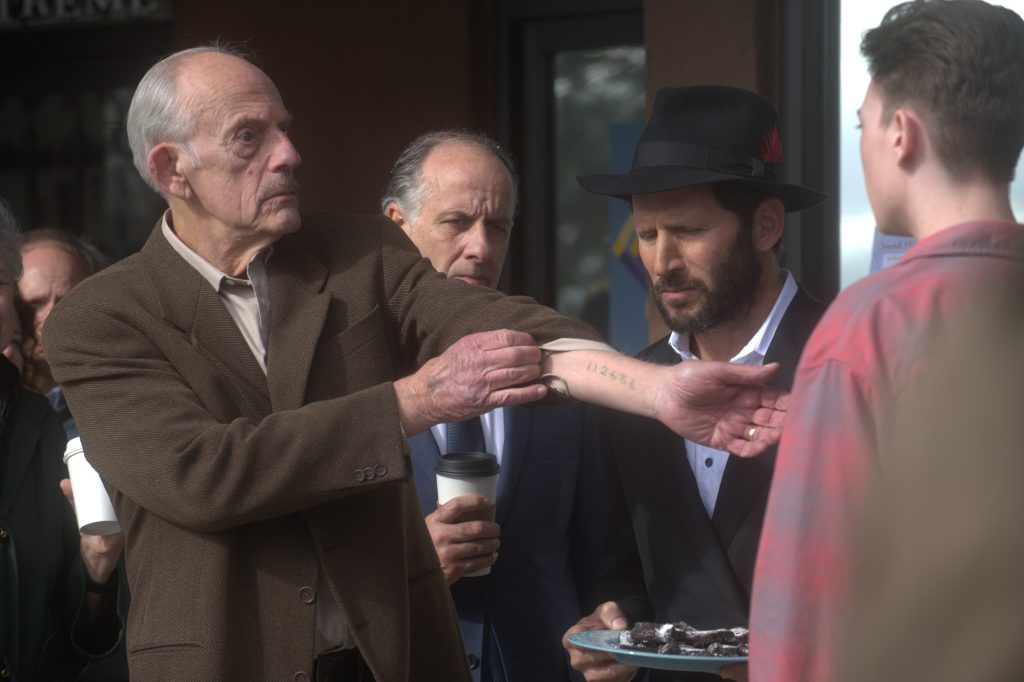
One of the most moving scenes in Guns and Moses comes when Rabbi Mo introduces Clay to Holocaust survivor Sol Fassbinder (Christopher Lloyd). I’m usually not in favor of non-Jewish actors portraying Jewish characters—especially with the growing push for authentic representation—but I’m willing to make an exception here. The Back to the Future star worked with a dialect coach to capture the proper accent, and the result is striking. Different from so many of his previous roles, Lloyd’s turn as an Auschwitz survivor is among the most emotionally powerful work he’s done on screen.
Like many thrillers, Guns and Moses features a standout set piece—and in this case, it’s a visually inventive cat-and-mouse chase filmed at the Mojave Solar Farm. It’s not North by Northwest, but it’s certainly memorable and has an opportunity to become iconic. The plant’s massive parabolic trough mirrors—designed to heat conductive fluid to super-high temperatures—become the backdrop for an intense sniper pursuit. As the white-hot mirrors shatter under gunfire, Rabbi Mo, in his signature black coat, fedora, white shirt, and checkerboard socks, scrambles for survival. Fortunately, director Salvador Litvak secured the location, sparing the need for digital destruction.
The high-desert landscape isn’t just a setting—it helps shape the film’s neo-Western tone with sun-drenched isolation and looming threats. Whether classic or contemporary, Westerns are known for their sweeping vistas. Guns and Moses may not linger on them the way a John Ford film or other classic Western might, but when it does, it makes the most of the terrain.
Musically, composer Aaron Gilhuis’s score supports the film just as effectively. It’s modern, much like the film’s visuals, yet it nods to the great Western scores that came before. It fits neatly into that liminal space where Westerns and thrillers converge. And Guns and Moses wouldn’t be a Jewish film without a few familiar melodies—like “Kol Ha’Olam Kulo” and the “Berditchever Nigun,” composed by my fifth cousin twelve times removed, Rabbi Levi Yitzchak of Berdichev.
It might seem like Jews are over-represented in Hollywood, but Jewish cinema—especially films about Orthodox Jews—remains niche. That’s what I love about Guns and Moses: it gives us the Orthodox Jewish representation we so desperately need, and it does so without mockery. That’s because director Sal Litvak is Orthodox himself, and it shows. The film has played well with audiences on the festival circuit for good reason. It’s smart, sincere, and self-assured—Guns and Moses has all the makings of a cult classic. Unless something changes, I’ll be pushing Mark Feuerstein for Best Actor at the end of the year.
In a time when Jewish communities around the world are grappling with fear, grief, and rising hatred, Guns and Moses gives us a rare cinematic figure: an old-school hero shaped not by vengeance, but by faith and moral clarity. Rabbi Mo may wear a black fedora and long coat, but what makes him iconic isn’t the look—it’s his refusal to abandon compassion, even in the face of terror. That’s what lingers after the credits roll: not just a gripping neo-Western, but a reminder that sometimes, the most unlikely among us rise when we need them most.
DIRECTOR: Salvador Litvak
SCREENWRITERS: Nina Litvak & Salvador Litvak
CAST: Mark Feuerstein, Neal McDonough, Alona Tal, Gabrielle Ruiz, Mercedes Mason, Jackson A. Dunn, Paulo Costanzo, Ed Quinn, Zach Villa, Roger Guenveur Smith, Michael B. Silver, Jake Busey, Craig Sheffer, Cherie Jimenez, Massi Pregroni, Juju Journey Brener, Mila Brener, Mark Ivanir, with Christopher Lloyd and Dermot Mulroney
Concourse Media will release Guns and Moses in theaters on July 18, 2025. Grade: 5/5
Please subscribe to Solzy on Buttondown and visit Dugout Dirt.