Danielle Solzman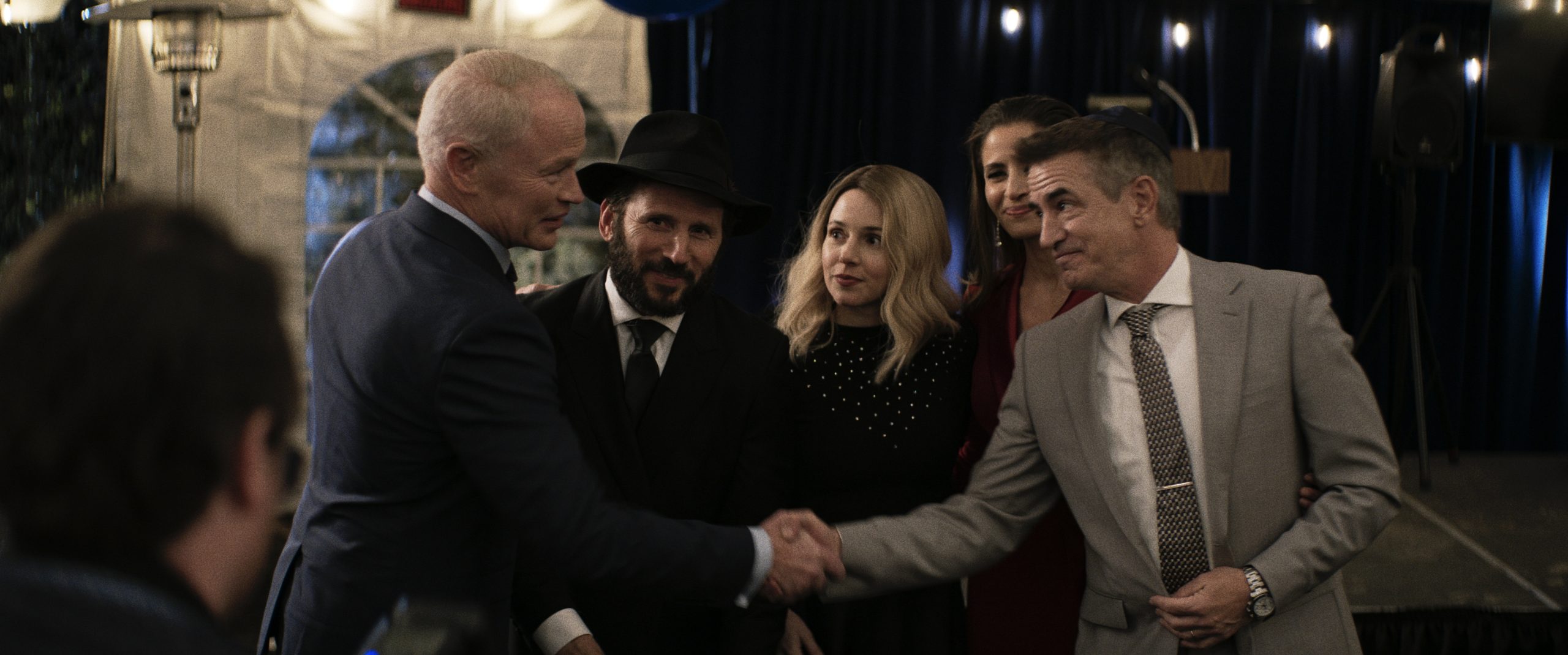
Mark Feuerstein opens up about his role as Rabbi Mo Zaltzman in Guns & Moses, a timely neo-Western thriller inspired by real-life antisemitic violence.
In a wide-ranging conversation, the actor discusses training with Jewish security group Magen Am, channeling heroism without glorifying violence, and the emotional power of working alongside Christopher Lloyd. Feuerstein also reflects on the film’s prescience given the post–October 7 surge in antisemitism and shares how his character embodies faith-driven strength. He emphasizes the importance of Jewish storytelling in this moment and hints at the possible return of Dr. Hank Lawson in a Royal Pains reboot.
In Guns & Moses, Mark Feuerstein stars as Rabbi Moses Zaltzman, a Hasidic leader in a quiet desert town whose world is upended by a violent attack on his congregation. When a local white nationalist with a history of threats is arrested, Rabbi Mo questions whether the police have the right suspect—and takes it upon himself to uncover the truth. As the investigation deepens and more lives are lost, he’s forced to confront his own limits, including whether he’s capable of using a gun when it matters most. At the film’s core is a tense and unlikely connection between the rabbi and the accused, exploring the moral weight of justice, identity, and conviction.
Sal Litvak directs the film from a script he co-wrote with his wife, Nina. Feuerstein leads a cast that includes Neal McDonough, Alona Tal, Gabrielle Ruiz, Mercedes Mason, Jackson A. Dunn, Ed Quinn, Zach Villa, Roger Guenveur Smith, Michael B. Silver, Jake Busey, Craig Sheffer, Cherie Jimenez, Mark Ivanir, with Christopher Lloyd and Dermot Mulroney.
Guns & Moses starts playing in select theaters this weekend.
It’s so nice getting to chat again and for the first time, face-to-face!
Mark Feuerstein: Amazing. Danielle, it is so nice to see you!
Likewise.
Mark Feuerstein: How are you?
I’m doing well. It’s an inferno outside and that’s not really helping temperatures in the apartment.
Mark Feuerstein: I’ve heard. There’s a heat wave.
Yeah.
Mark Feuerstein: Where are you right now?
Chicago.
Mark Feuerstein: Yeah. I talked to somebody else from Chicago and he was saying it’s just a killer.
Yeah.
Mark Feuerstein: I’m sorry. Well, let’s create some some cool breezy conversation to lighten up the air around you.
It’s hard to believe that next January will mark the 20th anniversary of the Narnia Rap Battle.
Mark Feuerstein: Oh my G-d, that’s amazing that you are mentioning that. The East Coast–West Coast rap battle that only some keen viewers like yourself are aware of. More people would be aware of Andy Samberg’s incredible voluminous history of digital shorts for SNL. But some will remember when “Lazy Sunday” met its match on the West Coast with “Lazy Monday”. Yo Stein, what’s up Feuerstein? Let’s rock a ice blended at the Coffee Bean. And Color Me Mine out on the West Side, spinning pretty plates and dropping dope rhymes. You get it.
Yeah. What was it about the script that drew you to Guns & Moses?
Mark Feuerstein: Danielle, when you read a script like an indie, you never know what you’re going to get. They could be horrendous. The role could be not great or small.
When my manager and I read this script and we chatted the next week, we said, Wow, this is actually pretty great. I get to play a character who is not only funny, but also dramatic, but also a badass rabbi who learns how to fire a Glock. I was like, This is the full enchilada. I was thrilled that I was offered the role of Rabbi Mo.
I met with Sal Litvak and his wife Nina, who wrote it, at their sukkah during Sukkot, where all great opportunities begin. We sat and we discussed the story. I saw how genuine and passionate Sal and Nina were about their faith and about telling a story.
Just so you know, this movie was inspired by the Poway shooting at the synagogue in Poway, California, where a shooter showed up to kill 15 members of the congregation. A rabbi there got up and lunged at the shooter, losing a finger, but saving the congregation. Sal was so inspired and Nina was so inspired by that act of selfless action that they invented Rabbi Mo, a character who in the face of injustice, in the face of a murder of a patron of his community, will stop at nothing to find the truth—even going so far as to learn how to shoot a Glock.
Did you do any particular prep prior to production?
Mark Feuerstein: Yes. Sal Litvak, the writer and director, is part of an organization in California called Magen Am, which is a private security organization to protect synagogues around LA and other areas. His friend, who founded Magen Am, taught me how to shoot a gun.
I went to the gun range many times. Even Sal was giving me instruction on how to hold the gun with two hands, how to feel for the trigger and feel for the little release that you feel right before you’re supposed to press the trigger, and where your finger is supposed to be.
I remember when we have this montage where I look like a badass waving my long black coat behind me in the wind as I fire my gun. It took a few takes, but finally Sal said I did everything right and nailed it. I was happy to honor he who had learned how to shoot a Glock himself.
I must add that Zaltzman was the family name before coming to the East Coast.
Mark Feuerstein: Oh, is that right? Holy cow. So you share a kinship with, though fictional, the imagined history of the Zaltzman family.
Yeah. All these years, I thought it started with an S and then we started digging into Jewish genealogy—no, it starts with a Z.
Mark Feuerstein: I think a lot of them do. There’s a word that if you look it up on Google, it’s called Sitzfleisch. But the word is actually Zitzfleisch. It means the ability to keep your ass in your seat and do the work, which is something that you have. You have Zitzfleisch, and I have—yeah, another example of an S that’s really a Z.
When I spoke with Sal and Dermot last week, they had mentioned photography already wrapped well before October 7. Could you imagine taking part in this film and in the time since it wrapped production and premiered, antisemitism surged so much?
Mark Feuerstein: I could never have imagined, Danielle, just how much antisemitism would grow in this country from 100 to 200 to 300 percent. I don’t know the numbers, but I know they’re not good. It’s really sad, complicated, and hard.
There have been so many different chapters to this experience for Jews in the last two years—everything from realizing we might be a little more alone in this country than we thought, realizing many people really do hate us, though they probably don’t know us, and that we have to fend for ourselves.
That’s one of the lessons in this movie, Guns & Moses. There’s a moment when my character, Rabbi Mo, quotes Rabbi Hillel, who says, “In a place where there is no man, [strive to] be the man”—or woman. And the message is: you can’t rely on anybody to save your ass.
Same is true in acting. Somebody once told me, No one’s in the Mark Feuerstein business more than Mark Feuerstein. That has been true. No one’s going to do it for you. You have to protect yourself.
But the rabbi doesn’t want to be violent, and there’s a scene with the woman who plays my wife, who is Alona Tal. Hindy says to Rabbi Mo, “Are you afraid that you won’t be able to shoot the gun?” And I say, “Yes, and that I will, because I don’t want to.” He’s not a violent man. This is not a movie that glorifies violence. It’s just a movie that suggests you be prepared—but always be looking to connect instead of to fight.
Yeah. Even though it wasn’t a traditional Lawson brothers reunion, I loved how the film had a nice Royal Pains easter egg.
Mark Feuerstein: Ah, Danielle, thank you for noticing. I appreciate that. Yeah, there were two actors.
One was a guy who played Killer Keller in Royal Pains, named Mike Silver, my old friend from New York City. Paulo Costanzo was kind enough to fly out from New York to be in Guns & Moses. He plays Sid Barofsky, who is a very believable suspect for who might have killed the patron of our community—the most generous benefactor of our synagogue community in the high desert town that this movie is set in.
Paulo does such a great job. Mike does such a great job. I was so thrilled to be on set with them again. That’s when you know you have brothers and sisters in arms who are in it for the love of the game, because nobody was getting rich off this movie. But it was an important story that everybody signed on to tell and I was so touched by that.
What was it like getting to work with Christopher Lloyd?
Mark Feuerstein: Oh my G-d. So of course, I’m a huge fan of Christopher Lloyd—from Taxi, where he played Jim Ignatowski, to Back to the Future, in which he’s brilliant. But the scene in which he does his thing is so important to the message of the movie.
Because in this time of complicated messaging regarding affinity groups and diversity, equity, inclusion, and whatnot, there is this element where we’re not supposed to go to any other group to explain their history to us. We’re just supposed to do our own work. And that’s okay. I understand everybody’s sensitive.
But Jews have never been afraid to tell their story. No Jew turns down an opportunity to tell you of our suffering or our heroism.
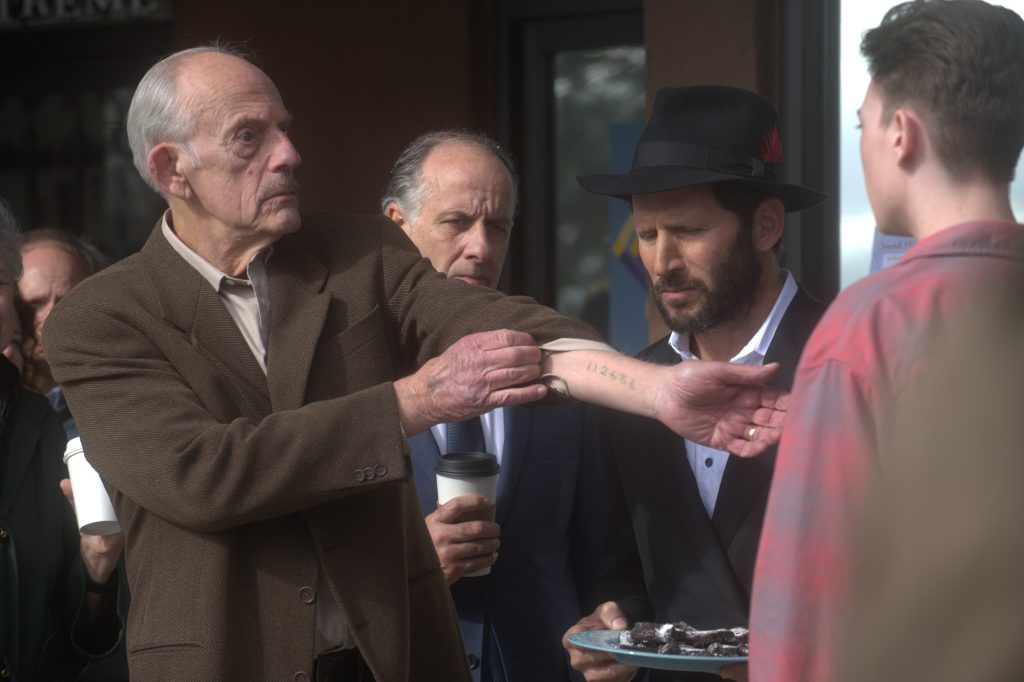
There’s a neo-Nazi in the movie who keeps terrorizing our little high desert community, and instead of just running and hiding, like the stereotype of Jews that is reinforced by certain stories, this rabbi goes up to the car, tells him, Hey, if you’re such a tough guy, get out of your car and let me introduce you to someone I’d like you to meet. He gets out and I introduce him to a survivor, played by Christopher Lloyd, who tells him how he lost his whole family in the Holocaust.
And then it’s not so easy for a neo-Nazi and all of his colleagues in the movie to deny that the Holocaust happened. Which—there are many people out there, Hitler apologists as well, who would have you believe it didn’t happen or it wasn’t as bad as people tell you.
But there’s Christopher Lloyd telling this kid. And it’s only because this kid is listening, is curious, is willing to open his eyes, and is beautifully rendered by Jackson Dunn, the actor who plays this character.
But it’s when he takes the brownie at the Kiddush of my synagogue that I say, I just don’t know if he could have been the killer. I just don’t know. And though other people around him would have him believe that, he’s not willing to settle on the lowest common denominator.
I think that’s a great message for the world at this time when people are on TikTok, Instagram, and Facebook and just willing to believe the last post they saw because someone had the balls to post misinformation and hate. My character, Rabbi Mo, is not willing to stand for that. He’s going to look harder, find the real truth, and find the killer.
What do you typically look for in a character when you’re reading a script?
Mark Feuerstein: I look for the fun it will be to play them—and sometimes that means playing a role model like Dr. Hank Lawson on Royal Pains, who I cherished getting to play for eight years because he is an example.
I mean, Andrew Lenchewski—I don’t know if we talked about this years ago, but he wrote in the stage directions, Dr. Hank Lawson will make an entire generation of kids want to go to medical school. I got to have the experience of a kid coming up to me and saying, Dr. Hank, Dr. Hank, it’s because of you, I’m going to Johns Hopkins Medical School next year. That’s a very satisfying moment if you want to play a role model.
But then, most recently I got to do Hotel Cocaine. We filmed it in the Dominican Republic. I played Burton Greenberg, a coke-snorting, hippie hotelier who gets involved in the drug trade. I loved it.
So it’s really about just the fun of what we get to play. I’ll be playing a lawyer on Nemesis, which I know how to do. I got that in my back pocket at all times.
This journey of being in this business offers you so many different opportunities and some of them are amazing and really stretch you as an actor. Some of them are closer to who you are, but in all cases, I’m just so grateful to get to work and get to do what I love for my living.
Yeah. I read in April that NBC was looking at rebooting Royal Pains.
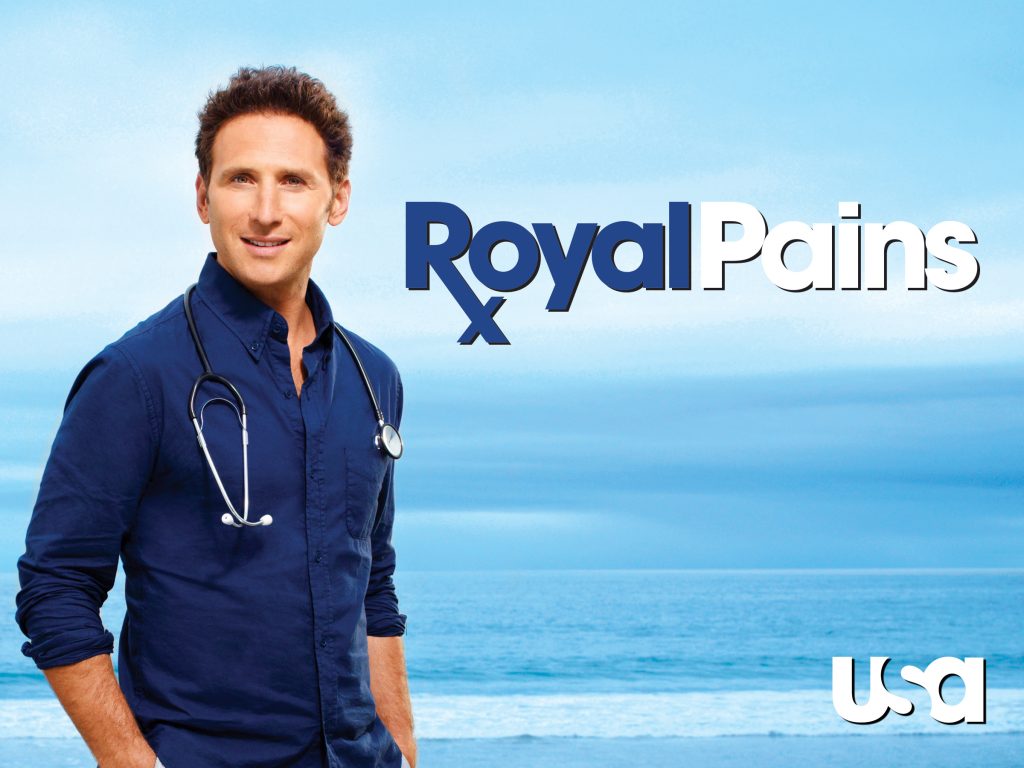
Mark Feuerstein: From your lips to G-d’s ears, Danielle. They did announce it and they have written a script. If all goes well, Danielle, you and I will be doing another interview in which I’m talking about Dr. Hank Lawson again. I hope it happens.
How quickly will you be able to get back into character when it happens?
Mark Feuerstein: It’s not going to take too long, Danielle. It’s going to be very quick. I love that role.
I cherish getting to play this doctor who won’t just take care of the rich, as so many people in the medical profession and beyond have decided to do, because it’s how to make money, but this doctor who wanted to save both the rich and the poor alike, and he became sort of the Robin Hood of medicine.
I can’t share the concept for the reboot or the reinvention of Royal Pains that is to come, I believe. But it’s an amazing take that Andrew Lenchewski and Michael Rauch had on a new iteration of the show, and I just dream that we get to make it a reality.
Well, I will be praying that it becomes a reality!
Mark Feuerstein: Thank you, my friend. Thank you.
It’s been a pleasure getting to chat and hopefully it won’t be another ten years before a formal interview.
Mark Feuerstein: Well, you look terrific and I’m so happy to see you.
Thank you so much.
Mark Feuerstein: Alright, Danielle. I’ll talk to you soon. Stay in touch, okay?
Oh, I will!
Mark Feuerstein: Okay, bye.
Concourse Media will release Guns & Moses in theaters on July 18, 2025.
Please subscribe to Solzy on Buttondown and visit Dugout Dirt.