Danielle Solzman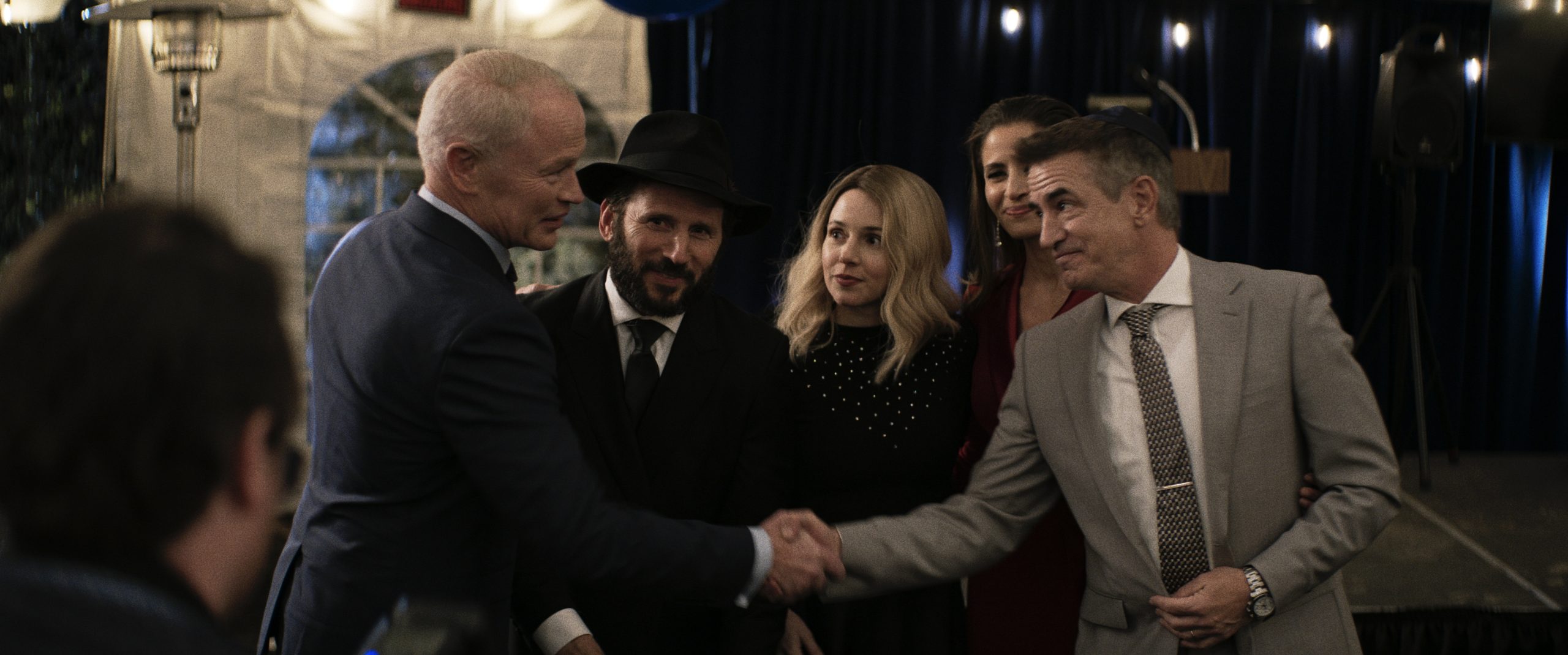
Sal Litvak and Dermot Mulroney discuss making Guns & Moses in 2022 and how the Jewish neo-Western resonates differently after October 7.
In this thoughtful conversation, director Sal Litvak and actor Dermot Mulroney reflect on the making and deeper meaning of Guns & Moses, a Jewish-themed neo-Western thriller completed before October 7 but released in a radically changed world. They discuss the film’s timely relevance, the challenges of shooting on a tight indie schedule, and the emotional weight of portraying violence and identity. Litvak shares the film’s spiritual and cinematic influences—from Cary Grant to North by Northwest—while Mulroney explains how timing and community shaped his participation. Together, they highlight the film’s urgent message about truth-seeking, resilience, and self-defense, offering a unique portrayal of Orthodox Jewish life rarely seen in mainstream cinema.
In Guns & Moses, Mark Feuerstein stars as Rabbi Moses Zaltzman, a Hasidic leader in a quiet desert town whose world is upended by a violent attack on his congregation. When a local white nationalist with a history of threats is arrested, Rabbi Mo questions whether the police have the right suspect—and takes it upon himself to uncover the truth. As the investigation deepens and more lives are lost, he’s forced to confront his own limits, including whether he’s capable of using a gun when it matters most. At the film’s core is a tense and unlikely connection between the rabbi and the accused, exploring the moral weight of justice, identity, and conviction.
Sal Litvak directs the film from a script he co-wrote with his wife, Nina. Mark Feuerstein leads a cast that includes Neal McDonough, Alona Tal, Gabrielle Ruiz, Mercedes Mason, Jackson A. Dunn, Ed Quinn, Zach Villa, Roger Guenveur Smith, Michael B. Silver, Jake Busey, Craig Sheffer, Cherie Jimenez, Mark Ivanir, with Christopher Lloyd and Dermot Mulroney.
Guns & Moses starts playing in select theaters this weekend.
It’s so nice to talk with you. All things considered, how are you doing?
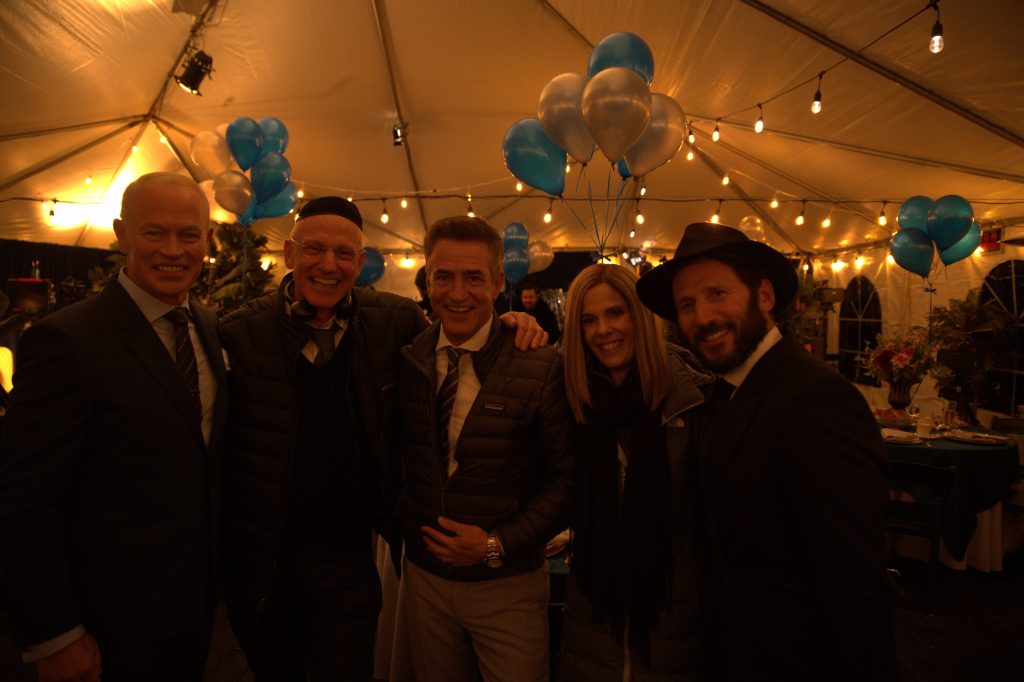
Sal Litvak: (Laughs) Hanging in there. This is the last one, so we won’t have to rush away, but it’s been fun hanging out with Dermot as we move from room to room.
Dermot Mulroney: Thank you, Sal. Same here.
I have to say that I had a nightmare last night that I was preparing questions for Dylan McDermott.
Dermot Mulroney: It is. It’s nightmarish. Welcome to our mutual nightmare. It’s actually been a playground for 38 years that we both appreciate.
Sal Litvak: I love that you did that on Saturday Night Live, right?
Dermot Mulroney: That’s at least 15 years old, maybe more. Do you know what I mean? So yes, our legacy is larger than it would have been had the other not been here to resonate. It is. It’s nightmarish.
One of my usual questions is usually what was the genesis behind the script. But seeing as where antisemitism has surged during these past few years, what was the state of production heading into October 7?
Sal Litvak: Well, we shot the movie before October 7. It takes a long time.
Dermot Mulroney: The filming was well completed by then. Yeah, the post-production takes the time it takes, but it certainly puts this film out for the public at a time that’s different than when it was made. Drastically different.
What’s the reception been like as Guns & Moses has played at film festivals?
Sal Litvak: I traveled with it quite a bit, shown it to all different kinds of audiences. We definitely played at Jewish film festivals, but also other kinds of audiences.
It’s an amazing response. It really brings people together, whether people are of faith or not of faith, whether they’re Jewish or they’re Christian, people in the Second Amendment community, people in the law enforcement community.
There’s just so many questions that are asked in the movie and there’s just a lot to talk about. It’s funny—every time I’ve seen the movie with an audience, it ends and people are still sitting in their seats talking about it. They’re not in a rush to get out of there. There’s just a lot to talk about, about what just happened, what did we experience, and what did we learn?
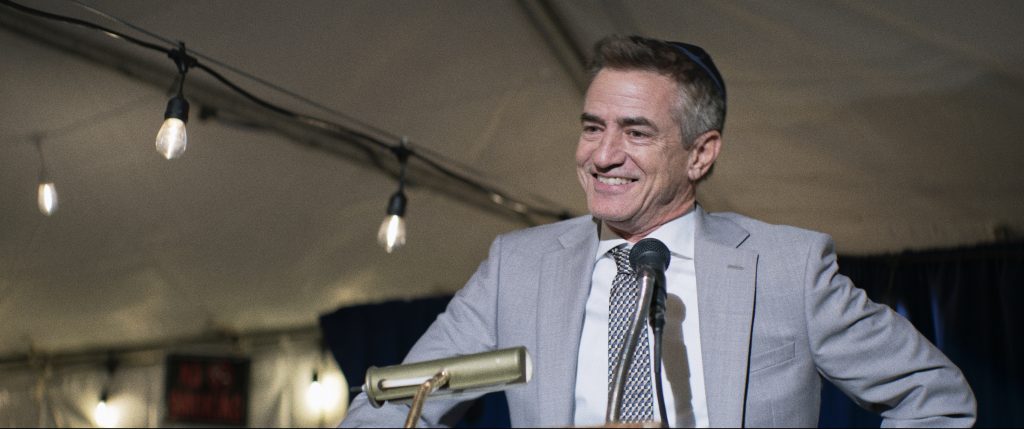
Dermot, I have to admire the commitment to doing press, seeing as how brief your character is in the film and the trailer gives his fate away.
Dermot Mulroney: Thank you. I’ll say quite honestly, it hasn’t been easy today. The film’s landing at a very intense time. To that, I’ll put it in context of my whole entire experience in this film.
I can’t give anything away, but I will say that it’s been difficult to portray gun-wielding, violent people for this many decades. This film takes that square on the chin and I have a lot of admiration for that.
Yeah, without giving too much away, it has a different resonance now than it did when we filmed it and it hasn’t been easy to manage that within myself, yeah. Yeah, it’s difficult.
I would add great art is challenging and this just at least is landing right at the time where that’s what this film is.
Sal Litvak: Yeah, and I would add that his character, that Alan Rosner just looms over the whole movie. He’s somebody that people are talking about before you meet him.
Dermot Mulroney: Indeed. In terms of the duration, yes. Oh, and then thank you. I’ll take that as a compliment, not to cut you off, Sal. Because, yeah, I wanna promote independent film and unique voices in cinema so that’s why I’m here. Thanks for noticing.
What was it about the script that drew you to the role?
Dermot Mulroney: Sal can tell you. We’re being honest about it. I tried to work on the film in a number of terrific roles. Here too, just to be quite frank, this is the one that worked into my already booked schedule so we worked hard enough to get—I’m on another project as I’m filming this. It’s one of those things where timing and community come together to make something happen.
Sal Litvak: Yeah. A great actor can play different roles in the movie. I just felt the helping hand, the guiding hand of G-d, making it all happen together and the timing work together. But really, the generosity, the collaboration, it was a very tight schedule with a lot of action in it. The only way we were gonna get that done is that everybody was being very generous with their time. I mean, I couldn’t say cut, I had to just say back to one, here’s the adjustment, that’s the only way that we were gonna make our days. That takes a lot of trust and a lot of commitment from the actors.
Yeah. I want to talk about Rabbi Mo Zaltzman. That’s my family’s name from the old country before it got changed at Ellis Island.
Sal Litvak: Ah. I didn’t know.
Yeah, and it still gets butchered.
Dermot Mulroney: I was about to say, do you get confused with people with similar names? Because if you do, as we discussed earlier, I share that space with you.
Not with similar names, but a lot of people will spell it S-A instead of S-O.
Sal Litvak: Right, or with the T-Z. Exactly.
I don’t really see the T-Z that often when people are writing me or my parents.
Sal Litvak: Okay. My name gets butchered all the time.
Were there any particular influences that you all were thinking about when it came to writing the character?
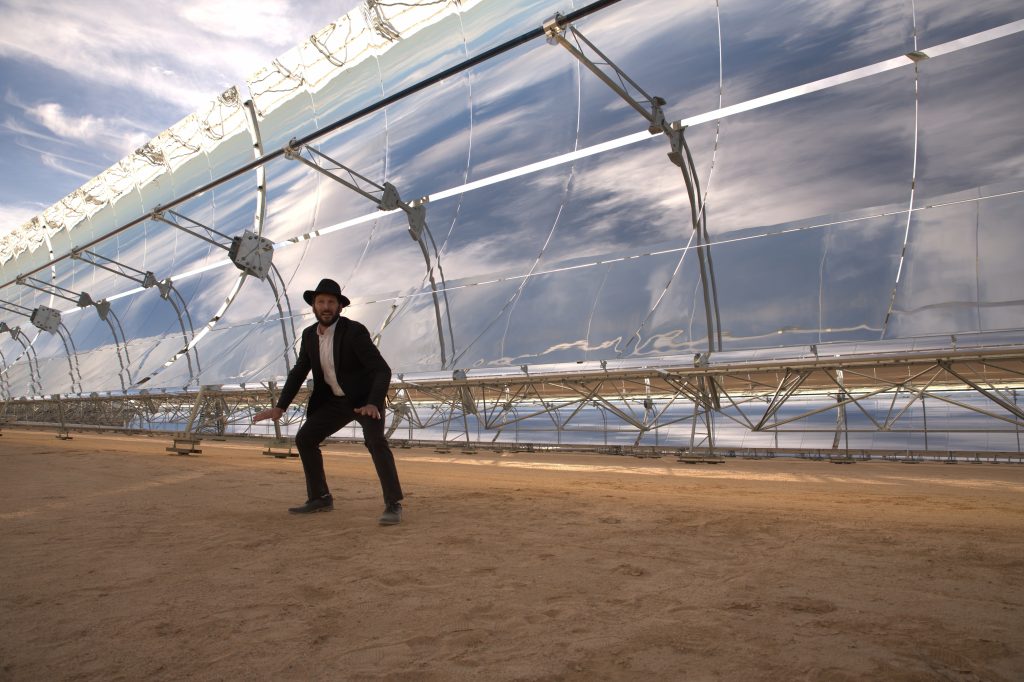
Sal Litvak: We definitely thought about North by Northwest. That’s not only our goal in making the mirror farm scene—the cat-and-mouse scene—was to be as iconic as the Mount Rushmore scene in North by Northwest by Hitchcock, but also the way Cary Grant plays that role. There’s a lot of humanity. There’s a lot of humor. He’s got to be quite self-deprecating. He knows that he has to play something that he’s not. He’s got to rise to a level, be an investigator, solve a crime, and he’s not a cop and he’s not a detective.
I think that Mark brought a lot of that charm, that kind of self-questioning and that ability to literally learn something while he’s on camera.
Alan, I mean, Dermot, when he’s playing his part, he’s got to play two roles simultaneously. There’s what’s going on the surface, what we think he wants, what he really wants, and he’s different things to different people. That’s not easy to pull off.
What was the most challenging aspect of making the film?
Dermot Mulroney: Even as we know, the time that it took to film my role was very tight. I don’t know, did you say it was 18 days that you did all of this or thereabouts? That to me was the—yeah. And to get as much footage as you did that one particular night with that whole crowded event. On any other film, that would have been several nights a week.
Sal Litvak: Oh yeah, a week probably. It was a little bit like the wedding scene in The Godfather. They were a week behind after one day of shooting (Laughs). We did not have that luxury. We could not fall behind. We had to keep moving. We could not have done it without the professionalism and the talent of Dermot and the team.
What do you hope people take away from watching the film?
Sal Litvak: You want to speak first, Dermot?
Dermot Mulroney: No, feel free. You’re so eloquent about the layers of meaning in the film.
Sal Litvak: I think it’s important that we ask questions. I think that’s what our tradition is all about. Not every question is going to have an answer and not every answer, if you find it, is going to make you comfortable.
What Rabbi Mo is all about is pursuing the truth wherever it leads. Even when people are telling him that he’s wrong to ask the questions, to get involved, let the police do their job. Who do you think you are? Why are you getting involved? As he keeps saying, where there is no man, be the man. That’s a saying of our great sage, Hillel. What that means is in life, in society, if you spot a problem that no one else is solving, maybe it’s your fate to step up and solve that problem or it won’t be solved. Maybe that’s why you were put in this place at this time.
But that kind of self-discovery won’t happen unless you ask the questions. I think that’s what’s so inspiring to me, watching it with audiences, seeing how they react, how they stay after, and how they’re having conversations with each other. There’s just not another movie like it. We took on big issues, but we knew that our first job was to entertain and that people wouldn’t bother asking those questions if they weren’t fully immersed in the movie. We had to deliver a great thriller, but we did it in the context of tough questions that are facing America and the world right now.
Dermot Mulroney: See what I mean about putting it so eloquently? Thank you, Sal. I know all of that’s wrapped up in a thriller, a corruption, family betrayal. There are ecological issues that are thrown in and it has even organized crime sensation in some areas so it really delivers on all of those notes as well.
Yeah. You even got the neo-Western thing going on there.
Dermot Mulroney: That would be what I left out, exactly. Thanks for pulling that up as well.
When I think of Jewish Westerns, The Frisco Kid is one of the first films that comes to mind and this is quite the contrast to that.
Sal Litvak: Yeah, it’s not a comedy. I think that humor is always part of every great movie. It’s certainly a part of Jewish movies and our Jewish tradition. But the Western is very important to me. A Western is a type of thriller, and we watched so many thrillers preparing for the movie. But when you look at the environment that we live in and where we shot it, Los Angeles, a little bit north, the high desert, where so many Westerns have been shot.
Well, what does it look like in 2025? Now, the West—
Dermot Mulroney: I’m sorry, but please continue. I have other work to do immediately. Thank you so much for your time. Sal, thank you for the day.
It was nice to meet you.
Dermot Mulroney: My pleasure, thank you so much.
Sal Litvak: It was great to work with on this. I look forward to seeing you next time. Take care.
Yeah, is that the Western landscape in 2025. The same landscape now includes strip malls, power lines, minivans, mirror farms, and solar fields. A hundred years from now, who knows what it’ll look like? But it won’t look like the way it does now. These elements are iconic in our world now. We’re blind to them because we see them every day. But I wanted to capture them in the movie and make those elements, the minivan, the strip mall, the power lines as iconic to this neo-Western, as the saloons and covered wagons and corrals are iconic to traditional Westerns.
What was it like working with the rest of the cast?
Sal Litvak: It’s real joy. It’s a real privilege. Dermot, Neal, these guys have done so many movies and they come prepared. There’s no prima donnas. Everyone knows we’re working on an independent movie and we’re not going to get it done unless we’re all collaborating.
But really, what’s most special about it is that we wrote it. We went through those scenes a million times as we were writing them. We had readings. We heard what it would be like. We had some rehearsals, thank G-d, something I demanded. We saw the scenes come alive a little bit there. But then on the set, so many new things happened that we never imagined. We came to understand our own story in a way that we never understood it before, even though we wrote it, and that’s the joy of working with great actors.
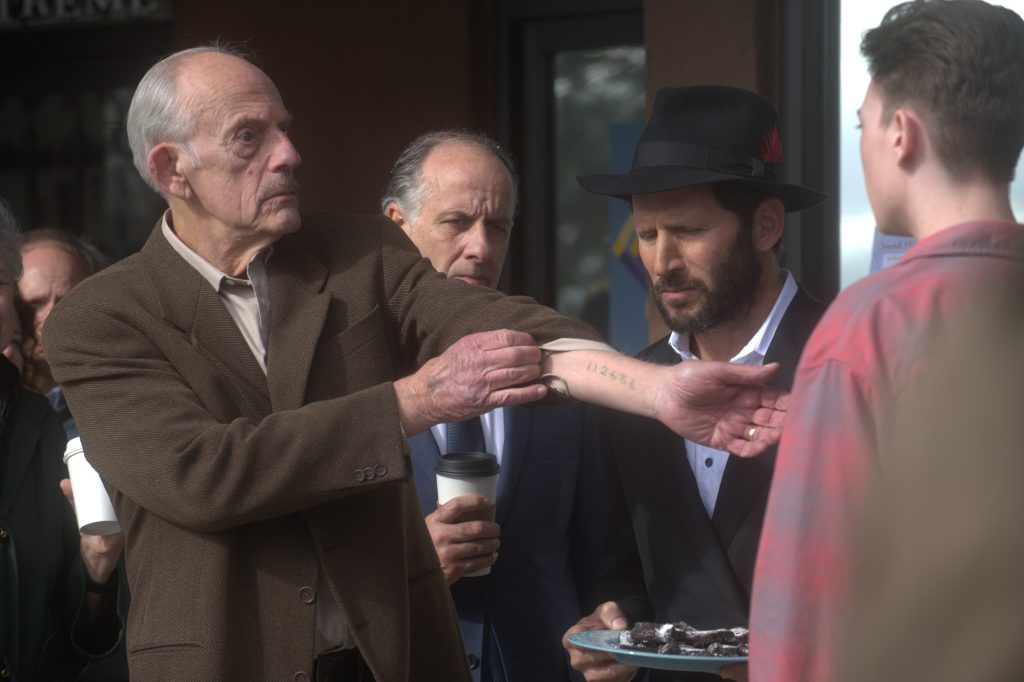
You’re the descendant of Holocaust survivors and you have Christopher Lloyd playing a Holocaust survivor. Can you talk about his character and how Christopher ended up in the role?
Sal Litvak: Yes. So first of all, Christopher was so committed to this role that—he’s obviously not an old Ashkenazi Jew from Eastern Europe, but he got the accent perfect because he hired his own dialect coach to make sure that he would. He really prepared. The story that he tells, which is crucial to the plot of Guns & Moses, because it makes such an impact on the young neo-Nazi, who’s learned to hate Jews without really meeting Jews. That story, of course, comes from the real world.
As you mentioned, my mother was a Holocaust survivor. She was carried through a concentration camp by my grandmother as an infant. My grandfather was murdered. The Holocaust was something that was in my house growing up. The pictures of my grandfather, the stories, the memories, what they wouldn’t say, what they wouldn’t talk about, always loomed over us.
There’s been lots of movies about the Holocaust. Hollywood tends to love dead Jews and schticky Jews. This is something different. This is the Jewish action hero. This is the Jewish detective. But these elements, like the Holocaust, are so much a part of the Jewish psyche and the American Jewish psyche that the question was not was there a Holocaust, but how has it impacted us, and how does it impact us when we move into other aspects of the American Jewish story?
Here’s one that we don’t normally see, a Chabad rabbi in the high desert. Chabad rabbis are in small towns everywhere. The Orthodox Jewish community is something that we really never see, except to be mocked in most movies. Here, it’s taken seriously. It’s my community. I’m an Orthodox Jew, which is to say a visible Jew. The danger to our community, it’s something we’ve been aware of. That’s why I joined Magen Am and learned how to use a firearm and became licensed so I could carry. Big synagogues can afford armed guards. Small synagogues like ours can’t. These are all elements that are that are swirling around the movie, around the script, around the performances.
Now that the movie is coming to theaters on July 18 across America, listen, we knew that Jews under attack who fight back would always be relevant. We could not have imagined when we shot the movie at the end of 2022, what America and the world would look like in 2025. Post-October 7 and with so much Jew-hatred and calls for violence against our community happening on a daily basis.
Yeah. These last few weeks, my headspace and focus has been completely off. I have to watch movies and TV for work. Some days, it’s just easier transcribing an interview than watching a movie, just because it’s easier to focus on that than focusing on a movie when my phone is, what, a foot, maybe two feet away?
Sal Litvak: Yeah. Yeah. Where are you based, Danielle?
Chicago.
Sal Litvak: Chicago. What happened in Washington, those two murders outside the Jewish event, what happened in Boulder, throwing a Molotov cocktail at a Holocaust survivor who was the same age as my grandmother was when I was at her passing that changed my life. Yeah. I mean, it’s a very emotional time for us.
Yeah. A friend of mine had been on a trip to Morocco with Sarah. That shows you just how close these things hit.
Sal Litvak: Sarah in Boulder?
No, the one who was murdered in D.C.
Sal Litvak: Oh, in D.C. Oh my gosh. Wow. Wow. Yeah, murdered for caring, for being a Jew, for being at a Jewish event, and of all people, who are trying to forge peace and find new solutions to seemingly intractable problems. I do think it’s possible. But there is also something to be said for strength. We have to be strong. We have to be able to protect ourselves. Thank G-d we have allies in this fight.
It’s been fascinating watching the movie with Christian audiences, conservative audiences. When we first cut the movie, before we had done the sound, my producing partners showed it to a big agent who sells independent movies to distributors. He watched the movie, and he says, Great movie, you guys are going to make a lot of money in streaming. I said, Well, thanks, but we see this as a theatrical film. He says, Yeah, but how many Jews are there really? New York, L.A., Florida? I said, Well, that’s an important part of our audience, but a much bigger part of our audience is Christians and conservatives across the country.
And he said, What are you talking about? Those people hate Jews. And I was shocked, I was like, Have you ever met the people you fly over between New York and LA? Have you ever thought to yourself, Why does America support Israel so much?
It’s not because of the tiny Jewish population. There are a lot of Americans who have our backs, who care, who take the Jewish tradition seriously, who want to learn from it. I knew that because at Accidental Talmudist, our Jewish wisdom platform, I teach Torah every day to a wide and diverse audience that includes a lot of non-Jews who are fascinated by an unbroken wisdom tradition that stretches back to Mount Sinai.
Rabbi Mo, in addition to being a different kind of action hero and a family man, even a rabbi, he’s also a man of faith and a man of the Jewish faith and a man who takes his Judaism seriously. We just never see that in a movie coming out of Hollywood, which just as a filmmaker, creates a wonderful opportunity to share a character with the audience in a thriller, in a mystery, in a detective procedural, in an action movie that they haven’t seen before. Isn’t that what we always want? Convincing characters that we care about that we haven’t met before.
Yeah. It’s nice seeing a character like him. I mean, the closest thing I can even think of is The Hebrew Hammer and that’s a comedy.
Sal Litvak: Which was fun, but schticky. It was a fun movie. It was quite a while ago, too. I think it’s 30 years ago.
Not that long. It premiered at Sundance 2003, which is hard to believe it was a Sundance movie.
Sal Litvak: Okay, so 22 years ago. Aimee Schoof, our producer, produced The Hebrew Hammer. That was a nice return for her. She’s not Jewish, but she’s been involved in these two movies with Orthodox Jewish action heroes.
Yeah, just a small world. It was so nice getting this opportunity to talk.
Sal Litvak: Thank you so much. I appreciate it, Danielle. I remember you said you enjoyed the movie, so I was really looking forward to putting a face and a voice together with the emails that we exchanged.
Alright. Take care.
Sal Litvak: Okay. All the best. Have a great day.
Concourse Media will release Guns & Moses in theaters on July 18, 2025.
Please subscribe to Solzy on Buttondown and visit Dugout Dirt.