Danielle Solzman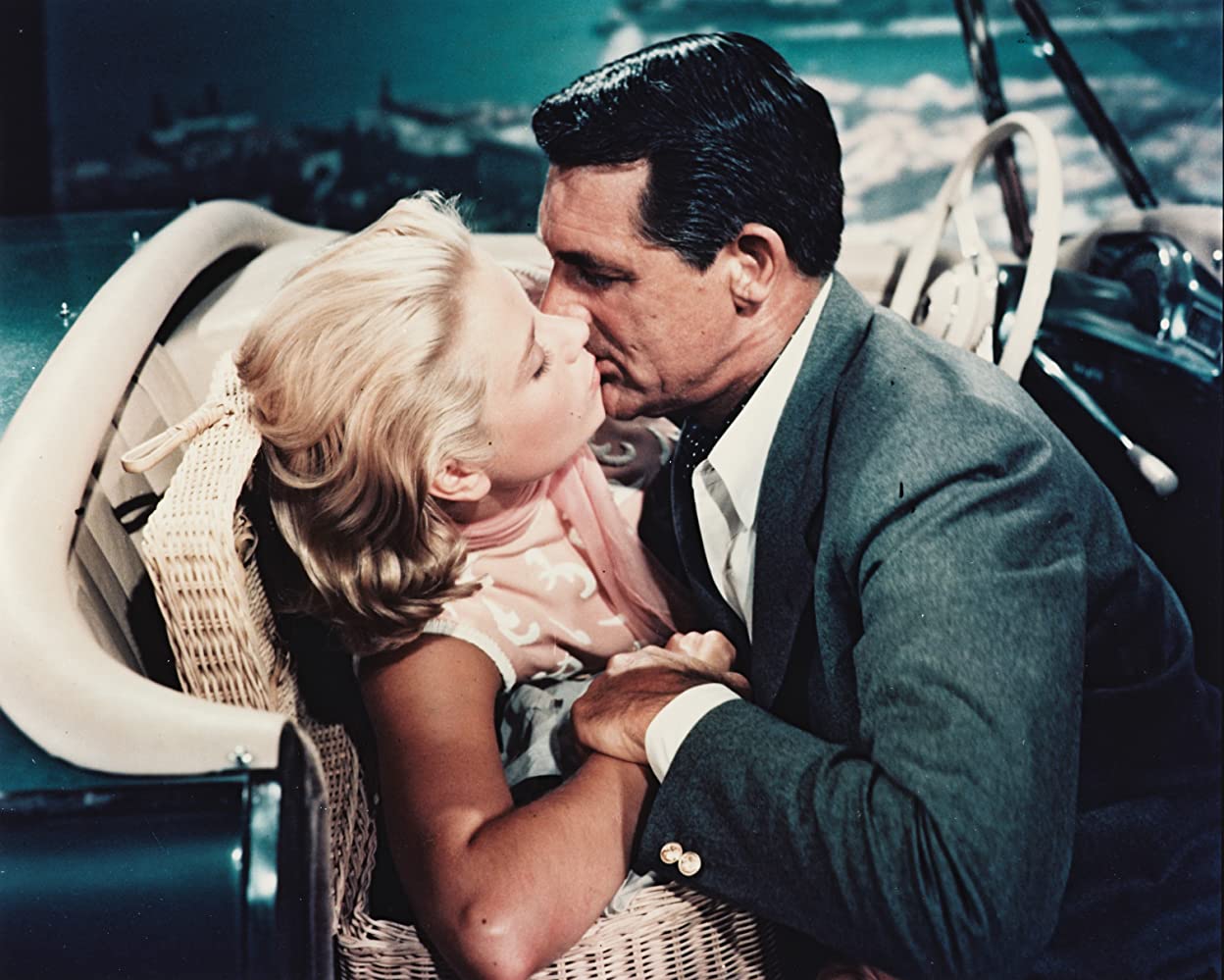
After arriving on 4K Ultra HD for the first time in October, Alfred Hitchcock’s To Catch a Thief is now available in a 70th Anniversary Limited Edition 4K UHD Steelbook. Unlike 2020’s Paramount Presents Blu-ray, the 70th Anniversary Steelbook includes bonus features that were included with the original 2012 Blu-ray release. Why they were not included with the Paramount Presents Blu-ray release is beyond me. However, they were thankfully restored for last year’s 4K UHD upgrade. That being said, the release comes with the 4K UHD disc and a digital copy.
I previously reviewed the film in 2020 when To Catch a Thief was among the first titles to join the Paramount Presents line. As I re-run my review for the 70th Anniversary Steelbook’s release, there are some modifications from my original review. For one, I’m not including any of the then-new commentary that I had about Paramount starting their Paramount Presents line on Blu-ray. All of that will stay on the piece from the film’s 65th anniversary.
What follows is my original review from 2020:
To Catch a Thief teams up Cary Grant and Grace Kelly in Alfred Hitchcock’s 1955 thriller about a reformed jewel thief attempting to clear his name.
Retired jewel thief John “The Cat” Robie (Cary Grant) is suspected of a new wave of robberies on the French Riviera. To clear his name, he evades the police and seeks help from old Resistance allies at a local restaurant. But with everyone under suspicion, tensions rise. Danielle (Brigitte Auber), the daughter of wine steward Foussard (Jean Martinelli), helps him escape to safety.
To catch the real thief, Robie teams up with insurance agent H.H. Hughson (John Williams) to identify wealthy tourists at risk. He targets American tourists Jessie Stevens (Jessie Royce Landis) and her daughter Frances (Grace Kelly), posing as a businessman from Oregon. Frances is intrigued, and despite playful banter and flirtation, she quickly discovers Robie’s true identity.
After Jessie’s jewels are stolen, Frances accuses Robie, and he vanishes before the police arrive. While staking out an estate, Robie is attacked—one assailant is killed, revealed to be Foussard, who couldn’t have committed the rooftop crimes. At the funeral, Danielle publicly blames Robie, while Frances privately confesses her love and agrees to help him trap the real thief.
At a masquerade ball, Robie swaps places with Hughson to slip away unnoticed. On the roof, he catches the real burglar—Danielle—red-handed. She confesses that her boss Bertani (Charles Vanel) masterminded the thefts. Robie saves her from falling, then returns to his villa, where Frances insists on joining his life—whether he likes it or not.
Alfred Hitchcock was the Master of Suspense. He made some very good films in the 1940s, but the 1950s saw a number of titles considered among his best. North by Northwest is my personal favorite of his collaborations with Cary Grant, but To Catch a Thief isn’t far behind. That said, this film doesn’t contain as many suspenseful elements as one might expect from a Hitchcock thriller. It’s more of a romantic thriller than a suspense-driven one—and tame by the standards of modern-day thrillers.
Cary Grant is one of the greatest actors of his generation. He didn’t team up with Hitchcock that often, but their final two films together are also classic thrillers. Because of Grant’s fame, the Production Code Administration was concerned about him playing a villain. That certainly wouldn’t be the case today—audiences have no trouble suspending disbelief. An actor should be able to play both hero and villain. It’s that simple, or at least it should be.
This was also Grace Kelly’s final Hitchcock film after her work in Dial M for Murder and Rear Window. The director tried to lure her back for future projects and came very close. It’s a hell of a film to go out on, especially with its stunning scenery and her on-screen chemistry with Grant. To be fair, she made two more Hollywood features—both released in 1956—but this was effectively the end of her film career before becoming Princess of Monaco.
In adapting David Dodge’s novel, screenwriter John Michael Hayes packed the script with suggestive dialogue. Hitchcock had a knack for playing cat-and-mouse with the Production Code censors. They cut the more outrageous material, but with the rest, Hitchcock and Hayes got creative. Take the beach scene: Grant strolls shirtless while Kelly applies sunscreen in an unmistakably sensual way. The fireworks sequence is another scene the censors flagged—and for good reason.
That fireworks scene is loaded—visually and verbally. Before the sky even lights up, Frances (Kelly) teases, “I have a feeling that tonight you’re going to see one of the Riviera’s most fascinating sights. I was talking about the fireworks!” She clarifies only after noticing Robie looking at her necklace. The scene works so well because of its clever editing, the suggestiveness, and how it skirts the line with the censors. One can only imagine how much more overt it could have been in a post-Code era.
To Catch a Thief’s Technicolor photography is stunning in VistaVision, capturing the French Riviera in vivid detail. It’s no surprise Robert Burks won the Oscar for Best Color Cinematography. Lyn Murray’s score has never sounded better thanks to the Dolby Audio presentation. The film also received nominations for art direction and costume design. Edith Head’s wardrobe—especially during the masquerade ball—is a visual highlight. Of course, Grace Kelly looks stunning throughout.
The production blends Riviera location shoots with studio backlot work. Some interiors were filmed at the Carlton Hotel, though you’d only know that from the film’s bonus features—one reason I appreciate Laurent Bouzereau’s documentary featurettes. The interview with unit production manager C.O. “Doc” Erickson offers insight into how specific locations were chosen. Even part of the chase sequence was shot from a helicopter.
On rewatch, you begin to notice the use of rear projection during the driving scenes. I didn’t think much of it on first viewing, but it’s impressive how seamlessly the footage is blended. That said, it becomes more noticeable when characters are driving close to the edge of the road with tight, winding corners.
Even 70 years later, To Catch a Thief dazzles with VistaVision beauty, suggestive sparkle, and Hitchcock’s signature sleight of hand.
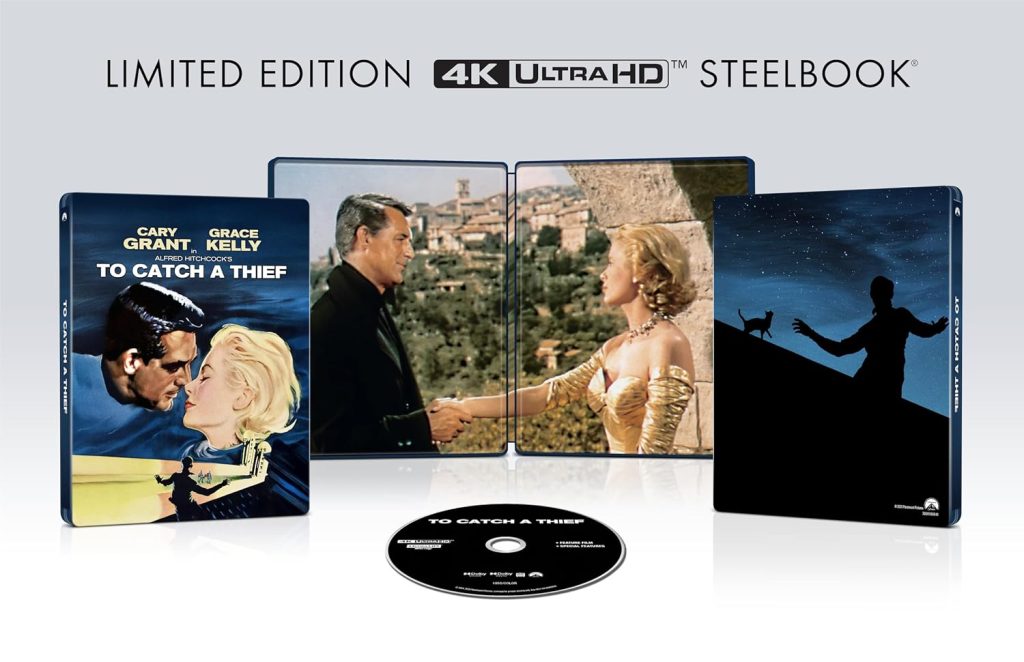
Bonus Features
- Commentary by Dr. Drew Casper, Hitchcock Film Historian
- Filmmaker Focus: Leonard Maltin on To Catch a Thief
- A Night with the Hitchcocks
- Unacceptable Under the Code: Censorship in Hollywood
- Writing and Casting To Catch a Thief
- The Making of To Catch a Thief
- Behind the Gates: Cary Grant and Grace Kelly
- Alfred Hitchcock and To Catch a Thief: An Appreciation
- Edith Head: The Paramount Years
- Original Theatrical Trailer
DIRECTOR: Alfred Hitchcock
SCREENWRITER: John Michael Hayes
CAST: Cary Grant, Grace Kelly, with Jessie Royce Landis, John Williams, Charles Vanel, Brigitte Auber, Jean Martinelli, Georgette Anys
Paramount Pictures released To Catch a Thief on August 5, 1955.
Please subscribe to Solzy on Buttondown and visit Dugout Dirt.