Danielle Solzman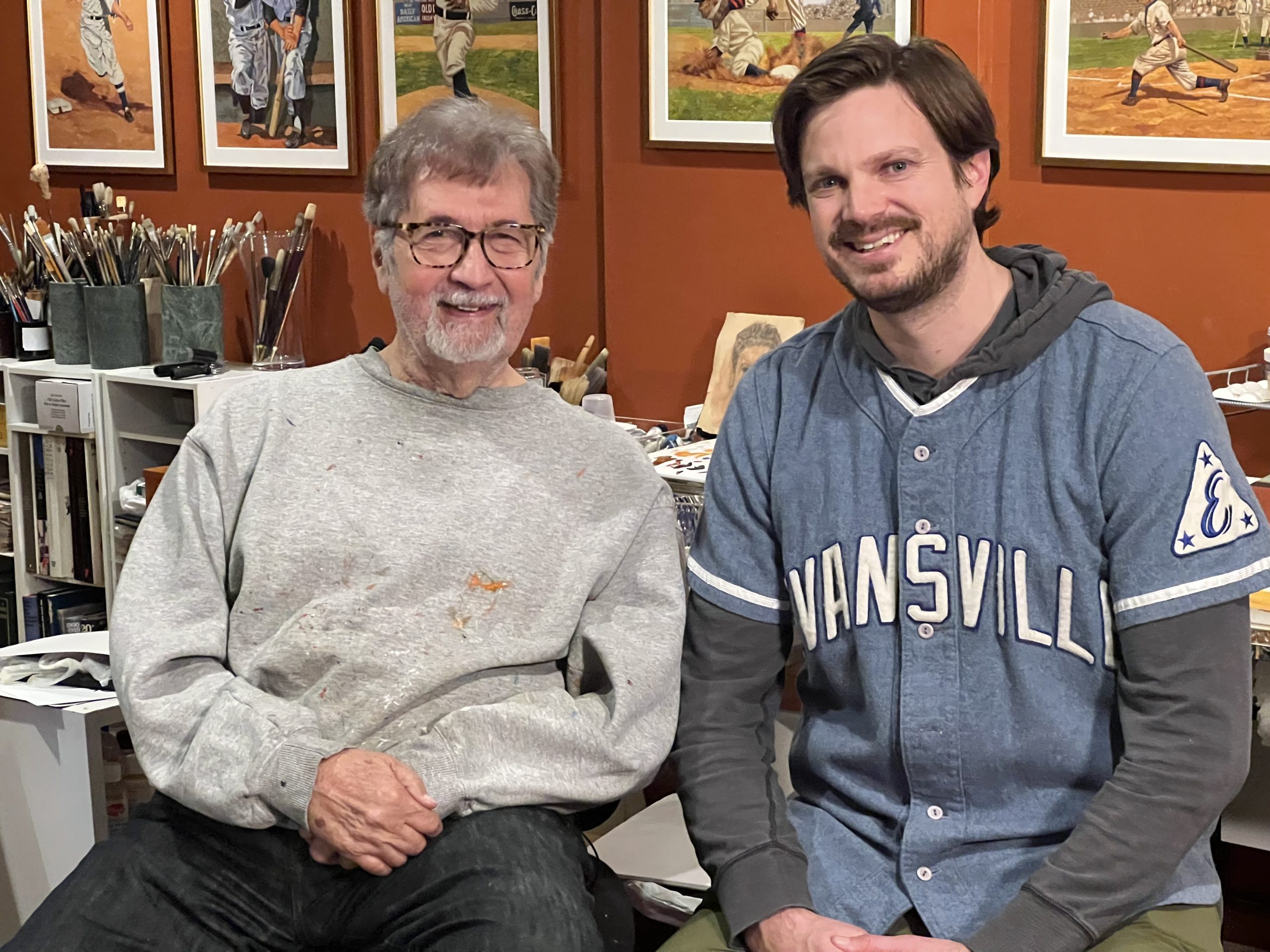
Marq Evans discusses The Diamond King, his documentary on artist Dick Perez, covering inspiration, process, legacy, and the heart behind the Hall of Fame art.
In this in-depth conversation, filmmaker Marq Evans dives into the creative journey behind The Diamond King, his documentary spotlighting legendary sports artist Dick Perez. Evans reflects on how the project came to be, why Perez’s story resonated with him, and the process of balancing nostalgia with deeper character insight. He shares behind-the-scenes anecdotes, including near-misses like trying to get an Aaron Judge portrait to the player himself, and explains what makes Perez’s work so enduring to baseball fans. The interview also explores themes of legacy, artistic identity, and the unexpected ways careers take shape. Above all, Evans hopes viewers walk away with a greater appreciation of Perez—not just as an artist, but as a person with a remarkable story.
The Diamond King is a documentary celebrating the life and legacy of Dick Perez, the pioneering artist behind some of baseball’s most iconic portraits. Blending realism with emotional depth, Perez’s work—most famously the Diamond Kings card series—helped revolutionize sports art and capture the spirit of America’s pastime. Born in Puerto Rico and raised in Harlem, Perez’s lifelong love of baseball and painting shines through in his vivid depictions of the game’s greatest legends. Featuring interviews with Perez, family, and baseball figures, the film explores his creative process and lasting impact. More than a biography, The Diamond King is a tribute to baseball’s visual history—and the artist who helped define it.
The Diamond King is available to watch on Apple, Amazon, Google, Kinema, and Tubi.
It’s so nice to meet you face-to-face.
Marq Evans: Yeah. Nice to meet you in person as well. Thanks for the coverage back in January and just your support with the film.
What was the genesis behind The Diamond King?
Marq Evans: It was June 2022, my son had started getting into baseball, baseball cards and, that leads to, “Dad, let’s see your collection.” I pulled out my own cards and we were just going through them and ran across some Diamond Kings and just that rediscovery took me back to my childhood and I was just curious. I don’t remember ever thinking about that when I was a kid collecting those cards. Back then, it was more about, Oh, this is a really cool looking Ken Griffey Jr. card. But I loved him. I love those cards.
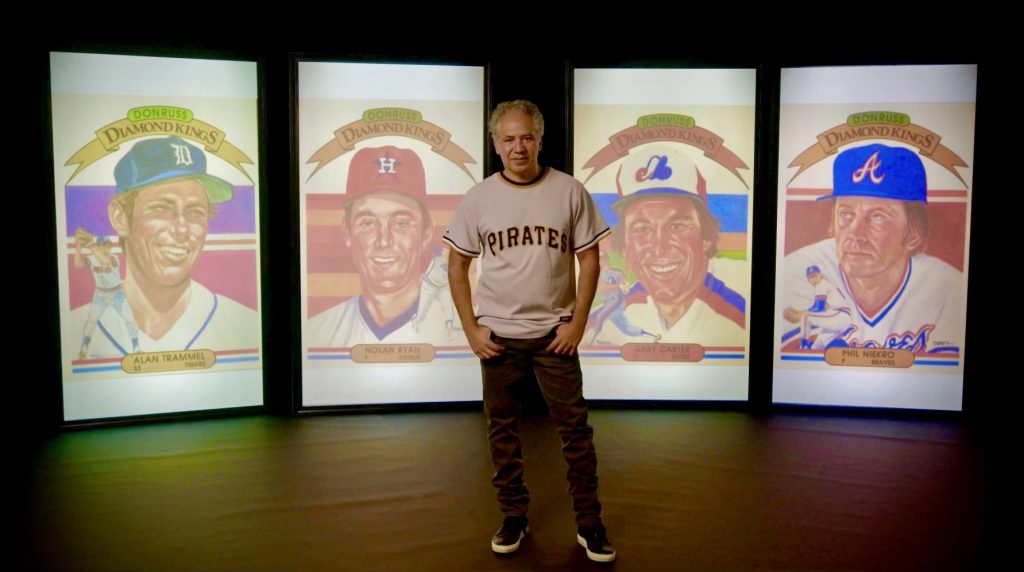
When I started researching a couple of years ago, I had—so first of all, Dick Perez has a great website, dickperez.com, which you can just get lost on that website, which I have several times. That’s where I went just out of curiosity, what’s the story behind this artist? Had I found out that he did the Diamond Kings for 15 years and a little bit more about that, that would have been kind of cool and that probably would have been it.
But what I found was that not only did he do the Diamond Kings, but he did other cards that I wasn’t aware of, like the Perez-Steele art postcards and all those sets that were a little bit before my time. Also, he was the official artist of the National Baseball Hall of Fame for 20 years. He had painted literally thousands and thousands of baseball paintings spanning the history of the game from the 1800s until today.
When all that together and in his bio revealed a little bit about his personal story, too, that I was interested in. Within a half an hour of seeing all this, I’m like, Oh, this could actually make for an interesting movie. Part biography, and then through his work, also being able to kind of get a glimpse of the history of baseball, which you do in his work, whether it’s the Diamond Kings or the Perez-Steele cards, all of his Hall of Fame work.
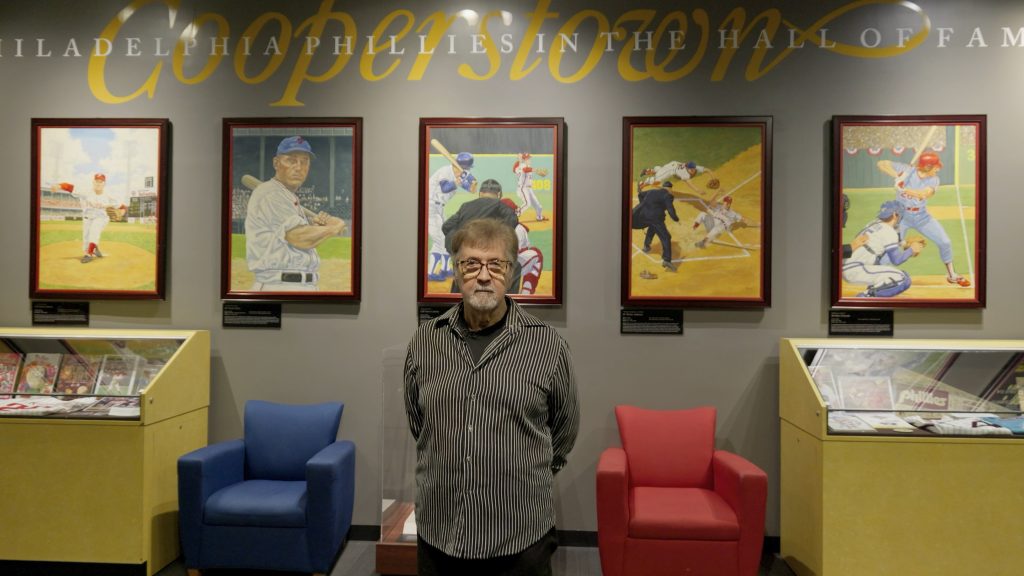
He’s even got, for instance, an exhibit at Citizens Bank Park in Philadelphia, and it’s all of the Hall of Famers that were Philadelphia Phillies, but also that were Philadelphia A’s, or players that were from the Philadelphia area that are in the Hall of Fame, and so even through that exhibit of just Philadelphia players, it’s a whole history of the game, again, from the 1800s until, I guess, Scott Rolen is probably the most recent player that’s in there, being the most recent Phillies Hall of Famer.
So yeah, all that together, I just thought it would be—I love baseball, thought it would be a fun, kind of a different take, something that suited my sensibilities to do some sort of baseball film.
Was Dick quick in saying yes or did it take some time to reach that point?
Marq Evans: He was really quick to say yes, which is not always the case. A lot of times the subjects, even if they’re excited and interested, they’ll make you work for a while. That’s certainly been the case in my experience. But he’s a big movie fan, too. He was just so flattered that somebody had thought that his story would be interesting for a movie and it was work and everything.
We were talking within a couple of days and on the phone, he was just like, “Well, I’m in. What do we do?” That was great. But even then, we kept it casual because, obviously, neither one of us, I’m sure, would want to commit to something where, if we don’t get along with each other that we’re like, we’re doing this. I was going to be in New York a couple months from then and I just said, why don’t I stay a couple extra days, we’ll film an interview, some other things, and we’ll just see kind of how it goes and no real pressure or commitments. But if we have fun doing it and it seems like there’s something there, then we’ll just keep going.
That’s kind of how it went for a while was we just kind of keep going. Early on—do you remember the movie, there’s an Errol Morris film called The B-side about Elsa Dorfman, the large format photographer.
I don’t think so.
Marq Evans: So it was for Errol Morris, a more simple, straightforward documentary, but I just really loved that simplicity about that film. When I started the Diamond King, I had that one in mind. I read some interviews with him where he had heard that she was retiring and her whole collection of photos were going to be sent to archive or something.
He’d always talked to her about maybe wanting to do a film about her work. He realized, well, now’s the time, that now’s the chance. I think it started as they put together a 15 minute short film and maybe it was going to be a short, and then it was a 40 minute film. I think when they submitted the film to Telluride, it was 40 minutes and it ended up being a feature film.
I liked that low pressure, low stakes, just as long as we’re having fun doing it, we’ll just see what it turns into. It just kept going and growing.
I grew up collecting baseball cards so it was a primary reason as to why my interest was piqued. I had no idea about the role Bill Madden played in Dick getting his start in doing the Diamond Kings for Donruss.
Marq Evans: Yeah, neither did I, before getting into it. Dick had told me that story about how when Donruss started, they knew nothing about baseball, but they had this contract along with Fleer to join Topps at the time to start producing baseball cards.
They’re like, Well, what do we do? They just so happened to get Bill Madden on the phone. I think he called them because he was doing a story for, I guess, probably the New York Daily News and Bill Madden, Hall of Fame sportswriter. He was like, “Hey, I’m doing the story. It’s great that you guys have a license.” They just admitted to him, “Yeah, it’s great, but we don’t know what we’re doing.” And they asked him, do you know anybody that knows anything that might be able to help us? He was like, “Well, yeah, me, I can help.” They hired him to kind of run Donruss.
One thing that he did early on that didn’t make it into the film, one of the big ideas was to bring on Dick Perez and Frank Steele, which turned into the Diamond Kings. The other idea that he had was to really, really focus on rookie cards and rookie players. That’s where the rated rookies came from. That was a Bill Madden invention. He probably put more emphasis on the rookies at the time than maybe some of these other brands did. He would really scout these players as they were coming up, because he wanted to make sure that if a player—
The Jose Canseco card—I don’t know if you know that story, you probably do—is one of the most famous rated rookies or rookie cards, at least of that era, because I believe Donruss was the only one to have him in the set in, what was it, 1985, I guess? I think they had a 1985 card, because he got called up late in the season.
Bill was on him, knew that this was gonna be a great player, and so he sends his photographer out. It was a night game. He was sitting in the dugout so they had to shine a little light on there just to get the light, and that’s the card. That’s the picture that ended up being on the card, and so he was in that set, but he wasn’t in the other sets. I didn’t know any of that going in, but those were fun stories to hear.
And then, of course, the market became oversaturated in the late 1990s, early 2000s.
Marq Evans: Yeah, which is why none of my baseball cards are worth anything. All these cards we collected as kids. I guess maybe I do remember thinking about the financial side of it mostly because I’d wanna go to the card shop and sell a card that had some value so I could get more cards, so I could save up and buy a box of Upper Deck or something. But I don’t remember necessarily thinking, this is gonna be my retirement someday. Maybe I did. I know a lot of people thought that way.
And then, we grow up, we find our cards again, and we’re like, oh yeah, what are these worth? Pretty much nothing, because there’s just so many of them, I guess, unless they’re perfect condition, rated PSA 10 or something.
I started getting into collecting a little bit more with my son the last few years once he got into it. It certainly seems like a lot of that is back, certainly a lot of cards being printed. I guess it’s a little bit different now because of all the parallels and variations and stuff can potentially make cards a little bit more rare than they were back then. You got your one of ones and everything.
But as far as this story goes, that was the end of an era for Dick Perez creating the Diamond Kings. I mean, that really coincided. I think their contract was up and then they just decided not to renew because they just didn’t have that same great feeling about doing those cards as they did certainly for the first decade that they were doing them.
What was the most surprising thing you learned about Dick Perez during the making of the film?
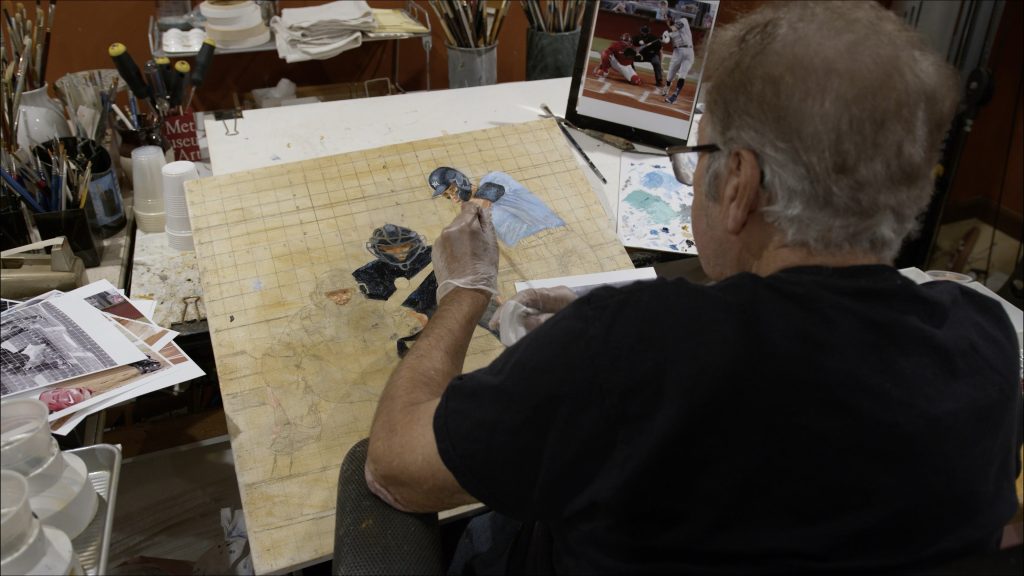
Marq Evans: I would say the most surprising thing I learned about Dick—I knew he was a great and prolific artist. What really impressed me was just watching him work as somebody that—he’s 84 years old now. He’s still doing the same thing every day. He wakes up, he spends time with his wife. They do the crossword, Wordle, and share coffee with each other. He goes down in his basement and he just works till 3 PM. He just paints, does his business, and then he comes back up and he spends the late afternoon and evening with his wife as well, too. That’s just his routine. That’s what he does. That’s what he loves to do.
That was cool, just seeing how he worked. But then also, he did a lot of new paintings for the film in some capacity, whether it was for a card set that we produced for the movie or just for paintings to show his process. It would have been very easy for him to just numerous times be like, “Marq, I didn’t quite get this done” or “I’m running behind on this.” And it would have been okay. But that is not even something that would cross his mind. I mean, he gives himself a deadline and he’s going to hit that deadline. He’s going to show up when he’s supposed to show up. That was just cool to see him work and how professional he was.
Just some surprises along the way with the film itself that—I did obviously a lot of research going into it and knew a good amount of what I wanted to get out of it. But the two big discoveries were wanting to follow the relationship with him and his wife just because I loved that. I loved them together. They got married within four or five months of meeting each other in college and have been married ever since. Just spending some time around them, I thought, I want to incorporate that into the movie, because I just thought it was a great love story.
And then, also, his relationship with his mom. That was never something I knew about, not anything that either one of us had really considered, but several interviews, somehow the conversation would take us there and he would talk about his mom in a way with so much love, but also, as he said, there was unfinished business in their relationship for some various reasons that we would get into.
We would have those conversations, but then, when I put two and two together and realized that when I go upstairs in his house, I see paintings on his walls of—a lot of his wife and his kids and family and stuff, but I never saw one of his mother who was so important to him. I started exploring that, wondering if there was a reason with this unfinished business that he had never painted her, would it be too difficult? What was that?
That ended up being something that is one of my favorite parts of the film. Even just something that I was happy to—through the film—help him with because the process that we went through and he went through was very satisfying for him ultimately.
Can you talk about bringing on both Joe Posnanski and John Ortiz?
Marq Evans: Yeah, I’m trying to think who came first.
I think John came first from the very beginning. I had this idea for an on-camera narrator. Obviously, just a traditional narrator is very common in documentary, somebody that you hear, but you don’t necessarily see. I think I’d had the idea for previous films, maybe not even films that I made, but films that I developed and tried to get going where there was going to be more of a character that was more important narratively, that can help tell the story.
John Ortiz’s narration in this, until the end, the way I designed, it was like a separate piece where it’s the voice of baseball’s past and it weaves in and out with Dick’s story. And then, ultimately they join. Hopefully, that comes across.
Whereas, like I said, previous ideas to do this on-camera narrator was more of—I think the idea might have come even in Wes Anderson’s Moonrise Kingdom. There’s that separate documentary that’s taking place throughout the film. I kind of thought that might be kind of fun to do in a documentary with a character that’s taking you through this film. That was an initial thought years ago and then just always had in the back of my mind.
I thought, well, this could be cool to have a component of an on-camera narrator that’s—like I said—the voice of baseball or baseball’s past. That was a plan from the very, very beginning.
I was telling a friend of mine about it, who I grew up with. We collected baseball cards together and so he was all excited about this movie. I mentioned to him that I wanted to have a on-camera narrator for it. He just said, “Well, you should get my buddy, John.” My friend lives in Santa Monica and his next door neighbor was John Ortiz. I know John from all kinds of films. I’ve been a fan of John’s. He’s a tremendous and underrated actor.
I was like, “Well, yeah, do you think that’s possible? “And he’s like, “Well, we hang out all the time. We see each other all the time. Our kids are friends, families are friends, but I’ve never really talked to him about the business.”
My friend is in the movie business as well, too, on the acquisitions side. He’s like, “Well, let me talk to him.” It was Halloween a couple years ago, maybe two years ago now. He brought it up and John, a big baseball fan, was like, “Well, sure, this sounds awesome. Let me see some of Marq’s work.”
I sent him some of my films and we had a Zoom call. By the end of that, he was just like, “I’m in, let’s do it.
But it took a while. I mean, I probably had him committed for close to a year before we shot. One, schedule with him, but more just our timing. Obviously, we had to have the film pretty much close to being done or at least the story pretty much being locked before we could shoot and see how it was gonna play out. It just took a while to get the film there.
Even when we did have the film there, working with Joe Posnanski came in a couple different spurts. The way that came together with Joe—Joe was the former writer for the Kansas City Royals before he became the amazing and popular author, book writer that he is today, on his own website and everything.
When he was with the Royals, he covered and spent a lot of time with Dan Quisenberry. One of my producers on the film is Michelle Quisenberry, who was Dan’s cousin. Michelle had gotten to know Joe a little bit when Dan was sick and ultimately passed away. Joe was spending a lot of time with Dan and wrote a lot about him during that and Michelle got to know him then.
When Michelle came on board the project, she mentioned, “Well, you should get Joe Posnanski to be involved.”
Everybody’s initial thought—or at least Michelle’s thought and what Joe thought this was going to be was that he’d be a talking head interview. But nothing in my research had showed that Joe really knew much about Dick Perez. Of course, he knows everything about baseball but that to me didn’t feel—I think as you even noted when you wrote about the film, I wanted this to be interview subjects that were very close to the story and to Dick. And that’s it.
I’ve done films before that have lots of interview subjects. I would interview 50 people and maybe 25 are in the movie. I was like, “Oh, I want to interview just only a few people at first.” It was maybe just Dick and it had to expand out from there, obviously.
It didn’t make a lot of sense for me to ask Joe to be a talking head, but I had this other idea and I thought he’d be perfect for that. He understood what we were going for. He got it right away. He’s a big fan of John Ortiz so he was very excited to be writing words that John was gonna perform.
I think when I first sent Joe something, I had 50 minutes of the film and I knew he was about to go on a big book tour, I think, for the most recent book that he did, Why We Love Baseball. I sent him what I had and the way we worked was, he was just gonna respond, fresh eyes as an audience member and be like, here’s where it might be fun to come in and talk about something baseball-related to a little bit of where we’re at in the film.
We worked back and forth a little bit and then he went on his tour and I kept working on the film. When he got back, many months later, the movie changed a little bit, so he had to rewrite some stuff, but then he finished the end.
And then once we had that, we were ready to book John. We shot that in LA. We had two days scheduled, and I think we ended up shooting it all in six or seven hours.
I mean, once he got going, he just really got going, which was also impressive to watch, because, he could have just mailed this in. It’s a very, very, very low budget indie documentary, but he rehearsed, he knew his lines. We rehearsed together a little bit. We had a teleprompter, but for the most part, he didn’t use it, which made for a better performance, because he just wanted to go and be himself.
What you see on camera there, I think it works out well, because that’s just authentically him. He’s such a baseball fan. He was joking the other day. He was like, “I’m the kind of baseball fan that’ll just show up to random Little League games and watch just because I love the game so much.”
I think that that comes out. He’s a great actor, but he’s not really having to act too much there. He’s playing himself more than anything.
There are some shots in the film that were taken at the 2023 National Sports Collectors Convention in Rosemont, Ill. What has the reaction been from sports collectors and baseball fans?
Marq Evans: I think it’s been great. I guess I’m not really hearing from anybody that’s like, the movie sucked, which, thank you for not emailing me if that’s what you think, which I’m sure there’s people out there. There always is. But it’s been great.
We made the movie in part in collaboration with some of that community. I don’t know if you know Jason Schwartz. He’s somebody that I saw on social media a couple years ago when I first started thinking about this project. I just noticed he was connected with all kinds of different collectors, including the current sports art people, which I love some of those art cards that are back in baseball now, too.
I ended up engaging with him. I didn’t know him and told him about the project. I knew he was a big fan of Diamond Kings and he just started connecting me with a lot of different people. That was huge because then we could have a conversation as we were making it. We could do things like advertise that, “Hey, we’re gonna be at the National, come meet Dick. Maybe you’ll be in the movie.” That ended up happening. That was really important to start building that community early on.
I know a lot of them are watching the film and have said great, really nice things about it. It also gives us a chance to, when we had—it wasn’t the final version of the film—but we went from shooting a scene in the film at the National in 2023, and then at the National in 2024, had a sneak peek, which was the first sneak peek screening. I think you were there but didn’t know about the movie, is that right?
In 2023.
Marq Evans: You were there in 2023, okay.
Yeah. I’ll be back this summer. I just got my credential approval email now it’s a matter of figuring out how many Baseball Hall of Famers that I can I take photos with this time around.
Marq Evans: Yeah, very cool. I remember you shared those pictures from—I guess it was ’23 that you shared the pictures from. And yeah, you would have probably been in the movie had you known that we were there in ’23 and stopped by.
Yes, and then in ’24, we showed the sneak peek and the movie was pretty close. It wasn’t final color, maybe only half of the music was done at that point. The rest was just temp music. Ultimately, I cut a few minutes out of the film, too. To be honest, even the Palm Springs version that you would have seen, I think I cut 45 seconds out of that. So not much, but there was just a scene that I always felt was just a little bit too long and I tightened that up. It wasn’t the final mix either. I thought some of the music was a little bit loud.
I guess that’s the thing when you’re doing something like this, which was just, we’re gonna try to keep the budget really low and went into this without any intention to look for a distributor, with the full intention of doing self-distribution. It means it’s a lot of work, but I’m doing all kinds of things that I’ve never had to do on a film before, but it’s been a fun process to learn that.
It also gives that freedom to just, one, not take a distribution deal that sucks, which a lot of times we do, because there’s not anything better, potentially. And so this, we’ve had offers, but it’s like, well, why would I do that? But then also, to just be able to change the film—when we had the sneak peeks, I remember looking at it and being like, it’s too long. It’s three or four minutes too long. A couple of these scenes are too long. I remember thinking, Eh, I’m going to keep it though. I like that stuff.
But then seeing it three or four times, because we showed it at the National, we showed it at the SABR Convention in Minneapolis, we showed it at the Hall of Fame in Cooperstown, and through those, I still thought I’m keeping it just like it is. And then, we showed it at the Negro Leagues Baseball Museum in Kansas City. It took seeing it that fourth time.
It was a great screening. The audience might’ve been the best audience out of all of them, super engaged, great Q and A. We had Joe there, Bob Kendrick from the Negro Leagues Museum, the president, he hosted it. An amazing event, but that’s when I realized it’s a better movie if I cut it down a little bit, so went back and did that.
I suppose that would be possible when you had a traditional distributor, but I probably wouldn’t have felt the same way through the whole process. That’s been a lot of fun just being able to be like, well, we can do whatever we want.
It wasn’t until seeing John Ortiz pop up on the MLB Network Podcast the other day that I realized, oh, it’s actually been released.
Marq Evans: It’s out, yeah. John’s been great as far as helping spread the word, doing some media like that, which is really cool. It’ll be interesting. It’s doing fairly well right now on the VOD platform. Apple, Amazon, Google, we’ve got it up on Kinema as well. Now it’s just, okay, what will end up being next? Can we find some sort of partner on the SVOD side? Are there any international territories like Japan, South Korea, or some of the Spanish speaking territories that might be interested in this film that love baseball? I hope so.
I’m glad that it’s out. This first phase, people other than this just small group of Kickstarter backers or festival goers can see it now, now being out for a wider audience is great. For me, it’s just about people learning about Dick Perez. I just think he’s a wonderful person, obviously a great artist, and seeing that history of baseball through his artistic vision.
Usually, all the press would be wrapped up by release day.
Marq Evans: Yeah. I even thought early on, I was like, maybe we do a Blu-ray first, which obviously is totally backwards of the traditional distribution. But that’s what I just felt like we can do whatever we want with it. We did a good amount of press leading up to release day, at least for what we could do, again, on a smaller film. I was happy with that.
But if we went through a regular distributor –this is no knock on them, they’re doing the best that they can—that would be it. There’s that run and then it’s done. I hope and think that there’s opportunities for the film to have a longer life, a big part of it being the baseball side of it. But hopefully, people will keep hearing about it, want to talk about it, watching it, and sharing it with others.
Given the Perez-Steele postcards of Hall of Famers, were there any attempts made interviewing them?
Marq Evans: Yeah, there were a few. There were a couple guys. Obviously, a lot of the Perez-Steele Hall of Famers have passed, right? But there were some and I put a couple of feelers out there. I also didn’t want it to just be one. The idea was maybe—for instance, the Hall of Fame had the East-West game, and there was quite a few guys there that had Diamond Kings, for sure. I thought, well, that could be interesting—to see if I can get in there on the press line with the cards and just shoot a bunch of them looking at their cards. There were ideas like that, that I think would have would have made sense.
The one thing that I wanted to do with the film, the only thing that I wanted to do and didn’t happen was we really wanted to try to get that painting that Dick paints throughout the movie of Aaron Judge to Aaron Judge. I had this vision of Dick presenting it to him and having a nice little moment there and we just weren’t able to get that done. We could have waited, kept trying, and maybe it would have happened, but at some point, you got to finish the film. Hopefully, still someday, because I know Dick really wants him to have it. All kinds of people asked to buy it for a pretty significant amount of money and he’s just like, I want to give it to Judge. Hopefully, we can get that done.
What do you hope people take away from watching the film?
Marq Evans: I just think an appreciation of Dick and his work. When I think more about it, here’s this guy who loses his dad in this tragic accident as a five-year-old and from a family that doesn’t really have any money in Puerto Rico. That right there, that’s a pretty tough hand to be dealt and his life could have gone in a totally different direction. From family support and then just his own determination to follow the path that he did and reach the very pinnacle of a career as a sports artist, as he talks about in the film, he’s like, Picasso doesn’t have a World Series ring, Matisse doesn’t have a World Series ring.
He wanted to be a baseball player—that didn’t work out. He realized that pretty, pretty young, but to reach the height that he did as an artist in sports is inspiring. I think, if nothing else, watch the film for an inspiring story—get to know the man, Dick Perez. That to me would be just the most important thing is that people appreciate Dick as an artist and person.
Thank you so much.
Marq Evans: Yeah, thanks, Danielle.
The McCaw released The Diamond King on VOD on April 25, 2025.
Please subscribe to Solzy on Buttondown and visit Dugout Dirt.