Danielle Solzman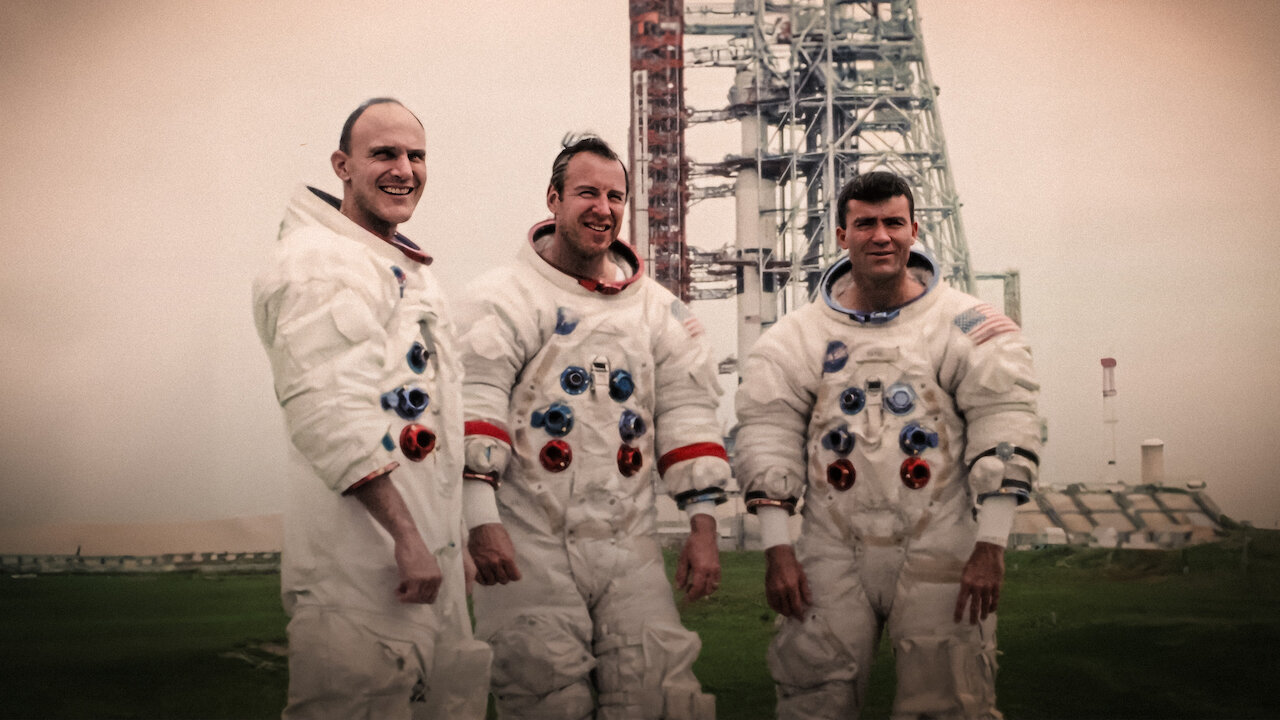
With Capt. Jim Lovell’s recent passing at 97 years old, the 2024 documentary Apollo 13: Survival feels newly poignant and timely in light of his heroics. The film is dedicated to the memory of Marilyn Lovell, who died in 2023.
“Houston, we’ve had a problem here,” – John “Jack” Swigert, command module pilot
Apollo 13: Survival revisits one of space exploration’s most famous emergencies through an archive-rich lens. In April 1970, a devastating mid-mission explosion left three astronauts stranded en route to the moon. Over the tense four days that followed, NASA mounted a high-stakes rescue effort that played out in real time for a global audience.
Drawing on full mission audio, previously unseen footage, and archival interviews with the astronauts, their families, and Mission Control, Apollo 13: Survival immerses viewers in the urgency and ingenuity of those perilous hours. The result is a gripping, cinematic reconstruction of an extraordinary fight for survival—one that remains a defining moment in human spaceflight history.
Much like the earlier Apollo 11, Apollo 13: Survival was made with rare access to the complete recordings of the Apollo 13 mission as well as the aforementioned archival interviews. I imagine that a number of these interviews were originally from Apollo 13: To the Edge and Back, an earlier NOVA documentary released in 1994. Archival footage is also credited to another NOVA documentary special, To the Moon. But anyway, the interviews are presented as voiceovers rather than on-camera talking heads.
With technology being what it was in the late 1960s and early 1970s, director Peter Middleton and his crew have had to employ reconstructive techniques for the parts of Apollo 13: Survival where visual coverage is limited. These include borrowing representational footage from other NASA missions and, in some instances, Apollo 13, the 1995 Ron Howard film about the doomed mission. One can tell the difference by the grain in the image or lack thereof.
On April 13, 1970, the Apollo 13 crew broadcast its final TV transmission as they were 200,000 miles away from Earth. Shortly following a montage sequence, the documentary flashes back to the start of the story. Apollo 13 was supposed to land in the mountains of the moon, thus increasing the mission’s risk.
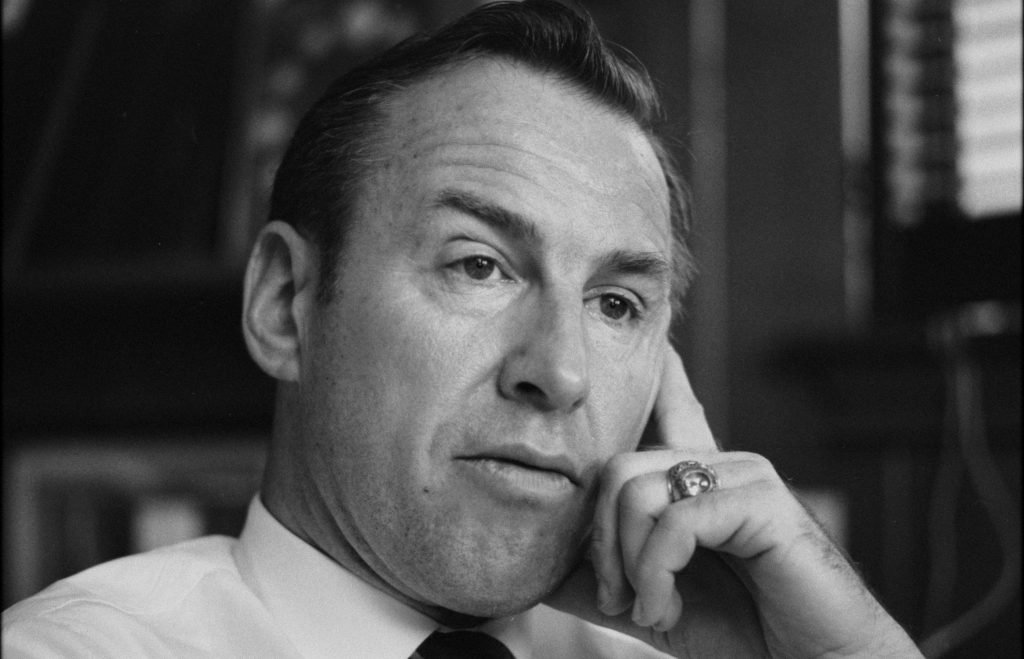
“There’s something about the power of rockets that fascinates people,” Capt. Jim Lovell says. “And it was a fascination to me, long before there was a NASA or anything like that.”
Lovell, who commanded Apollo 13, had been on Apollo 8. Their mission had been to land on the moon but alas, it didn’t happen. During the later Apollo 11 mission in 1969, Lovell had been the backup to Neil Armstrong. One couldn’t blame him for wanting to do the same thing. His plan for after the mission was try and find normalcy. He was in the second group of astronauts that survived the intensive screening in 1962.
Lovell’s wife, Marilyn, was apprehensive about her husband flying to the moon for a second time. She was in essence a space widow while her husband trained and worked as an astronaut. At the time, she didn’t know that Apollo 8 mission had a 50-50 chance of coming back.
Ken Mattingly was diagnosed with German measles a few days before the launch. Rather than spend money to postpone the flight by another month, John “Jack” Swigert replaced him as the backup command module pilot. Mattingly relocated to Mission Control in Houston, where he proved to be beneficial after Apollo 13 had a problem.
The number five engine shut down early, and they continued on with four of five engines. They could go on with four engines, so they continued inching towards orbit. Lovell was well aware from history that something always goes wrong with every flight. It seemed as if the engine shutdown was the mission’s only issue. Or so they thought.
I’ll never not be impressed looking at the footage of Earth from space. It looks so small and serene as the rocket passes by. But as peaceful as it may look from above in Apollo 13: Survival, the reality is not the same on the ground as we all know.
NASA provided all the families with squawk boxes so they could hear everything happening. The Lovells had one in each room.
Shortly as the flight gets into orbit, we learn about the Lovell family and their history in Apollo 13: Survival. Archival interviews allow us to learn about Marilyn Lovell and her marriage to Jim, such as when they first met. Rockets were blowing up daily at Cape Canaveral, so one could imagine how this might impact the wives and girlfriends. “Those days were tough on all of us gals,” Marilyn Lovell recalls.
“I think there are very few people that actually thought we were gonna land on the moon by the end of the decade,” Jim Lovell says.
The late 1960s painted a bad picture in America. Riots, assassinations, and of course, Vietnam. When they weren’t being met with tragedy, NASA’s missions brought joy to the American people. Where previous flights had 2,500 correspondents in the press room, we learn from watching Apollo 13: Survival that only 500 showed up for Apollo 13, presumably because the shock of walking on the moon had been brought down to earth after the Apollo 11–12 missions landed on the moon.
And then a problem happened.
“Uh, Houston, we’ve had a problem,” Lovell reported. “We’ve had a main B bus undervolt.”
Because of Ron Howard’s 1995 film, the quote is often repeated incorrectly, but the audio in Apollo 13: Survival allows us to hear it correctly. At this point, we’re just barely over a half hour into the film. Mission Control didn’t have any clue what was going on, but the Apollo 13 crew that they were venting gas of some kind into space. From there, it was a matter of how do they get back to Earth and quickly. Otherwise, they would run out of oxygen and die in space. As Kranz says, they were in “deep shit” some 200,000 miles from Earth, and the final fuel cells were dying. Forget the moon—it was about saving the crew.
What they had to do was move everyone from the command module into the lunar module. This was the only way that they could supply the essentials needed to save their lives. They had 15 minutes to get it powered up rather than the 20 minutes they would need in a perfect situation. An important step was to transfer the navigation data from the command module to the lunar module. They had to do this perfectly.
Apollo 13: Survival captures a phone call between Marilyn Lovell and Ken Mattingly, informing viewers that Jim and Marilyn’s children went to bed before the accident happened. How does she let them know what happened? And at that, there was only a 10% chance the crew would come back. Marilyn found solace in the bathroom, the only place she could be alone, and prayed.
After a successful burn, they shut down engines nearly 80 hours into the flight so as to conserve power. While they were within the ballpark of being able to bring the crew home, nothing was for certain. Lovell knew it was his last chance to be in space, and he had to say goodbye to his dream of landing on the moon. But first, there was still the issue of making his way safely back to Earth with the rest of the crew. The spacecraft was shallow and off-course, meaning they would skip off of the surface and miss the planet altogether. They would need to do a manual burn in order to get back on track.
The computer was down, the guidance system wasn’t working, and the auto-pilot was off. They had to burn manually while using the Earth as a target. Everyone had to work together for the burn to be a success. If the maneuver didn’t work, they would end up being screwed.
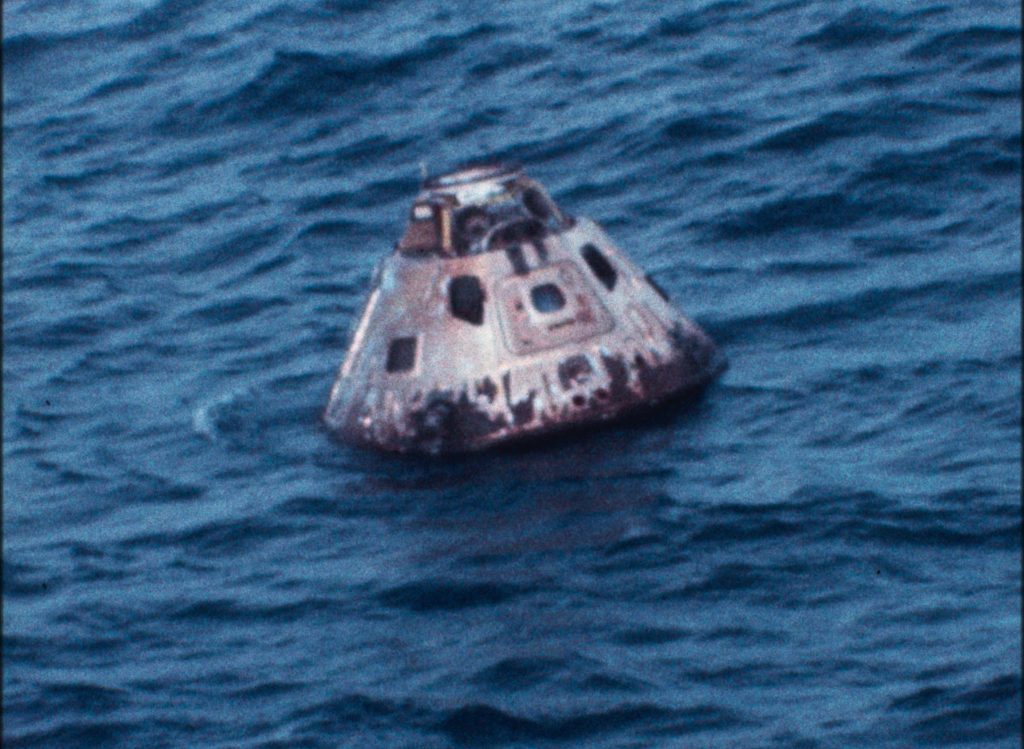
The suspense built up on re-entry day. It was no longer just an American story but a global one—one where people prayed across the planet. The archival news footage really captured the mood of the day as shown in Apollo 13: Survival. With already limited resources, the crew had to transfer back to the command module so that they could descend to Earth. Flying at 25,000 miles per hour, they were heading towards a spot in the Pacific Ocean when they lost the Odyssey’s signal. It was a waiting game. The tension finally came to an end when Odyssey splashed down.
Two months after splashdown, Apollo 13: Survival reveals that an investigation revealed that human error during the pre-flight maintenance had damaged one of the spacecraft’s oxygen tanks. At 55 hours, 54 minutes into the flight on April 13, an electrical fault caused the near-fatal explosion.
James Spinney’s score varies throughout Apollo 13: Survival. The score is ethereal, intense, whimsical, somber, dramatic, epic, gentle, suspenseful, climactic, triumphant, and pensive. It’s very different from James Horner’s score of Apollo 13, but the film is no less intense or epic in capturing the highs and lows.
Apollo 13: Survival is a gripping, immersive account of NASA’s most harrowing mission, capturing the courage, ingenuity, and resilience of the astronauts, Mission Control, and their families. To borrow a line wrongfully attributed to Gene Kranz in Apollo 13, failure is not an option.
DIRECTOR: Peter Middleton
FEATURING: Jim Lovell, Marilyn Lovell, Susan Lovell, Dr. Thomas Paine, Ken Mattingly, Jack Swigert, Gene Kranz, Fred Haise, Barbara Lovell, Tom Stafford, Glynn Lunney, Walter Cronkite, Jules Bergman, John Aaron, Robert Heselmeyer
Netflix released Apollo 13: Survival on September 5, 2024. Grade: 4/5
Please subscribe to Solzy on Buttondown and visit Dugout Dirt.