Danielle Solzman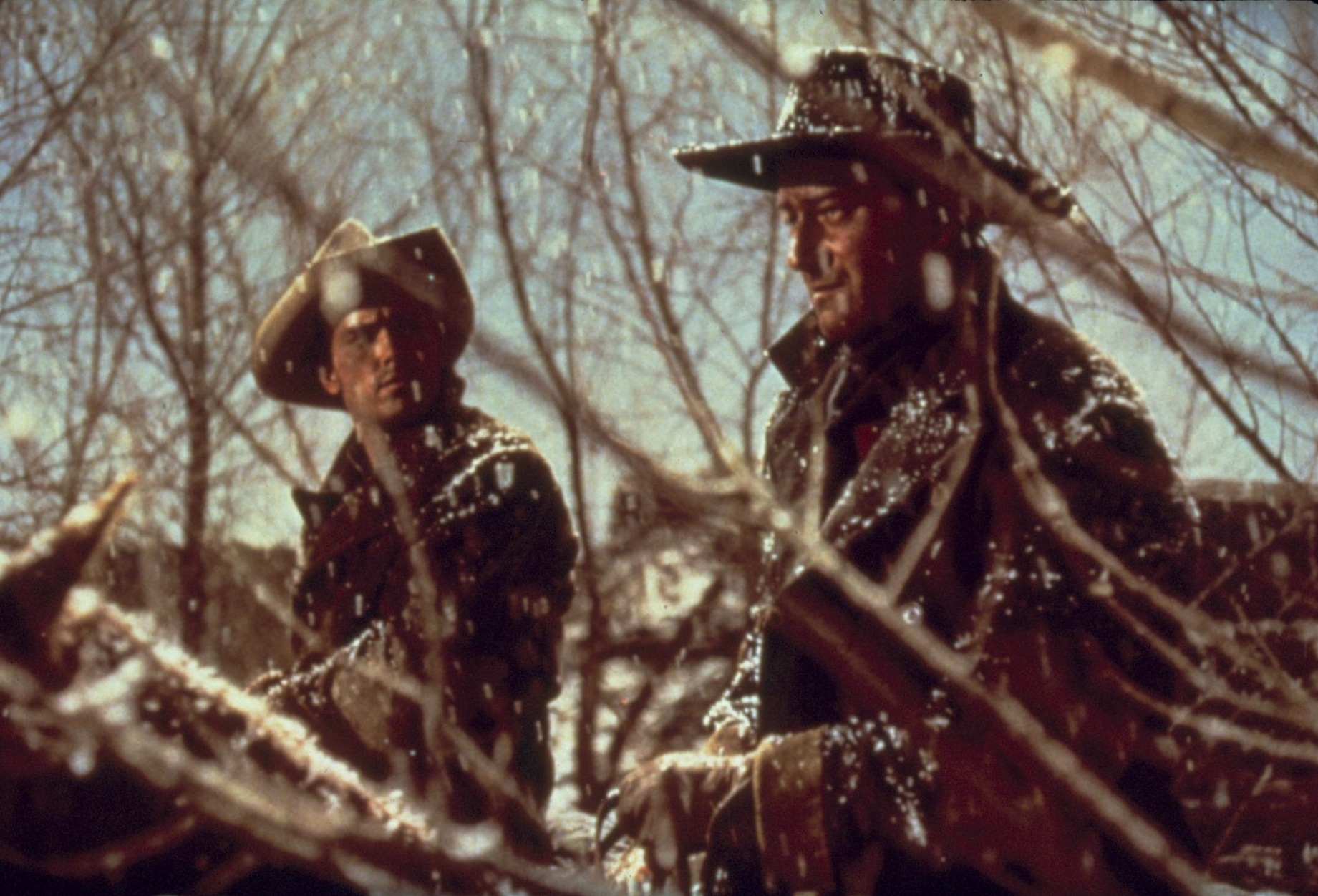
John Ford’s classic Western, The Searchers, was meticulously restored and made its way onto 4K Ultra HD last December via the Warner Archive Collection. Because this is a Warner Archive release, a digital copy of The Searchers is not included. The release includes only the 4K UHD and Blu-ray, showcasing the film in all its original VistaVision and Technicolor glory.
In 1868 Texas, Ethan Edwards (John Wayne) returns to his brother Aaron’s (Walter Coy) ranch after years away, having fought for the Confederacy and possibly in Mexico. A grim, solitary figure, Ethan refuses to swear allegiance to the Texas Rangers. When a neighboring ranch reports stolen cattle, Ethan joins a posse led by Rev. Capt. Samuel Clayton (Ward Bond). It’s a diversion: while the men are away, the Edwards home is attacked by Comanches. Aaron, his wife Martha (Dorothy Jordan), and their son are killed. Their daughters—Lucy (Pippa Scott) and young Debbie (Lana Wood)—are taken.
Ethan leads the search with Lucy’s fiancé Brad (Harry Carey Jr.) and Debbie’s adopted brother, Martin Pawley (Jeffrey Hunter). They find Lucy dead, and Brad is killed in a reckless charge. Martin stays on, loyal to Debbie, but the trail grows cold. Over the years, they continue the pursuit across Texas and into New Mexico. Ethan, driven more by hatred than hope, grows increasingly dangerous. At a trading post, they learn that Debbie—now a teenager (Natalie Wood)—is living as one of Scar’s (Henry Brandon) wives.
Ethan would rather see Debbie dead than “living with Comanches” and tries to shoot her, but Martin shields her and is wounded. Though Martin saves Ethan’s life afterward, he remains furious. Time passes. Back home, Martin’s sweetheart Laurie (Vera Miles) is preparing to marry another man (Ken Curtis), believing Martin lost. Then news arrives: Scar’s band has been found. Clayton plans an all-out attack, but Martin rides ahead to rescue Debbie first.
Martin kills Scar and finds Debbie, frightened but willing to come home. As Ethan rides up, it’s unclear if he’ll carry out his threat—but instead, he sweeps her into his arms and tells her, “Let’s go home.” Martin returns to Laurie, and the family gathers inside. Ethan stands at the door, watching. Then, alone and uninvited, he turns and walks away—an iconic image of a man whose time has passed, unable to rejoin the world he helped restore.
Make no mistake: The Searchers is an iconic John Ford classic and one of the greatest Westerns ever made. It’s not an exaggeration to call the film a masterpiece, even though it failed to earn a single Oscar nomination. That said, it cannot be viewed today without reckoning with its troubling elements. The film’s portrayal of Native Americans reflects the Hollywood norms of the 1950s, but the racism on display is striking, especially through Ethan Edwards. Far from a traditional Western hero, Ethan is consumed by hatred—so much so that he would rather kill his niece than see her live among the Comanches.
The racism in The Searchers is jarring when viewed without historical context. Ethan’s pursuit blurs the line between rescue and vengeance—does he truly want Debbie back, or is he driven by a need for retribution? Ford doesn’t soften the brutality, and the implication of what Debbie and her sister endured adds another layer of darkness. Martin Pawley, one-eighth Cherokee, serves as Ethan’s foil: compassionate, protective, and a reminder that empathy has a place even in such a violent world. Ford uses this contrast deliberately, forcing audiences to question Ethan’s place in the myth of the Western hero.
The film also leaves room for lingering questions. Ethan’s relationship with his sister-in-law Martha is hinted at through subtle glances and the musical motif of “Lorena.” Debbie was eight when she was abducted, and Ethan had been gone for eight years—is there a possibility she was his daughter? This ambiguity adds guilt to Ethan’s motivations and makes his final walk away from the Jorgensen home all the more haunting.
There’s a universe where Fess Parker is cast as Martin Pawley in The Searchers. Unfortunately for Parker, he was under contract to Walt Disney and Disney never told the Davy Crockett star about the offer. Instead, the role went to Jeffrey Hunter, who would later appear as Christopher Pike in the original unaired pilot for Star Trek: The Original Series, paving the way for Anson Mount to sport Pike’s Peak in both Star Trek: Discovery and Star Trek: Strange New Worlds.
Visually, Monument Valley stands in for Llano Estacado in northwestern Texas. Other locations in The Searchers include Mexican Hat in Utah, Bronson Canyon in Los Angeles, and Elk Island National Park. Thanks to the 4K restoration, these locations have never looked sharper. I watched the film back in 2011, and I don’t recall cinematographer Winton C. Hoch’s visuals being this crisp and vibrant.
When it came time to score The Searchers, producer Merrian C. Cooper turned to Max Steiner. A compromise was necessary because Ford shunned large orchestras, preferring folk songs to accompany his films instead. Sam Jones wrote and performed the title song, which Steiner wove into his score. The resulting music reflects the film’s complex tone, balancing heroism, isolation, and tragedy. Steiner relied heavily on folk melodies at Ford’s request, and while much of his work remains intact in the final cut, some adjustments and edits were made before release.
Frank S. Nugent’s script is adapted from Alan Le May’s novel, which draws on numerous 19th-century childhood abduction cases. One of the closest parallels is Cynthia Ann Parker, who was nine when she was abducted in 1836. While The Searchers takes place after the Civil War, both Parker and Debbie were taken by the Noyʉhka band. Debbie’s rescue mirrors Parker’s, which occurred during the Battle of Pease River (1860). The cavalry assault on the Comanche village is similarly inspired by the Battles of Washita River (1868) and North Fork of the Red River (1872).
The Searchers has left a lasting legacy, influencing countless filmmakers. Its impact is particularly visible in the Star Wars saga, with scenes and plotlines echoing A New Hope, Attack of the Clones, and Rogue One. Steven Spielberg reportedly re-watches the film before beginning every new project, underscoring how deeply its themes and imagery continue to resonate.
Even with its deeply uncomfortable racial politics, The Searchers remains one of cinema’s most important Westerns—a film whose artistry and legacy endure, even as its darker themes continue to spark debate.
Bonus Features
- Featurette: The Searchers: An Appreciation
- 1996 Documentary A Turning of the Earth: John Ford, John Wayne and The Searchers
- Archival introduction by John Wayne’s son
- Archival commentary by Director/John Ford Biographer Peter Bogdanovich
- Vintage Behind the Cameras Segments from the Warner Bros. Presents TV Series
- Outtakes
- Original Theatrical Trailer
DIRECTOR: John Ford
SCREENWRITER: Frank S. Nugent
CAST: John Wayne, Jeffrey Hunter, Vera Miles, Ward Bond, Natalie Wood, with John Qualen, Olive Carey, Henry Brandon, Ken Curtis, Harry Carey Jr., Antonio Moreno, Hank Worden, Beulah Archuletta, Walter Coy, Dorothy Jordan, Pippa Scott, Patrick Wayne, Lana Wood
Warner Bros. released The Searchers in theaters on May 26, 1956. Grade: 4.5/5
Please subscribe to Solzy on Buttondown and visit Dugout Dirt.