Danielle Solzman
Niagara: A History of the Falls, inspired by Pierre Berton’s book, explores the dramatic story of Niagara Falls, one of the world’s most iconic natural wonders. Dropping 170 feet from turbulent rapids into the basin below, Niagara Falls has fascinated and inspired onlookers for over 300 years.
As of my mid-July viewing, the documentary is not available to stream anywhere. I was able to borrow the DVD from my local public library.
This 1999 History Channel documentary delves into the human history surrounding Niagara Falls, from thrill-seekers like Annie Taylor—who became the first person to survive a plunge over the falls in a barrel—to figures like “Red the Riverman,” known for recovering bodies from the waters before making his own fateful descent. The film also examines how tourism, technology, and industrialization reshaped the area, with the arrival of railroads and hydroelectric power altering the region’s trajectory.
Through a mix of archival photos, original footage, and interviews, the documentary reflects on the tragedies, triumphs, and enduring fascination that have defined Niagara Falls for centuries.
Rather than begin with the earliest history of Niagara Falls, the documentary opens with Annie Edson Taylor’s 1901 barrel stunt—an audacious attempt to survive a plunge over the falls. From there, we meet William “Red” Hill Sr., a World War I veteran who recovered 172 bodies from the river before ultimately attempting the falls himself. His son, Wes Hill, estimates he personally pulled some 400 bodies from the water. Today, those responsibilities fall to the Niagara Parks police and fire departments, relieving the Hill family of the burden.
In 1960, siblings Roger and Deanne Woodward were swept into the river after a boating accident. Roger, just seven years old, recalls the rapids—not the drop—as the most terrifying part. Deanne managed to swim toward the American side, guided by a tourist’s call. Roger wasn’t so lucky: he went over the Falls, only to be rescued by passengers aboard the Maid of the Mist. Their companion perished. Roger was briefly seen as a celebrity for “conquering” Niagara, but the film makes clear—they were victims, not thrill-seekers.
Stunts and survival stories are only part of Niagara’s legacy. The deeper history begins in 1678 with French explorer Father Louis Hennepin, the first European to document the falls—though he exaggerated their scale. As Pierre Berton and Elizabeth McKinsey note, Indigenous peoples had long known the falls. It would take nearly two more centuries for scientists to understand the glacial activity that formed the Niagara Escarpment and, with it, the Niagara River some 12,000 years ago.
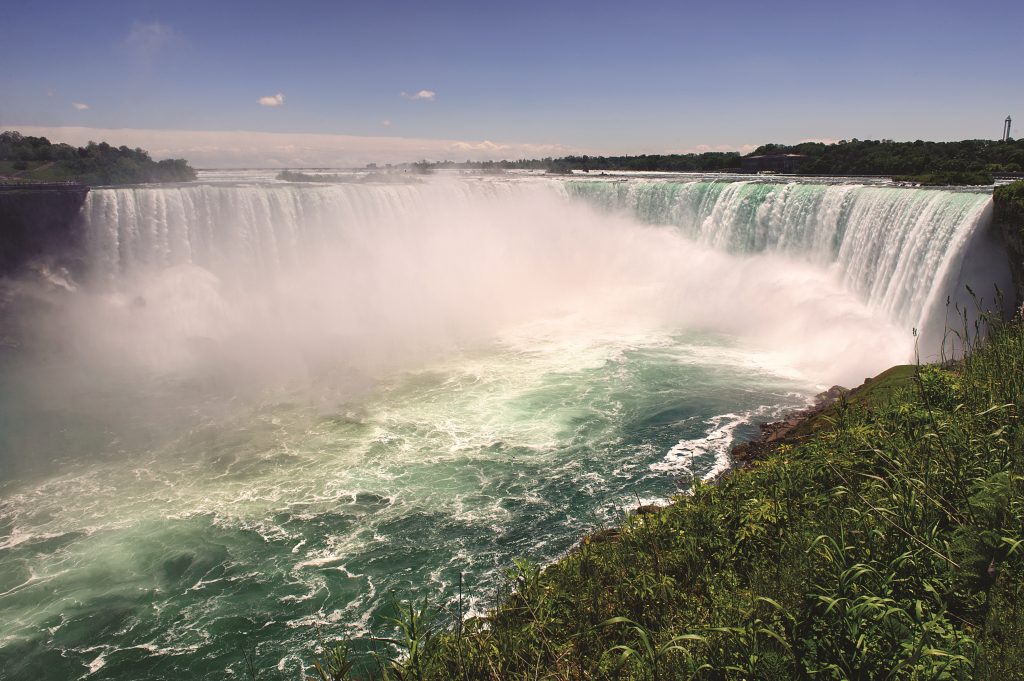
Today, one-fifth of the world’s freshwater flows through the Niagara River, plunging over the falls with a force equal to 20 stories. Thanks to ongoing erosion, the falls have gradually moved upstream from where Hennepin first saw them. The buildup of silt created Goat Island and separated the smaller Bridal Veil Falls from Horseshoe Falls.
Tourism grew steadily after one daring explorer climbed down and went behind Horseshoe Falls. By summer, the falls now draw up to 12 million visitors each year—but the seeds were planted much earlier.
In the 1800s, Niagara Falls, N.Y., was still frontier land. Surveyor Augustus Porter bought Goat Island and began charging admission. War of 1812 veteran William Forsyth, a convicted criminal turned promoter, opened the Pavilion Hotel in 1822. The Erie Canal’s 1825 completion made the area more accessible, sparking expectations of comfort and civilization. Women travelers were increasingly common, and with that came a wave of literary attention and early photography.
Terrapin Point, though controversial, offered spectacular American-side views. Tourists collected certificates at Table Rock and snapped souvenir photos of Native Americans, who were allowed on Porter’s land as a gesture against deportation—but were also objectified as curiosities.
Railroads arrived mid-century, bringing the first bridge between the U.S. and Canada. Engineers debated whether a suspension bridge could carry a train, but the Niagara Falls Suspension Bridge opened in 1855 and remained in use through 1897. The cost—$400,000—would’ve been tenfold in Europe.
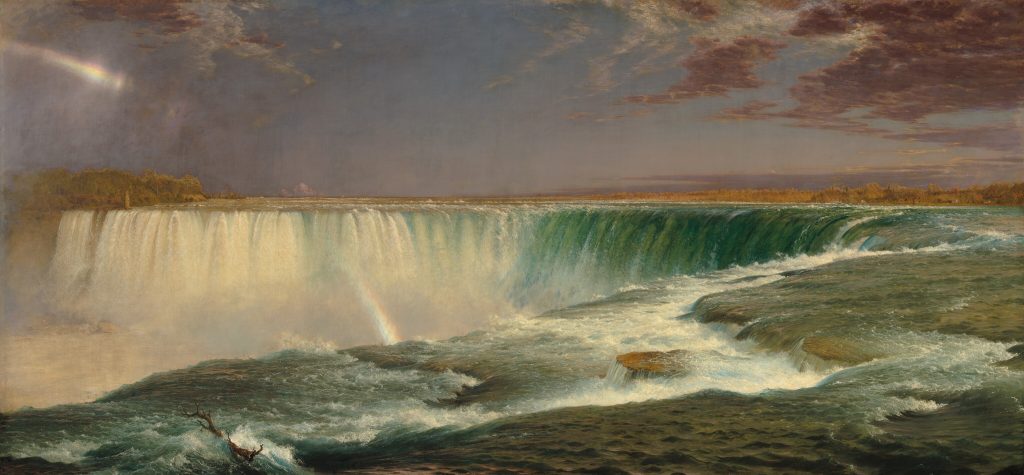
Artists like Frederic Church captured the falls on massive canvases, blending geological study and photography. His 1857 oil painting attracted over 100,000 viewers and remains on display at the National Gallery of Art.
In 1859, Jean François “Blondin” Gravelet was the first to cross the Niagara Gorge on a tightrope, followed by William “The Great Farini” Hunt. Though Hunt attempted another crossing in 1864 and lived to 91, Blondin remains the more famous daredevil.
Tourism and industry brought both prosperity and exploitation. Frederick Law Olmsted led a 15-year effort to preserve the falls’ immediate surroundings as public parkland. With support on both sides of the border, the New York State Reservation opened in 1885, followed by Canada’s Queen Victoria Park in 1888. “The age of exploitation is over,” declared the press.
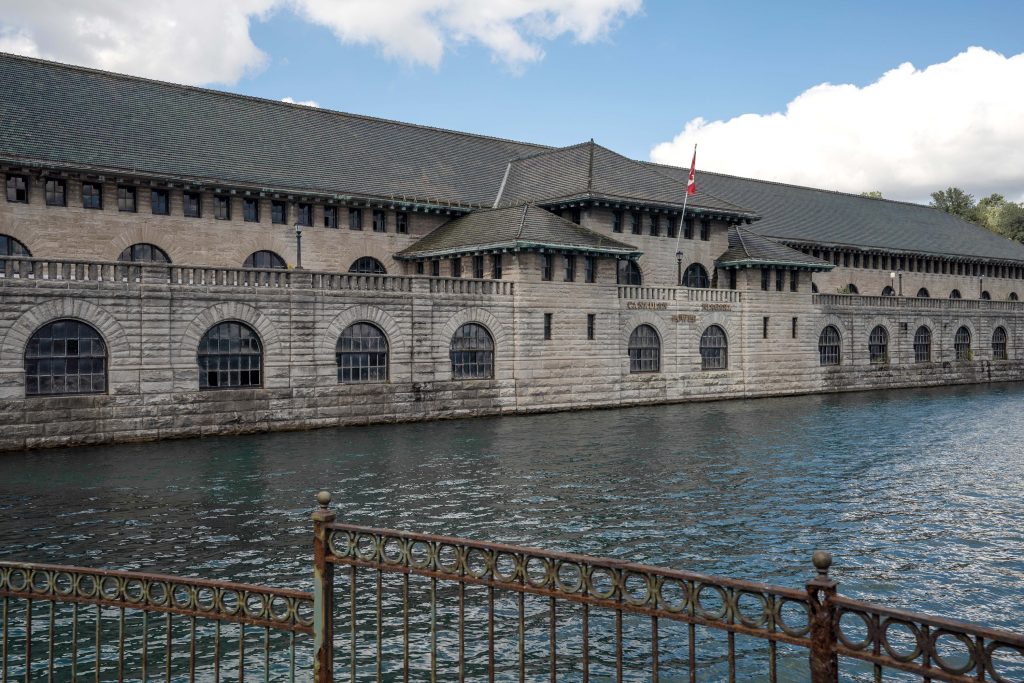
Niagara’s power soon became as valuable as its scenery. Hydroelectric plants emerged, and by the 1880s, the area was a world leader in power production. Early efforts failed, but Thomas Edison and Edward Dean Adams believed electricity could be widely transmitted. Meanwhile, Nikola Tesla envisioned alternating current after studying engravings. Backed by George Westinghouse, Tesla patented AC in 1888, igniting the “Battle of the Currents” famously depicted in The Current War.
Tesla famously passed electricity through his own body at the 1893 Chicago World’s Fair, winning the contract with Westinghouse. A year later, turbines began spinning in Niagara. Edison would go on to form what became General Electric. The power plants themselves became tourist attractions. Today, visitors can walk through a 2,200-foot tunnel and stand at the foot of the falls, 180 feet below ground.
Niagara inspired more than engineers. Before inventing his famous razor, King Camp Gillette envisioned a socialist utopia at the falls, imagining a self-contained city-state for America’s 60 million citizens. His ideas failed, but others like Henry Perky (inventor of Shredded Wheat) built factories along the river that became attractions in their own right.
By 1909, unregulated electrochemical plants had moved in. Developer William T. Love began work on what would become Love Canal, intending to build a “Model City.” The project was abandoned, but toxic dumping continued. By 1978, the area was declared a federal disaster zone. A 1980 report revealed that 20,000 tons of chemicals had been dumped—affecting a third of nearby families.
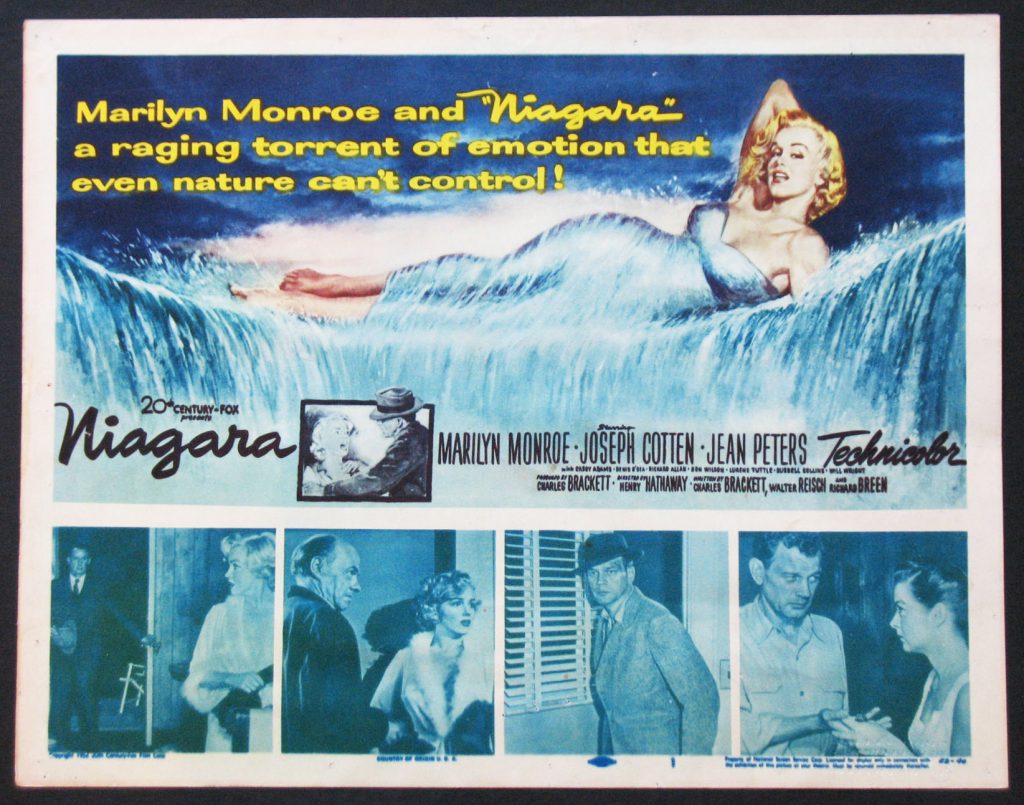
Niagara also became synonymous with romance. The first recorded honeymoon took place in 1801, but postwar prosperity made it a popular and affordable destination by the 1950s. In 1953, Niagara starring Marilyn Monroe and Joseph Cotten solidified the image. Some 13 million tourists visited the following year, and Monroe imitators still reenact her famous Table Rock walk.
The falls have also seen their share of disaster. A 1938 ice jam caused the collapse of the Upper Steel Arch Bridge, known as the Honeymoon Bridge. In 1956, a section of cliff collapsed near the Schoellkopf Power Station. In 1965, a failsafe on the Canadian side failed, triggering the largest blackout in North American history—30 million people lost power for up to 14 hours.
In 1969, the American Falls were temporarily “turned off” to study erosion. Scientists determined that the boulders actually helped protect the falls, and they were left in place.
The documentary includes reenactments, but these sequences lack the impact of archival footage. While understandable from a production standpoint, they occasionally fall flat next to the real thing.
One notable omission is a more thorough exploration of the falls’ natural regression. For centuries, Niagara has been eroding upstream—historically at a rate of 1 to 1.5 meters (about 3 to 5 feet) per year. Today, thanks to flow control and hydroelectric diversion, the rate has slowed significantly to about 1 foot per year, and may be reduced further to just 1 foot per decade. While Niagara Falls won’t vanish anytime soon, the long-term future of the landscape raises compelling questions about whether humanity will continue to intervene—or eventually let nature run its course.
Niagara: A History of the Falls is a well-researched and informative documentary that covers an enormous amount of ground, from Indigenous history and industrial transformation to daredevil feats and environmental activism. At times, it can feel like too much to take in at once, and the reenactments don’t always match the power of the original footage. Still, it succeeds in conveying the enduring mystique and complex legacy of one of the world’s great natural wonders.
DIRECTOR: Rachel Low
SCREENWRITER: Michael Machlear
NARRATOR: Edward Herrmann
FEATURING: Pierre Berton, Wes Hill, Roger Woodward, Deanne Woodward-Simpson, Elizabeth McKinsey, Rick Hill, Bill Irwin, Patricia Jasen, Patrick McGreevey, Shane Peacock, Lois Gibbs, Karen Dubinsky
Niagara: A History of the Falls aired January 31, 1999 on The History Channel. Grade: 3.5/5
Please subscribe to Solzy on Buttondown and visit Dugout Dirt.