Danielle Solzman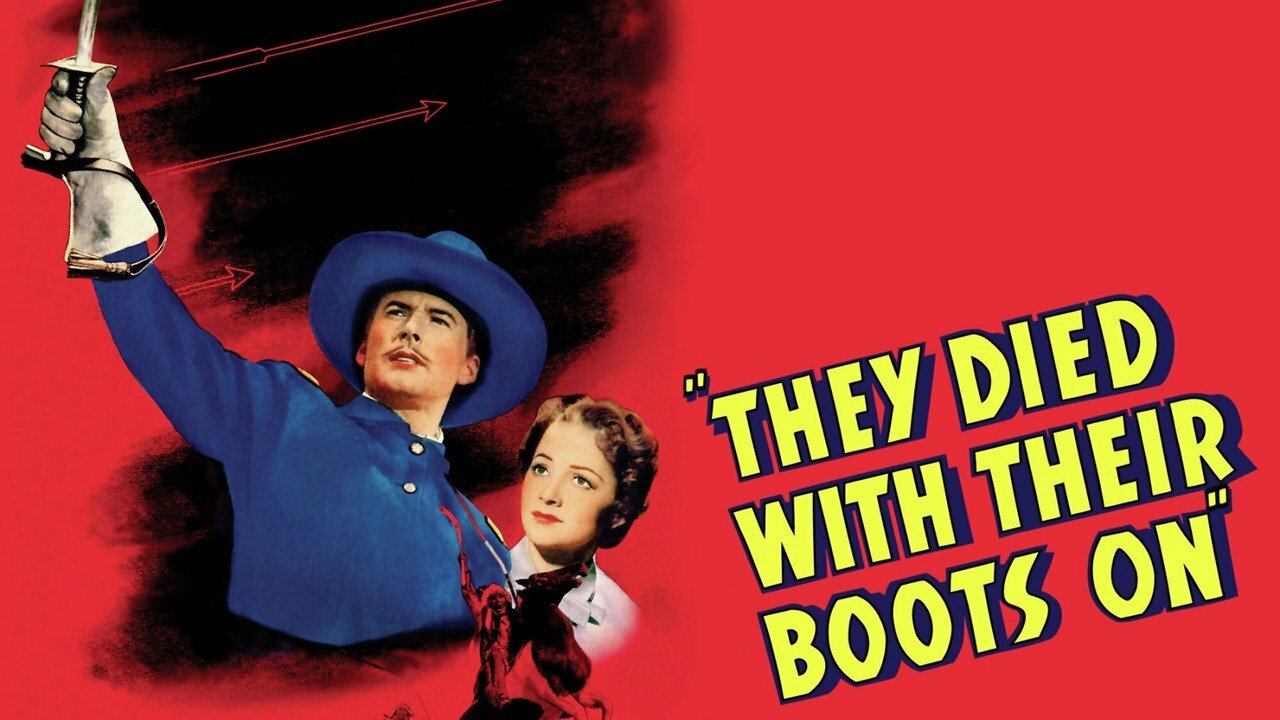
They Died with Their Boots On offers a highly fictionalized account about the life of Gen. George Armstrong Custer, covering a 20-year period from 1857-1876. It marked the eighth and final pairing between screen legends Errol Flynn and Olivia de Havilland and their first pairing not directed by Michael Curtiz. The studio wanted Curtiz to direct but Flynn had enough star power by this point to override the decision.
They Died with Their Boots On was recently released on Blu-ray by way of the Warner Archive Collection. The new 1080p HD master comes from a 4K scan of the original nitrate camera negative. The 141-minute film is presented in black and white with a 1.37:1 aspect ratio with side mattes and a DTS HD-MA 2.0 MONO soundtrack.
George Armstrong Custer (Errol Flynn) arrives at West Point in 1857, where his self-designed uniform earns him mistaken honors but little respect. Prone to pranks and poor discipline, Custer struggles through his studies, accumulating demerits and reaching the bottom of his class by the outbreak of the Civil War. Meanwhile, he develops a romantic interest in Libbie Bacon (Olivia de Havilland), though his enforced silence delays their budding connection. Early graduation and immediate military orders keep Custer from meeting her, setting the stage for a love story that will unfold alongside his unpredictable and daring military career.
Custer’s audacity earns him fame after defying orders to defend a strategic bridge, leading to his rapid promotion. Back home in Monroe, Michigan, he reunites with Libbie but clashes with her protective father. Despite briefly enjoying domestic life, Custer grows restless and turns to alcohol. Encouraged by his mentor General Winfield Scott (Sydney Greenstreet), he accepts a commission to serve in the Dakota Territory, where his leadership and battlefield ingenuity will soon be tested against chaos, corruption, and conflict with Native American tribes.
At Fort Lincoln, Custer faces an unruly regiment and the manipulations of his West Point rival Ned Sharp (Arthur Kennedy), who profits from illegal rifle sales to the Lakota. Custer restores discipline, closes Sharp’s saloon, and leads his men in early skirmishes, negotiating treaties with tribal leaders like Crazy Horse (Anthony Quinn). When Sharp fabricates a gold rush to undermine Custer, the general is humiliated before politicians and temporarily relieved of command. Despite congressional ridicule, Custer appeals directly to President Ulysses S. Grant (Joseph Crehan), regaining his position to confront the growing crisis in the Dakota Territory.
In They Died with Their Boots On’s climactic and tragic finale, Custer leads the 7th Cavalry into overwhelming odds against thousands of Native American warriors at the Battle of the Little Bighorn. His men are killed, but their sacrifice delays further conflict, revealing the exploitation and corruption driving the war. A final letter to Libbie clears the Native Americans of blame and names the political schemers responsible, solidifying Custer’s legacy as a courageous, if flawed, figure caught between duty, love, and betrayal.
One major problem with They Died with Their Boots On is that it covers way too much ground. Listen, I don’t have a problem with biopics in general but they need to span a narrower timeline than two decades of someone’s life. Steven Spielberg’s Lincoln did it the right way, opting for a narrow moment in President Lincoln’s life. Here, we have a film spanning two decades and then getting so much of the history wrong. That’s on the screenwriters and maybe the lack of an internet in the early 1940s.
Much like Santa Fe Trail, also starring Flynn, de Havilland, and featuring President Reagan as General Custer, They Died with Their Boots On features a good number of historical errors. Despite arguing that the Black Hills did not have any gold, Custer had previously led an 1874 expedition in which gold was discovered. Neither Custer nor Crazy Horse had met in real life. Phil Sheridan was not Commandant of West Point when Custer attended as a student. Custer and Libbie never met until 1862 and certainly not while he was a student at West Point.
As for the Battle of Gettysburg, there is a 35-star U.S. flag as the Michigan cavalry charges in They Died with Their Boots On. This flag did not go into effect until shortly after the scene took place. You would think they would have known better!
Don’t get me started on the issues with Little Big Horn in the film. Custer—with long hair rather than showing he had just gotten a haircut before the Little Big Horn campaign—is depicted as one of the final men to die. Historic accounts suggest that he was among the first and that none of the men brought their sabers. At no point in They Died with Their Boots On do we ever hear of Custer’s younger brothers—Tom and Boston—nor their nephew, Henry Reed, and brother-in-law James Calhoun. All of them joined Gen. Custer in being killed at Little Big Horn.
While Gen. George Armstrong Custer is a historical American figure worthy of a biopic, They Died with Their Boots On does not do proper justice to his life and career.
Bonus Features
- Warner Night at the Movies 1942 – hosted by Leonard Maltin
- All Through The Night trailer
- Newsreel
- Military short SOLDIERS IN WHITE
- Cartoon A TALE OF TWO KITTIES (HD)
- Featurette: THEY DIED WITH THEIR BOOTS ON: TO HELL OR GLORY
- Original Theatrical Trailer
DIRECTOR: Raoul Walsh
SCREENWRITERS: Wally Kline and Æneas MacKenzie
CAST: Errol Flynn, Olivia de Havilland, with Arthur Kennedy, Charley Grapevine, Gene Lockhart, Anthony Quinn, Stanley Ridges, John Litel, Walter Hampden, Sydney Greenstreet, Regis Toomey, Hattie McDaniel
Warner Bros. released They Died with Their Boots On in theaters on November 21, 1941. Grade: 2/5
Please subscribe to Solzy on Buttondown and visit Dugout Dirt.