Danielle Solzman
Seth Kramer discusses directing Fiddler on the Moon: Judaism in Space, sharing insights into its creative process, and the story behind the documentary short. This conversation took place during the first week of November 2025.
In this interview, director Seth Kramer talks about the making of Fiddler on the Moon: Judaism in Space, a documentary short he co-directed with lifelong collaborators Daniel A. Miller and Jeremy Newberger. Kramer reflects on the film’s origins, the spark that inspired its playful yet thoughtful exploration of Jewish culture in speculative territory, and the creative decisions that shaped its tone and structure. He discusses the team’s collaborative dynamic, the challenges of condensing a big idea into a short runtime, and the surprising ways audiences have connected with the film. Throughout the conversation, Kramer offers a candid look at the craft, humor, and intent behind bringing this imaginative project to life.
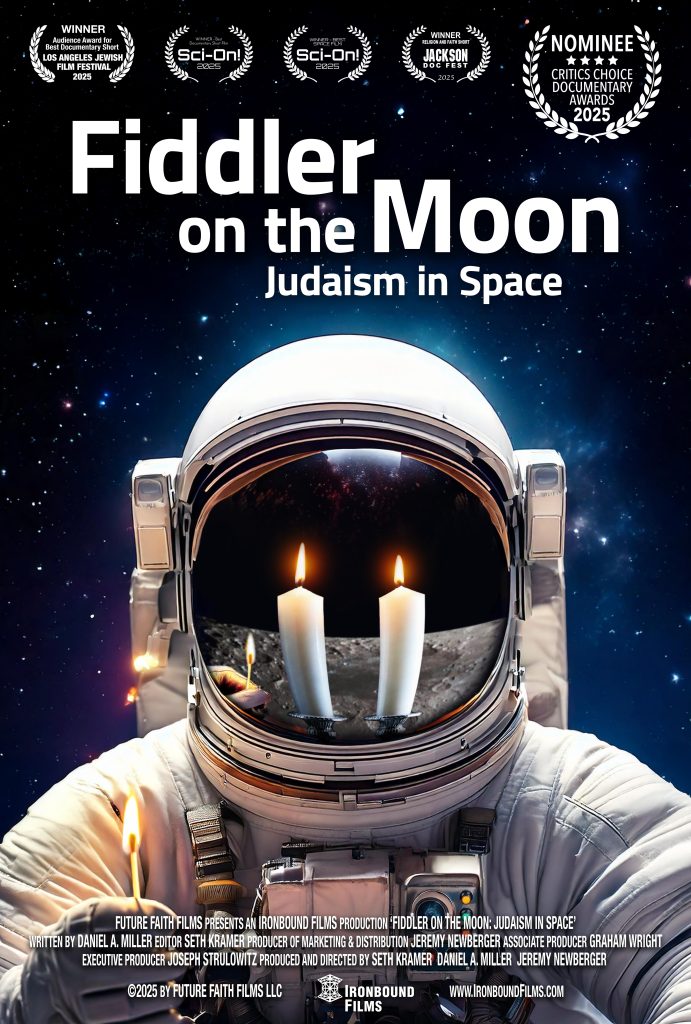
Directed by Seth Kramer, Daniel A. Miller, and Jeremy Newberger, Fiddler on the Moon: Judaism in Space features Josh Breindel, Sheyna Gifford, Jeffrey Hoffman, Zvi Konikov, Jessica Meir, Ben-Tzion Spitz, Neil deGrasse Tyson, Kelly Weinersmith, and Zach Weinersmith. The film seeks to answer the question: can Judaism survive in space?
Fiddler on the Moon: Judaism in Space is currently making a push for the upcoming Oscars, having qualified for Best Documentary Short with its theatrical run in September. The film was previously nominated for the Critics Choice Documentary Awards and took home the Solzy Award for Best Documentary Short. For more information on where you can watch the film, click here.

It’s so nice to meet you today. How are you doing?
Seth Kramer: I’m great. Yeah. I’m good. This is this is fun for me. The rest of the day will be downhill.
Fiddler on the Moon: Judaism in Space is currently nominated for a Critics Choice Documentary Award? How honored is the entire team?
Seth Kramer: Oh, we’re thrilled and we’re kind of surprised. We think the film has merit. But when you look at the list of all the other films in all the categories that have been nominated for a Critics Choice Award, and then you get to ours, it has Judaism in the title. It’s sort of glaringly different.
As Jewish filmmakers in particular, that feels terrific, especially in our current times.
Yeah. What was the genesis behind making the film?
Seth Kramer: I wish I could say this brilliant, hilarious, and fascinating idea was mine, but it was not. It started with a phone call. There’s a guy named Joey Strulowitz. I went to high school with him, and I hadn’t heard from him in decades. He gave me a call with an idea for a documentary. This happens a lot if you’re a documentary filmmaker and usually, you have to sort of politely let people down.
Joey’s an observant Jew and a space travel enthusiast. He pitched me on this idea, which at first, I didn’t know how serious he—this might be too much information, but he started pitching his idea just with the space angle that humanity is destined to live among the stars. NASA’s planning a manned space mission to Mars. Elon Musk is claiming we’ll have a colony on Mars before the end of the century, that kind of thing, which I thought was very interesting and not something I think of often.
But then after a dramatic pause, he says, how will Jews adapt? Which I thought was a joke, but he was serious.
So anyway, I took this idea to my partners, Daniel Miller and Jeremy Newberger, and we all equally fell in love with it as a story with great potential, so we ran with it.
It was a very long answer to a very short question so sorry about that.
How did the three of you balance directing duties?
Seth Kramer: Yeah, we are a three-person directing team, and I think that’s kind of unusual in the film world. We have it down to, if not a science, then an art, because we all bring different things to the table.
I typically edit the films. Daniel is typically our film’s writer. Jeremy is most likely the guy with the most off the wall ideas. That’s a very general way of describing what we bring to the table.
But beyond that, we all sort of mix and match. There are some fights too, but they get resolved peacefully.
What was the most challenging aspect of making Fiddler on the Moon?
Seth Kramer: Documentary is kind of funny. Because each time you approach a subject, it’s generally a subject that you haven’t spent a lot of time thinking about.
I’m gonna say something. I hope it doesn’t come across as obnoxiously tooting our own horn, but we’ve been nominated for three Emmys, and that’s great. That makes filmmakers proud. But the thing that makes me most proud about that is that they’re for three different topics entirely.
One is for outstanding historical documentary, another for outstanding science, and another for economic and business programming. So in each of those cases, you have to wrap your head around something that you’re not used to dealing with entirely, and become a little mini-expert.
This is Judaism, space travel, and the history of the space program so that was a real challenge. I’m not a rabbi, astronaut, or an astrophysicist. You have to become a little mini-expert in that in order to make a film about this, to talk with people about it, and get the most out of your interviews with rabbis or with Neil deGrasse Tyson.
That was a challenge.
Yeah. I feel like Neil deGrasse Tyson is this universal constant in any documentary that deals with space.
Seth Kramer: (Laughs) We tried to resist, but he’s obviously an expert in space. He has that covered. But he also is able to bring astrophysics and the history of spaceflight and where we’re heading into all these other domains. He knows a lot about human culture and as it turns out, he knows a lot about Judaism.
As much as you might try to avoid it, which we really didn’t, because he’s just brilliant and fun, he’s the right person to talk to and to sort of act as a glue because in our film, we’re talking with rabbis, scholars, Jewish astronauts. He was the right person to bring it all together. So here he is.
How long was the initial edit and were there things that you all wanted to keep in the film, but couldn’t find the right place?
Seth Kramer: When we start a new project, we don’t decide ahead of time how long it’s going to be. We like to say that the story will tell us how long the film needs to be.
This one was always around the 30-minute mark. If you want to focus more on the Jewish angle, there are lots of other examples you could bring into the film that are really, really Jewish. It might even be too Jewish for this interview, but I’ll tell you.
How do you build a mikveh on Mars? How do you build a structure that relies on fresh water that has fallen from the heavens? Will the ice that’s frozen on the Martian landscape suffice or is it no good?
But after a time, the audience will get the point. There are other examples of complications, let’s say, that astronauts who have tried to be observant have encountered in space.
But in the end, I think the film just needed to be this short, sweet statement on the topic. Hopefully, the audience carries it with them and we’ve given the audience enough to think about, beyond the film.
So there was never a time when you all considered making it a feature length movie?
Seth Kramer: No, no. I don’t know if it’s my age and my own personal lack of attention span—I think I could say this for all of us here, we’re becoming more interested in short films as an area to explore.
Yeah, most of what we’ve done for the 30 years that we’ve been making films is our long-form, feature-length. But this one really felt almost like a parable of sorts.
It’s something that we thought it would be great for Jewish audiences, but we also wanted to make it for general audiences. Any longer than 30 minutes, we’re really pushing our luck.
What was the most surprising thing you learned during the process of making the film?
Seth Kramer: I’ll give you a few things that pop to mind. One of the things that interested us about the concept was that it brings together religion and science, and these are two things that are typically viewed as kind of polar opposites.
It was interesting for us to bring them together and to see how they came into conflict or complemented each other, but we didn’t really understand how that would happen.
One of the issues that we had to deal with in the movie was what happened when humans first set foot on the moon. Largely viewed as a scientific milestone, but you can also view it as a religious event.
We discovered that rabbis around the world, many Orthodox rabbis, kind of freaked out because it raised this issue of, well, are Jews even allowed to go into space and set foot on the moon. We learned a lot about the debate there in short and we get into this in the film.
In Psalms, G-d gives the earth to mankind, but reserved the heavens for G-d. And so if man goes into space, are we breaching something? Are we heading into G-d’s turf?
One huge surprise for us was that we discovered that Rebbe Schneerson, one of the most revered figures in Judaism, was actually asked this question and not only found no problem with it and this kind of exploration, but thought that science and scientific questioning was a critical part of Judaism.
That scientific questioning not only is it not at odds with Judaism, but it allows us to uncover G-d’s design. And so, science informs the faith, and faith can perhaps inform the science.
That’s not something that we had thought too much about and it was a beautiful discovery for us as Jewish filmmakers.
What’s been the reaction as you all have played film festivals, opened up for a theatrical run, and held awards screenings?
Seth Kramer: Well, we thought that Jewish audiences would like this one. I mean, it’s a really Jewish movie, and it’s got all this Jewish humor in it.
We really wanted it to be a film for general audiences and we worked hard to make it so. Anytime something Jewish is mentioned, we’re sure to explain what that means to a general audience.
I think the biggest nice surprise is that it’s done really well in mainstream film festivals, and even Christian film festivals.
There’s been a lot of interest. I think we were really successful in this mission to bring the story to general audiences. While we hoped that would be the case—that the film would be embraced—that it actually was, I’ll admit, it was a bit of a nice surprise.
I’ll give you another one, too. We do screen this for a lot of Jewish audiences. I’ve been surprised that a lot of these audiences have no idea about the extent of Jewish participation in the space program or even that we have a Jewish astronaut who is currently enrolled as a NASA space astronaut. Or the story of the first Israeli astronaut.
So much of this is unknown even to Jewish audiences. That was a bit of a surprise to me, personally.
I knew about Ilan Ramon because I still remember hearing about the Columbia disaster. Even years later, I still get chills just thinking about it. I was too young when the Challenger exploded. But Columbia, I was 18 at the time.
Seth Kramer: Okay, right. So you would have been paying attention to it. You were in high school, I guess.
A lot of people don’t even sort of remember that and they’re reminded of it when we get into the film. Some people who were aware of it, the film allows them to experience it more than they had.
But there’s different levels of understanding and I’ve been surprised at how little time people have focused on this stuff. Because for Jewish audiences, you’d think it would be a source of pride. I think it is, but it’s sort of untapped.
I think for general audiences, space occupies a big part of the public’s imagination. It’s a big part of our culture. We’re not thinking of it as this radical science fiction way, like Star Trek. We’re thinking about it purely in terms of science.
I don’t think we too often think about space and space exploration through the lens of faith. We’re a very religious country and so it’s interesting to me that audiences are responding to it in that way to a surprising degree, having not thought about that so much.
I have to ask—if only because it came up in my social media mentions—why did you have to include a certain clip of a certain person?
Seth Kramer: (Laughs) Sorry. Yeah, him.
Because someone said they would have watched the film, but they watched the trailer and he popped up.
Seth Kramer: Yeah, you want to hear something? Well, he’s in the movie. Well, I’m gonna say his name.
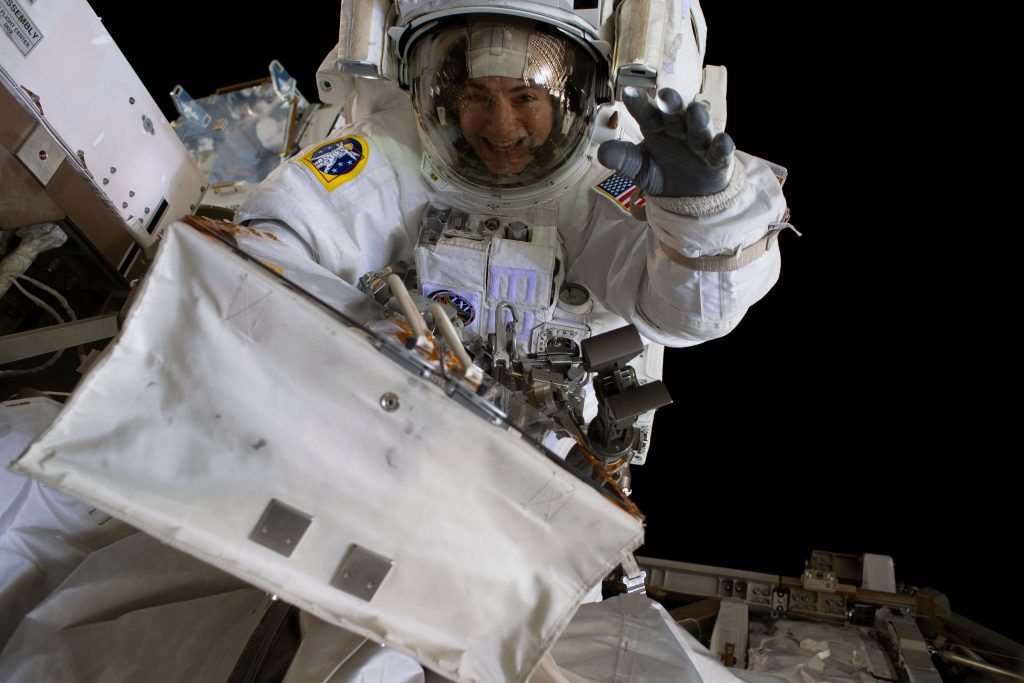
There’s a scene in the movie where Donald Trump is communicating to one of the astronauts who is involved in the first all-female spacewalk. It’s a very funny scene, I think, regardless of how you feel about Trump.
We’re here to report. We had Donald Trump in the trailer. We just released a new trailer that doesn’t include Donald Trump. A big part of the rationale is because he is so polarizing and we don’t want him to be a distraction.
You’re right to ask and we actually responded to that.
We didn’t encounter any negative feedback. You’re telling me something new. I didn’t see comments like that. But we weren’t born yesterday. We don’t live in a vacuum.
You’ll be happy to know there’s now a trailer for the film that’s not as politically divisive, doesn’t carry that risk. Very funny.
What do you hope people take away from watching the film?
Seth Kramer: This film is really different than any other film we’ve ever made. What are the challenges of being Jewish in space?
But there is a theme that we like to explore, which is what does it mean to be human? We delight intellectually in then asking the question: What does it then mean if some of those things that make us human are taken away or challenged?
This film does that. We’ve done that with our film The Linguist, which looks at endangered languages, and with The Anthropologist about what happens when the climate changes and indigenous people lose their homeland.
This is a very similar film in that regard. I think it’s an opportunity for people to think about what makes us human.
In this specific case, how millennia of astrological observations have shaped what makes us human and shaped our worldview and what might happen if those things are removed. It’s a very interesting thought experiment. It’s an interesting meditation, if nothing else.
I think for Jewish audiences, there’s an extra layer there that maybe general audiences don’t experience. It’s also a film that’s asking Jewish people in particular to imagine a future in which they have to place Judaism and Jewish life in a new context, which is something that comes up for our community every so often when we have to find a new place to live.
Not to end that answer on a down note, but the film does have all of that.
Now if only we can leave antisemitism behind when that time comes, because there’s enough baggage to check.
Seth Kramer: (Laughs) Should have stolen that line for the movie. We’ll do that for part two. But yeah.
It’s very interesting. We interview this couple, the Wienersmiths, who are not Jewish but have a very Jewish sounding last name.
They wrote this very fascinating book, A City on Mars. The book is all about the complications of space travel and all these things that we imagine ourselves doing. It’s nearly impossible.
All the ships that you see in science fiction—we don’t have enough resources on Earth to build anything like that. That kind of thing. It’s a very funny book because they’re very funny, but it debunks one idea after the next. So it’s a bit of a bummer.
One of these ideas is that I think we have, because we’ve seen the International Space Station, and we know that different people of different faiths and from different countries are working together, is that maybe we will overcome all these things that are a burden to us on Earth—all the racism and the hate and the bigotry—when we have to work together in space.
Well, they debunked that one, too, because they tell stories about what happens when people really go up that you don’t really hear about. There’s plenty of fights, and people take their baggage with them, unfortunately.
There have been instances on the space station where the Russians and the American astronauts aren’t talking to each other.
It’s a bit of a bummer. I’m sorry to tell you that we might have antisemitism wherever we go, including space. It’s a bummer, right?
Yeah.
Seth Kramer: Yeah. Sorry. Who knows. I’m glad you seem to enjoy it from that perspective though. It seems like you liked it.
Oh yeah.
Seth Kramer: I hope so. Well, anyway, I hope I did this—I have to tell you, being interviewed about movies is something that we have to do and it’s usually a little complicated.
This one is unusually tough because it’s combining these two things. I’m not a rabbi and I’m not an astronaut. So I hope I did you justice.
Thanks for your attention to our movies. We really do appreciate it. I meant it when I said it’s a pleasure to finally meet you face to face because your name comes up all the time here. So thanks.
That’s good to know.
Seth Kramer: Yeah, no, it does. We appreciate you so I’m psyched. I appreciate it. So thank you.
You’re welcome.
Seth Kramer: All right. Onward. Like I said, it’s all downhill from here, but thanks. This was a lot of fun. So take care. Good luck.
Following its theatrical release, Fiddler on the Moon is currently playing the festival circuit.
Please subscribe to The Solzy Report and visit Dugout Dirt.