Danielle Solzman
Ella McCay gives actress Emma Mackey her first leading role in an American film and marks filmmaker James L. Brooks’s long-overdue return to the big screen.
The film centers on Ella McCay (Emma Mackey), a gifted, big-hearted idealist whose life is split between serving the greater good and managing a family still shadowed by past hurts. When one disastrous choice makes everything spin faster, she’s forced to face a familiar truth: sometimes surviving the ones you love is the hardest part. The film turns this struggle into a warm, hopeful comedy.
I didn’t know much about Ella McCay going in other than the fact that it marks James L. Brooks’s first feature film in fifteen years. After How Do You Know underperformed in 2010, I assumed Brooks had chosen to step back from directing feature films and focus on mentoring and producing younger filmmakers like Kelly Fremon Craig (The Edge of Seventeen). But Brooks is back, and Ella McCay brings together the comedy and drama that have defined much of his work.
One of the first things that stood out to me with Ella McCay was the political setting. Ella is introduced as the lieutenant governor of her state. Disney pulled the FYC screener before I had the chance to rewatch the film, but based on what appears on screen, I would have guessed that the film took place in Rhode Island. The production notes say the filmmakers intentionally avoided naming the state to create an “anywhere U.S.A.” feel, but if you pay attention to the flags inside the State Capitol, it looks like Rhode Island regardless.
Brooks also uses the film to revisit the rhythms of 1950s screwball comedies. The film mixes earnest dramatic moments with comedic timing without committing fully to either tone. In that sense, the film fits neatly into Brooks’s long-standing interest in character-driven storytelling where personal conflicts and professional demands collide.
The film gives Ella a substantial personal history that informs many of her choices. At sixteen, she refused to overlook her father Eddie McCay’s (Woody Harrelson) affair, a decision that forced her into adulthood earlier than expected. Her mother, Claire (Rebecca Hall), took a different approach, and Ella chose to stay with her aunt Helen (Jamie Lee Curtis). Claire died soon afterward, and Ella’s younger brother Casey was sent to military boarding school. She returns to this fracture repeatedly, especially once Eddie decides to re-enter Ella’s life years later.
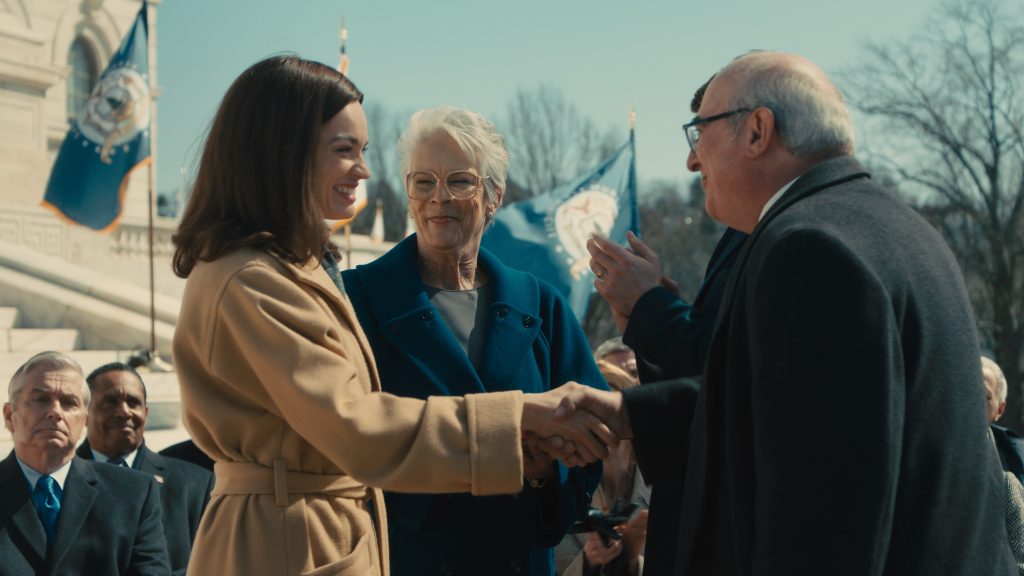
In 2008, Ella is serving as lieutenant governor under Governor Bill (Albert Brooks). When Bill is selected for a cabinet position in the Obama administration, Ella becomes governor at just 34 years old. The film presents Ella as someone trying to adjust to the increased pressure while also dealing with her father’s return and her brother’s isolation. Ella’s marriage to her high school boyfriend Ryan (Jack Lowden) adds another layer, as Ryan believes he should have a more active role in the governorship than is realistic. His behavior comes across as immature, and she treats this tension as part of the larger portrait of her strained support system.
Another detail that stands out in the film is the depiction of the governor’s security. Ella appears to have only two state troopers assigned to her: Trooper Nash (Kumail Nanjiani) and Trooper Alexander (Joey Brooks). Even for 2008, this seems unlikely. Nash becomes a friend to Ella, while Alexander primarily wants overtime due to financial strain. The only person consistently supporting Ella is her assistant Estelle Roth (Julie Kavner), who also narrates the film. Estelle acts as the gatekeeper to Ella, and even Governor Bill steps back once a scandal emerges, prioritizing his own career.
The scandal at the center of Ella McCay is not rooted in behavior that should be career-ending. It hinges on a law that seems ill-considered. The film uses it to show how committed Ella is to her work, sometimes at the expense of her family, but the fallout escalates once the source of the leak becomes known.
If we’re talking about political realism, Ella McCay takes several liberties. Depending on the state, governors and lieutenant governors either run separately (as in Rhode Island) or as a slate (some states have separate primaries to determine the general election state). Some states don’t have a lieutenant governor at all. In practice, no campaign strategist would recommend a mayor and their own chief of staff as a governor–lieutenant governor combination. For Ella McCay, accuracy in election mechanics is clearly not the priority.
All of this is to say that while Ella McCay sometimes sacrifices political realism for narrative convenience, the film remains focused on its central character and the pressures surrounding her. The structure may take shortcuts, but the film stays rooted in its portrait of a woman navigating personal history, public responsibility, and the consequences of her choices.
Ella McCay isn’t without its issues, especially when it comes to political realism, but it works more often than not. Brooks’s character-focused approach and Emma Mackey’s performance carry the film, making it a solid return even if it falls short of his best work.
DIRECTOR/SCREENWRITER: James L. Brooks
CAST: Emma Mackey, Jamie Lee Curtis, Jack Lowden, Kumail Nanjiani, Ayo Edebiri, Spike Fearn, Julie Kavner, Rebecca Hall, with Albert Brooks and Woody Harrelson
20th Century Studios releases Ella McCay in theaters on December 12, 2025. Grade: 3.5/5
Please subscribe to The Solzy Report and visit Dugout Dirt.