Danielle Solzman
As Jumanji marks its 30th anniversary, the fantasy-adventure favorite still thrills with the jungle-to-city chaos that made it a defining family blockbuster.
In 1969 Brantford, New Hampshire, young Alan Parrish (Adam Hann-Byrd) struggles with bullies and pressure from his father Sam (Jonathan Hyde). While hiding in the family shoe factory, he accidentally ruins a prototype made by his friend Carl Bentley (David Alan Grier), who takes the blame and is fired. Later, Alan follows mysterious drumbeats to a construction site, discovers the buried board game Jumanji, and brings it home.
That night, after arguing with parents Sam and Carol Parrish (Patricia Clarkson) about boarding school, Alan plans to run away. Sarah Whittle (Laura Bell Bundy) arrives to return his bike, and the two try out Jumanji, whose self-moving pieces and riddles quickly turn real. Alan’s first roll pulls him into the game’s jungle world, and Sarah flees as bats swarm the Parrish home.
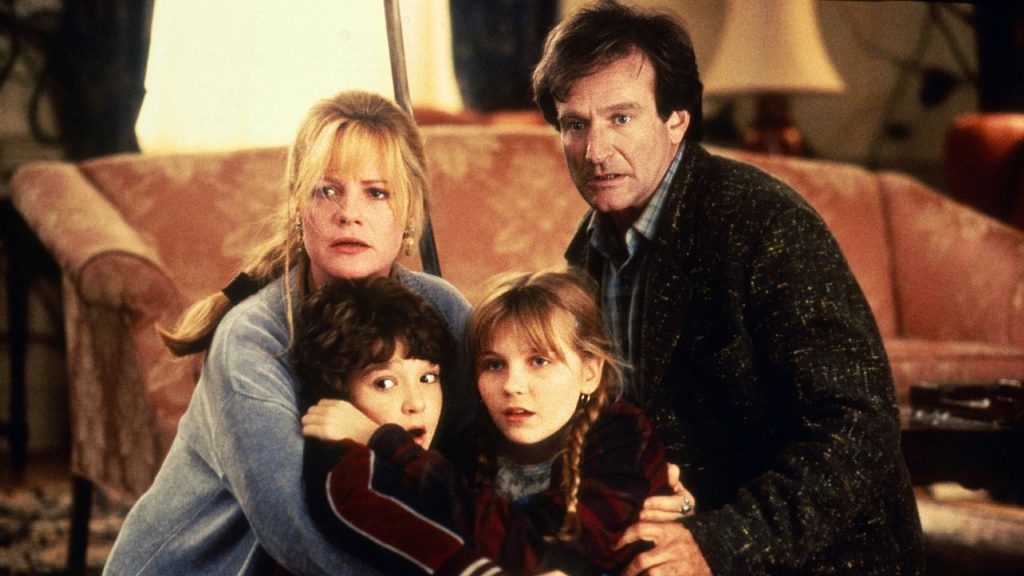
Twenty-six years later, Judy (Kirsten Dunst) and Peter Shepherd (Bradley Pierce) move into the abandoned Parrish house with their aunt Nora (Bebe Neuwirth). Finding Jumanji in the attic unleashes mosquitoes, monkeys, and a lion—along with the now-adult Alan (Robin Williams). At the empty shoe factory, Alan learns that Sam spent years searching for him until his 1991 death, leaving Brantford in decline. Alan soon crosses paths with Carl, now a police officer, who arrests him before learning his true identity. With Judy and Peter’s help, Alan persuades a traumatized adult Sarah (Bonnie Hunt) to rejoin the game.
The four resume playing, triggering escalating catastrophes across town, including a stampede of animals and the return of big-game hunter Van Pelt (Jonathan Hyde). After a chaotic showdown at a discount store and the Parrish mansion, Alan finally wins, resetting the timeline to 1969. He reconciles with Sam, admits the truth about the ruined shoe, and ensures Carl is rehired. In the restored future, Alan and Sarah—now married and expecting a child—meet Judy and Peter’s parents Jim (Malcolm Stewart) and Martha (Annabel Kershaw) and prevent their fatal ski trip. Meanwhile, Jumanji resurfaces on a distant beach, its drumbeats calling to new players.
Chris Van Allsburg’s children’s picture book is the source material for the now thirty-year-old classic. Van Allsburg worked on the screenplay at one point, adding material that wasn’t in the book, and without his involvement it’s hard to know whether Jumanji would have ever made it to the screen. Additional rewrites followed in order to secure Robin Williams, who initially turned the film down. TriStar, however, wouldn’t move forward without him.
The 1981 children’s book is only 32 pages, while the film runs 104 minutes including credits, leaving plenty of room to expand the story in adapting it for the screen. Much of that time goes toward showcasing the film’s visual effects, but this was always intended as crowd-pleasing entertainment. Nobody expected it to be an Oscar contender. It may not be as “idiosyncratic and peculiar” as Van Allsburg’s original story, but it earned the author’s seal of approval—and honestly, that’s more than enough for me.
What’s striking when watching Jumanji today is how advanced its visual effects were for 1995. The film arrived just over two and a half years after Jurassic Park, and while its game may have nothing on John Hammond, it unleashes one spectacle after another inside the Parrish home. ILM lets its imagination run wild, meeting the challenge of bringing these creations to life with far more complexity than a typical family adventure film. Once production moved onto a large-scale set modeled on the house, the effects team leaned heavily on practical work—after all, how else do you rip a home apart in an earthquake, let alone have a monsoon taking place inside?
Jumanji marked the first time ILM created digital hair in a feature film, not to mention giving CG animals expressive faces. We’ve come a long way since, but none of it would exist without the earlier breakthroughs that made Jurassic Park possible. I haven’t done a straight-through rewatch of the entire Jumanji franchise, but it would be fascinating to see them back-to-back and chart how far visual effects have evolved.
Despite all that technical achievement, the Academy didn’t even nominate the film for Best Visual Effects. Only Babe and Apollo 13 made the cut in 1995, with Babe taking the win. To be fair, the film was a shortlisted finalist, but the category wouldn’t expand to five nominees until 2010. For some reason, the Academy chose only two nominees that year. Both are worthy, but failing to nominate Jumanji was a missed opportunity.
Both Alan and Sarah spend years living in isolation, shaped by trauma the film only has time to address briefly because the plot prioritizes finishing the game. Still, echoes of It’s a Wonderful Life linger in the film’s final moments. When the game ends and they are transported back to 1969, they’re given a second chance—one that unfolds very differently from the timeline they previously endured.
Interestingly, Robin Williams isn’t at his zaniest here. While he and Bonnie Hunt were allowed to riff during alternate takes, he generally stuck to the script. Much of the comic relief instead comes from David Alan Grier, Bebe Neuwirth, and the monkeys. That’s not to say Williams didn’t have fun on set—the behind-the-scenes footage in the bonus features makes that clear. He was an extraordinary talent, and it remains a profound loss that his life ended too soon. The world was a better place with Robin in it.
Thirty years later, Jumanji still holds up as a thrilling blend of practical ingenuity, digital innovation, and heartfelt adventure. It may not capture every eccentric nuance of Chris Van Allsburg’s book, but it more than earns its place as a family classic—one powered by Robin Williams’s grounded warmth and ILM’s trailblazing effects work. The film’s emotional undercurrents, especially in Alan and Sarah’s second chance at life, give it a resonance that goes beyond spectacle. For all its chaos, Jumanji remains a reminder of what studio filmmaking could achieve when imagination led the way. Three decades on, the drums are still worth answering.
DIRECTOR: Joe Johnston
SCREENWRITERS: Jonathan Hensleigh and Greg Taylor & Jim Strain
CAST: Robin Williams, Kirsten Dunst, David Alan Grier, Adam Hann-Byrd, Bonnie Hunt, Jonathan Hyde, Bebe Neuwirth, Bradley Pierce, James Handy, Patricia Clarkson, Laura Bell Bundy
TriStar Pictures released Jumanji in theaters on December 15, 1995. Grade: 4/5
Please subscribe to The Solzy Report and visit Dugout Dirt.