Danielle Solzman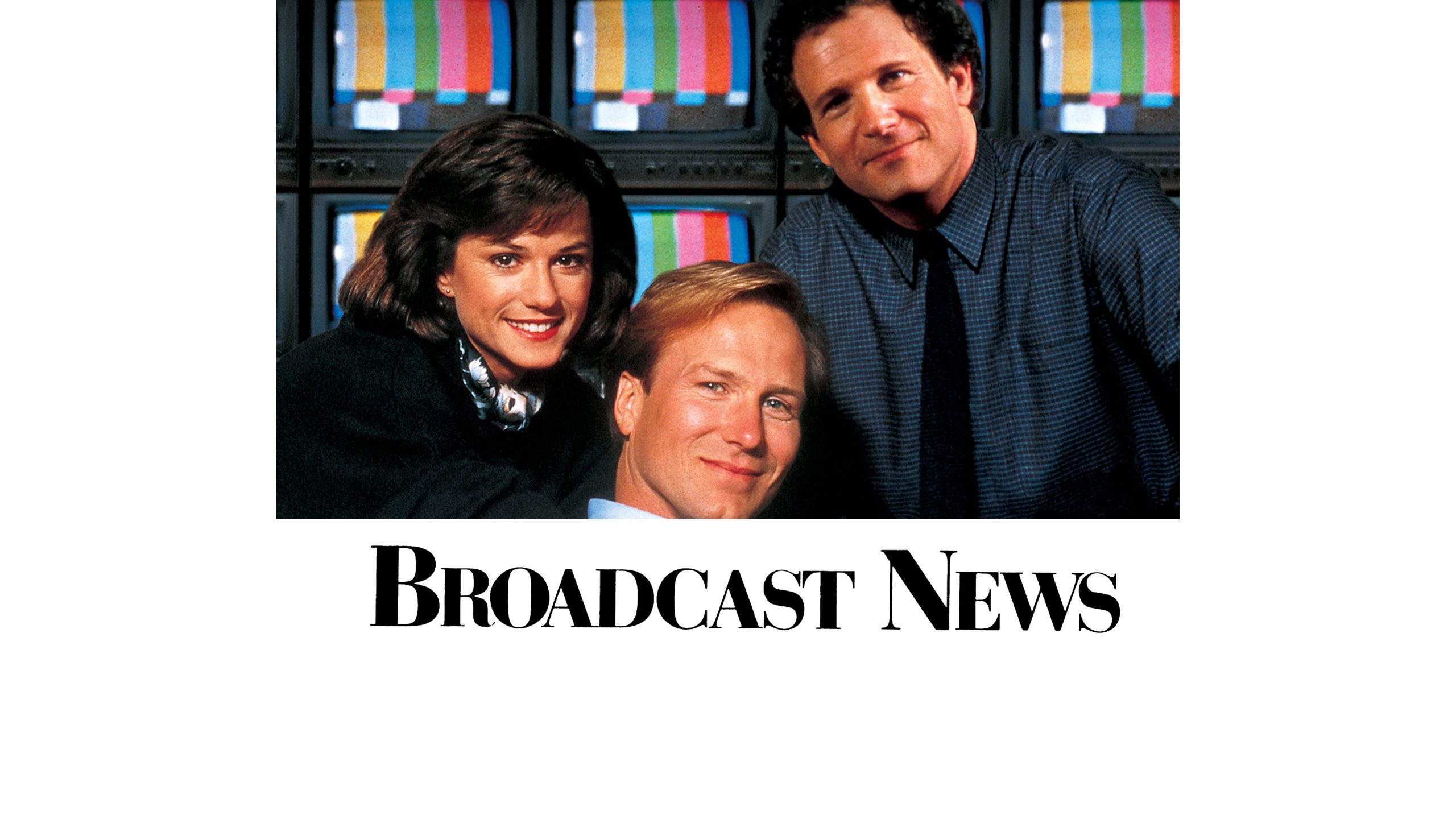
In his Oscar-nominated Broadcast News, James L. Brooks uses the structure of a romantic dramedy to examine the competitive, image-driven world of network news.
There have been plenty of films set in the world of media, and when it comes to television, Network is often the first title that comes to mind—a film that foresaw much of what would eventually unfold in the industry. The strength of Broadcast News is that James L. Brooks isn’t interested in copying the 1976 classic. By approaching television journalism through character rather than satire, both films are able to coexist without competing for the same ground.
Set in Washington, D.C., Broadcast News follows Jane Craig (Holly Hunter), a brilliant, high-strung producer at a national television network who is fiercely committed to journalistic integrity. At a broadcasters’ conference, her impassioned speech alienates most of the room but attracts Tom Grunick (William Hurt), a handsome anchor uneasy about his own intellectual limitations. When Tom is hired by Jane’s network, she becomes an informal mentor, helping him shape stories that impress management. Though Jane recognizes Tom’s professional shortcomings, she is increasingly drawn to him, even as his success highlights the industry’s preference for charisma over competence.
Jane’s closest colleague is reporter Aaron Altman (Albert Brooks), deeply ethical, emotionally fragile, and perpetually overlooked. During a major breaking news event, management insists Tom anchor live coverage, forcing Jane and Aaron to feed him information from behind the scenes. The broadcast is a triumph, cementing Tom’s rise while further sidelining Aaron. As Jane’s romantic feelings for Tom intensify, Aaron’s resentment grows, especially when Tom’s emotionally charged report on date rape earns praise and forces Jane to confront her own rigid ideas about what serious journalism looks like.
Budget cuts and restructuring push the love triangle toward crisis. Aaron’s lone anchoring opportunity exposes his lack of on-camera ease, while Tom continues to advance. Jane chooses Tom romantically, despite Aaron’s warnings that he embodies everything she claims to oppose. When Aaron later reveals that Tom faked tears during his most celebrated report, Jane is devastated and ends the relationship. Years later, the three reunite at another conference: Tom and Aaron are professionally secure, while Jane has risen to a powerful editorial position—having sacrificed romance to preserve her principles.

Brooks’s initial plan was to make a romantic comedy, and as luck would have it, he was surrounded by people working in network news. Over time, everything in his career came together for an exploration of the cult of personality in modern television journalism—or at least how it existed in the late 1980s. Before going on to create some of the best sitcoms in television history, Brooks had worked in newsrooms himself. Having created The Mary Tyler Moore Show nearly two decades earlier, a film about people working in news hardly came out of nowhere. There’s a specific breed of humor in Broadcast News that traces back to Your Show of Shows and Caesar’s Hour.
But even beyond comedy, Broadcast News contributes to debunking stereotypes about certain roles in television news. Even though things have changed today, much of the film still feels true. It raises questions about audience expectations and the role dishonesty plays in journalism. Dishonesty is a major turnoff. Case in point: when I tune into a news broadcast, I want to believe the journalists are being objective.
Brooks based Jane Craig on Susan Zirinsky, formerly of CBS News, who worked with Holly Hunter to prepare for the role. When The Criterion Collection released the movie on home video, the bonus features show how both Brooks and Hunter drew on their interactions with Zirinsky to bring the character to life. Zirinsky’s role as an associate producer—writing news copy for Jack Nicholson’s character and consulting on special reports for William Hurt—directly informed key moments in the film. Brooks originally wrote the role with Debra Winger in mind, but she had to withdraw before filming.
Broadcast News existed in a very different era, when TV wasn’t so fractured and most Americans watched the evening news. Tom Brokaw on NBC (1982–2004), Dan Rather on CBS (1981–2005), and Peter Jennings on ABC (1983–2005) dominated the airwaves for nearly a quarter century. Networks covered hard news, not soft infotainment, which helped maintain public trust.
Today, network news hasn’t seen the same kind of stability it once did. NBC remained relatively steady, with Brian Williams and Lester Holt anchoring for about a decade each. Meanwhile ABC cycled through several anchors before landing David Muir in September 2014, and CBS went through multiple successors after Dan Rather. Anchor tenures on the latter two networks rarely last as long as they once did.
In addition to Best Picture, Broadcast News earned Oscar nominations for Best Actor (William Hurt), Actress (Holly Hunter), Supporting Actor (Albert Brooks), Original Screenplay, Cinematography (Michael Ballhaus), and Film Editing (Richard Marks).
Revisiting Broadcast News now, it’s striking how little James L. Brooks got wrong about television news—and how much worse the industry has become at pretending otherwise.
DIRECTOR/SCREENWRITER: James L. Brooks
CAST: William Hurt, Albert Brooks, Holly Hunter, Robert Prosky, Lois Chiles, Joan Cusack
20th Century Fox released Broadcast News in theaters on December 16, 1987. Grade: 5/5
Please subscribe to The Solzy Report and visit Dugout Dirt.