Danielle Solzman
James Vanderbilt’s feature directorial debut dramatizes the Killian documents controversy and the media fallout behind Dan Rather’s exit from CBS in Truth.
On September 9, 2004, veteran CBS News producer Mary Mapes (Cate Blanchett) wakes up believing she’s helped deliver a major journalistic achievement. The night before, 60 Minutes II aired an investigative report she produced and Dan Rather (Robert Redford) anchored, alleging that President George W. Bush used family influence to join the Texas Air National Guard during the Vietnam era and later failed to meet his service obligations. With the 2004 election looming, the story carried the potential to seriously impact the Bush–Kerry race.
Working under intense deadline pressure, Mapes and her team—including freelancer Mike Smith (Topher Grace), journalism professor Lucy Scott (Elisabeth Moss), and military consultant Colonel Roger Charles (Dennis Quaid)—assembled eyewitness testimony and newly surfaced documents they believed supported their claims. Confident in their reporting, the journalists expected political fallout. Instead, the narrative quickly shifted as critics challenged the authenticity of the documents and questioned the rigor of the reporting itself.
Within days, the focus turned away from Bush’s military record and onto CBS News. Accusations of flawed journalism and possible deception engulfed 60 Minutes, ultimately costing Mapes her job and accelerating Rather’s departure from the anchor chair. As the scandal escalates, the film asks pointed questions about journalistic independence, media accountability, and whether modern newsrooms are equipped—or willing—to challenge power when the consequences become personal.
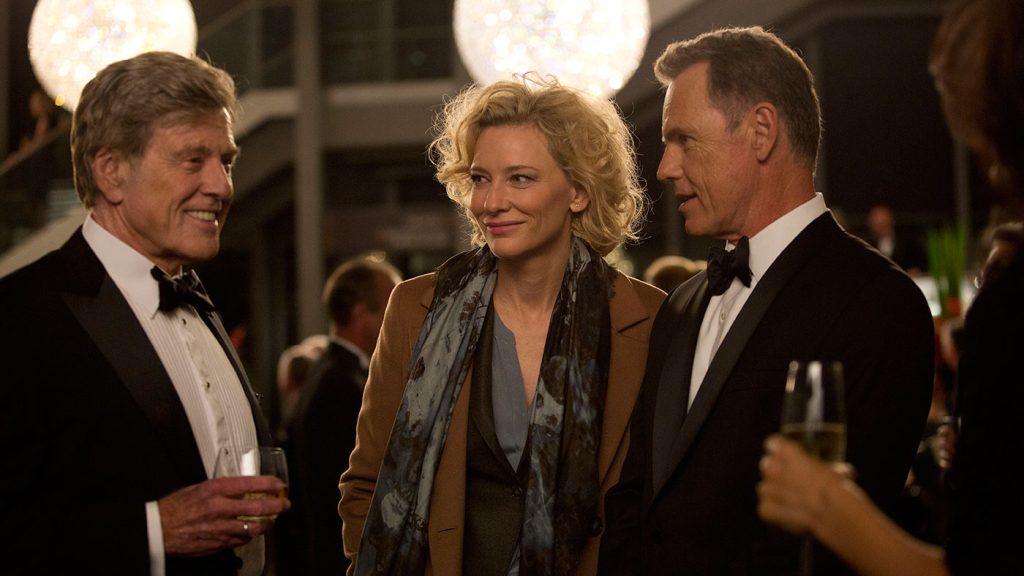
I’m a bit late to watching Truth, having missed it entirely during its 2015 release. Come to think of it, I don’t even remember it opening back home. I had planned to watch it this past year for a tenth-anniversary retrospective combined with a Robert Redford tribute, but my schedule got ahead of me. As they say, better late than never. What’s interesting, though, is that Truth and Spotlight were released during the same fall. The latter, which went on to win Best Picture, drew from Pulitzer Prize–winning journalism, while Truth revisited a still-controversial chapter in broadcast news history. And yet, Vanderbilt’s film ended up bombing at the box office.
Writer-director James Vanderbilt adapted his screenplay from Truth and Duty: The Press, the President, and the Privilege of Power by Mary Mapes. He first became aware of the book after a particularly juicy excerpt appeared in Vanity Fair. As a result, Vanderbilt frames the story largely from Mapes’ perspective rather than that of the legendary Dan Rather. Redford was cast with Rather in mind—one icon portraying another. Having known Rather since the 1970s, Redford even reached out to him after taking the role.
At the time, Mapes was at the top of her game, having recently produced the 60 Minutes segment that broke the Abu Ghraib torture scandal. The film shows her effortlessly moving between home life, the field, and CBS News headquarters in New York. Because of her close professional relationship with Rather, the two share a deep mutual respect and affection. That only makes the question more pressing: how did things unravel so catastrophically for both of them at this stage in their careers?
As Truth presents it, Mapes and her team did their due diligence. They made phone calls, vetted sources, and even met with Bill Burkett (Stacy Keach), a rancher and former Texas Army National Guard lieutenant colonel. They believed the documents Burkett provided were authentic, only later learning that he had lied about their provenance and supplied copies rather than originals. Their confidence was bolstered by document analyst Marcel Matley (Nicholas Hope), who stated the papers matched those in the official record. With that kind of endorsement, it’s easy to see why they believed the story was ready to air.
Vanderbilt demonstrates a solid grasp of the material, no small feat given that Truth dramatizes real events involving real people whose careers were permanently altered. It’s also one of those pivotal moments in broadcast journalism history—because, simply put, CBS News was never quite the same afterward. While it wasn’t the first time the network faced scandal (Michael Mann’s The Insider covered an earlier 60 Minutes controversy), this one struck at the core of public trust.
The film functions as a classic newsroom drama, a procedural, and a character study all at once. While movies based on true events are often nitpicked for accuracy, Rather publicly stood by the film’s depiction. In the production notes, he’s quoted as saying that Truth “is about what has happened to the reporting of news, how and why it’s happened, and why you should care,” adding that it’s “it’s not just pretty accurate, it’s astonishingly accurate.”
His comments go along with another line delivered by Col. Roger Charles about the state of journalism in Truth:
“This is what our business has become. Reporting on reporting. Why go through the trouble of breaking news when all you have to do is talk about other people breaking news? Thirty minutes from now, someone, somewhere, is going to be doing a story about this guy doing a story about us. You know what? They’re all gonna get Peabodys.”
I don’t know whether these comments were taken verbatim from Mapes’ book or invented for Truth, but looking around today, it’s more or less the same thing. Consider the current state of entertainment journalism: one outlet publishes an exclusive and, within minutes, the same piece goes live across multiple sites. At that point, it’s hardly worth writing about anymore, since there’s little value in rehashing the same information with a slightly different opinion attached. On the other end of the spectrum is broadcast and cable news, where some journalists continue pushing back against lies coming from the administration, while others seem to be missing their spine.
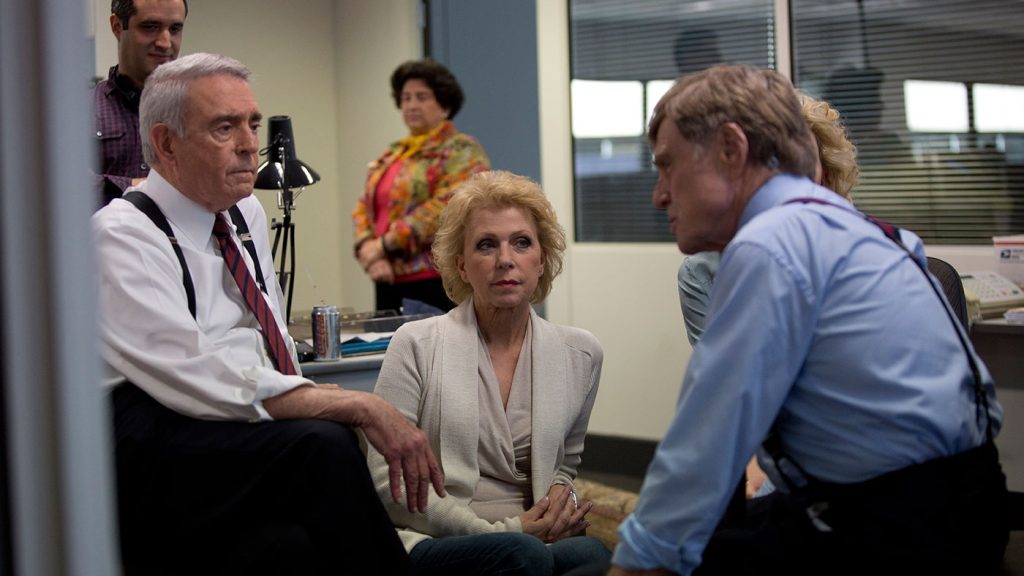
As Rather says in the film’s production notes:
“Our form of government is supposed to be for the people, by the people, of the people, and it only works if people know what is really going on. That is the mission of a journalist—to find out and report what those in power don’t want you to know, what they want to keep hidden. That’s only possible when journalists can operate within a system that supports independence and integrity.”
Before the credits roll, Truth reminds audiences that the Independent Panel Report found no evidence of political bias in the Guard story. Josh Howard (David Lyons), Mary Murphy (Natalie Saleeba), and Betsy West (Rachael Blake) were asked to resign, while Mapes was fired and has not worked in television news since 2004. Rather left CBS after his final CBS Evening News broadcast in early 2005 and later sued the network for breach of contract, alleging he was sidelined to appease the White House. The lawsuit was ultimately dismissed by the New York State Appeals Court.
Truth takes place during a time when CBS News stood for something—an era when its reporting wasn’t constantly questioned because viewers trusted a newsroom built by figures like Edward R. Murrow and Walter Cronkite. Watching the film a decade after its release and two decades after the events it depicts, it feels especially relevant as CBS News once again finds itself facing controversy after cutting a 60 Minutes story at the last minute. Truth serves as a reminder of what it means when journalists stand up against intimidation and interference. Just as importantly, it underscores the vital role journalism plays in preserving American democracy—and what’s lost when that mission is compromised.
DIRECTOR/SCREENWRITER: James Vanderbilt
CAST: Cate Blanchett, Robert Redford, Topher Grace, Elisabeth Moss, Bruce Greenwood, Stacy Keach, John Benjamin Hickey, Dermot Mulroney, and Dennis Quaid
Sony Pictures Classics released Truth in theaters on October 16, 2015. Grade: 4/5
Please subscribe to The Solzy Report and visit Dugout Dirt.