Danielle Solzman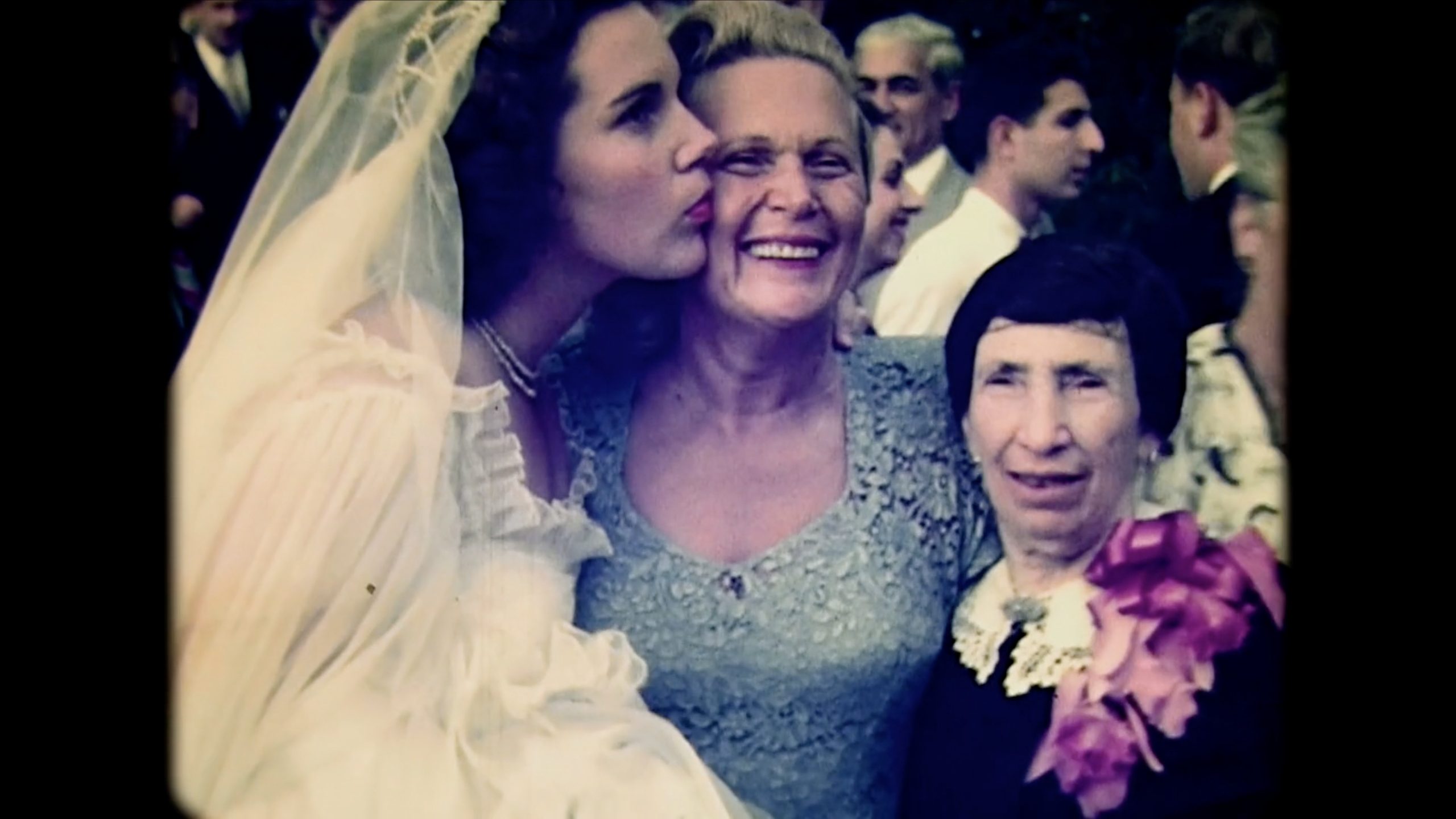
We Met at Grossinger’s revisits the Catskills at the height of the Borscht Belt, exploring how one resort became a cornerstone of Jewish American life and American popular culture.
It is a nostalgic look at the famed Catskills resort that helped inspire Dirty Dancing and reshaped Jewish American leisure culture. Founded and sustained across three generations of formidable Jewish women, with the indomitable Jennie Grossinger at its center, the hotel became a refuge for guests shut out of America’s WASP-dominated vacation world. At Grossinger’s Resort and Hotel, entertainers, athletes, and politicians mingled freely, creating a rare social space where talent and community mattered more than background.
The film makes the point that Grossinger’s was more than a getaway—it was a cultural engine that helped redefine both Jewish American identity and the broader entertainment landscape. Told through a consciously female perspective, the documentary evokes a mid-century crossroads where immigrants, celebrities, and public figures shared a common stage. Drawing on newly discovered archival material, personal recordings, animation, and firsthand testimony, the film traces the resort’s rise and decline while capturing how one hotel left a lasting imprint on American culture and collective memory.
The resort’s history dates back to the early 1900s, when Selig and Malka Grossinger left New York City for Sullivan County, N.Y., largely due to Selig’s declining health. After settling there, they began renting rooms and opened a kosher kitchen. Over time, the family purchased a larger property, and the rest followed. Jennie Grossinger would eventually marry her cousin, Harry Grossinger. After Harry’s death in 1964, she handed the family business to their daughter, Elaine, ushering in a new era for the resort.
Elaine and Jennie had very different personalities. Many may have wanted Elaine to be her mother, but the fact of the matter is that they were different people. Where Jennie had a dominant, commanding presence, Elaine was able to fly under the radar. That difference didn’t stop her from making history: Elaine became the first woman to serve as president of the American Hotel and Motel Association.
I have a confession to make. I had never seen Dirty Dancing, but after kicking off 2026 with We Met at Grossinger’s, I decided to finally rectify that. While I’m obviously familiar with the film’s place in pop culture, I wanted to see how it plays after learning about its inspiration. It has been decades since the Borscht Belt was the prime vacation destination for Jewish Americans, but there’s been renewed interest in the region in recent years, thanks in part to The Marvelous Mrs. Maisel and the work of photographers like Marisa Scheinfeld and Isaac Jeffreys, who have documented what remains.
The Jewish Vacation Guide—often compared to the Green Book—was crucial to Jewish life in America, serving as a resource that identified where Jews were welcome. While it’s easy to assume that Jews were fully accepted into public life after World War II, the reality was more complicated. Jews were—and to some extent still are—shunned, which is why spaces like Grossinger’s mattered so much. It was a place to turn for comedy, music, sports, and, crucially, the buffet.
By the 1980s, the Borscht Belt was in decline, with a growing number of resorts closing their doors. Grossinger’s shut down in 1986 after the family sold the property, and many of the remaining structures were later demolished or destroyed in fires. Kutsher’s, the longest-running resort in the Borscht Belt, closed in 2013. While antisemitism had declined to some extent by the 1980s and Jews were more broadly welcomed into American society, the need for places of refuge had shifted rather than disappeared.
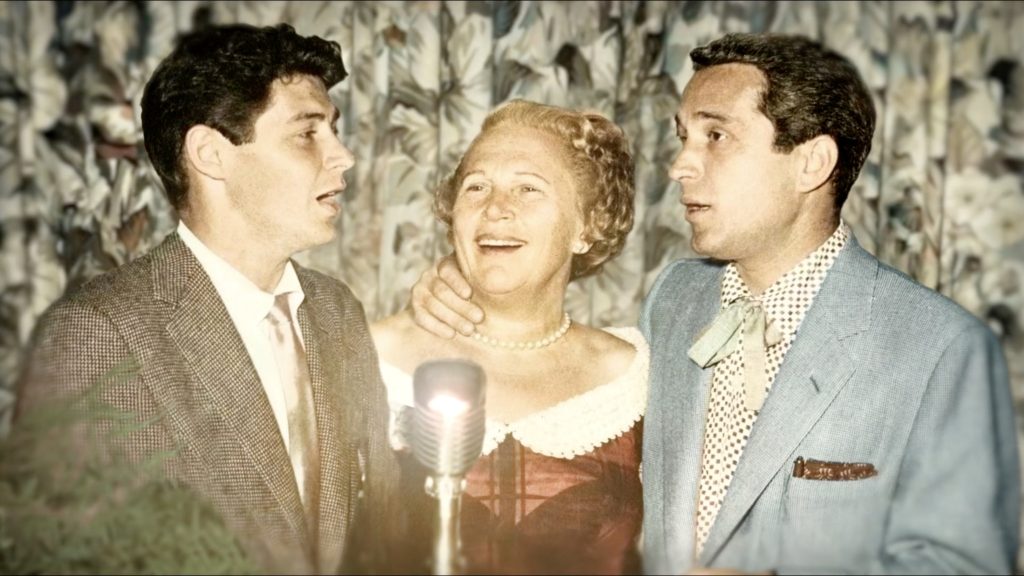
Jackie Hoffman describes the three-meal-a-day buffet as being like “an insane eating orgy.” Both Selig and Malka Grossinger were Orthodox, and the resort’s dining reflected this, with all food prepared in accordance with Jewish dietary laws (kashrut).
You cannot tell the history of stand-up comedy in America without mentioning the Borscht Belt. The heyday of the Catskills was when comedy went to school. Performers like Sid Caesar, Buddy Hackett, Mel Brooks, and many others honed their craft there before reaching wider audiences on television. We Met at Grossinger’s can only cover so much of the history of comedy in the Catskills, but there is an entire documentary devoted to the subject and plenty of others about Jewish comedians in general.
“Comedy and being Jewish kind of always go together,” argues comedian Jeffrey Gurian. “I think it’s because of what we went through as Jewish people. If we didn’t have a sense of humor, we wouldn’t be able to survive.”
The Catskills didn’t just attract Jews looking for a summer vacation. They also drew figures like Jackie Robinson and Eleanor Roosevelt. Robinson was initially hesitant to visit because of his celebrity, but his experience made him feel at home. That visit later led to the first biracial hug on television when Jennie Grossinger appeared on a 1954 episode of This Is Your Life. When former First Lady Eleanor Roosevelt visited Grossinger’s, she reportedly loved the herring, reflecting how her views on Jews evolved later in life after getting to know Jewish labor organizers.
The documentary also doesn’t shy away from how the Catskills became a shared refuge for Jewish and Black communities. Historian Myra Armstead recounts how her grandparents came from Virginia in the 1930s and turned their home into a boardinghouse, as Black workers were also drawn to the region. The Gratney M. Smith boardinghouse eventually became a central hub for the Black community.
At its core, We Met at Grossinger’s isn’t just a celebration of one family’s legacy, but of Jewish pride. In light of the alarming surge in Jew-hatred, the film serves as a sobering reminder of why places like Grossinger’s existed in the first place. As comedian Judy Gold says in the film, “We need to say ‘I am a proud Jew’ now more than ever.”
DIRECTOR: Paula Eiselt
FEATURING: Elaine Grossinger Etess, Susan Etess, Mitchell Etess, Mary Ann Grossinger, Joyce Antler, Myra Armstead, Debra Conway, John Conway, Hasia Diner, Judy Gold, Josh Gondelman, Joel Grey, Jeffrey Gurian, Barbara Haber, Jackie Hoffman, Andrew Jacobs, Isaac Jeffreys, Barry Lewis, Eileen Pollack, Al Rosenblatt, Marisa Scheinfeld, Steve Schwartz, Cherie Taney, Gary Veroba, Michelle Vilotti, Gail Geiver Weinstein, Mel Weinstein
We Met at Grossinger’s holds its Southeast premiere during the 2026 Miami Jewish Film Festival. Grade: 5/5
Please subscribe to The Solzy Report and visit Dugout Dirt.