Danielle Solzman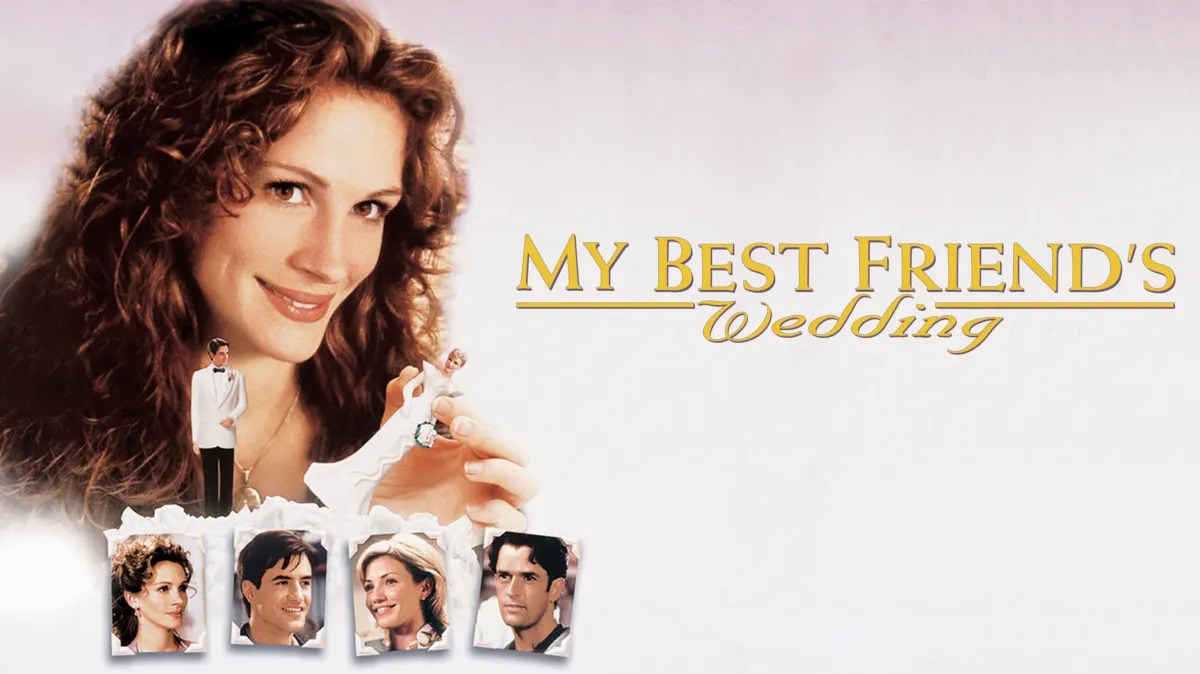
When a woman finds out her best friend is getting married in a matter of days, she sets a plan into motion to break up the wedding in My Best Friend’s Wedding.
Three weeks before her 28th birthday, New York food critic Julianne Potter (Julia Roberts) learns that her longtime friend Michael O’Neal (Dermot Mulroney)—with whom she once made a marriage pact—is set to wed in just four days. She rushes to Chicago, realizing she loves him, and meets his fiancée, Kimmy Wallace (Cameron Diaz), and her father, Walter Wallace (Philip Bosco), a powerful cable executive who owns the Chicago White Sox and complicates Julianne’s schemes. Despite being named maid of honor, Julianne’s attempts to break them up—through social sabotage and manipulating Walter to interfere in Michael’s career—backfire spectacularly.
Desperate, Julianne enlists her sharp-tongued friend George Downes (Rupert Everett), who briefly poses as her fiancé in a misguided bid to provoke jealousy. The plan only deepens the chaos, culminating in a public musical moment that underscores just how out of control things have become. When Michael admits to feeling conflicted, Julianne still cannot confess her feelings. She doubles down, creating a series of misunderstandings that involve Walter’s office and threaten to derail the wedding entirely.
As the fallout unfolds, Julianne is forced to confront the damage she has caused. A last-ditch confession sets off a chain reaction that sends all three leads racing across Chicago, emotions laid bare. In the end, honesty replaces manipulation, and Julianne steps aside, acknowledging that Michael’s future lies with Kimmy. At the wedding, she embraces her role with grace, letting go of what might have been. A final reunion with George offers a bittersweet sense of closure—and the promise of moving forward.
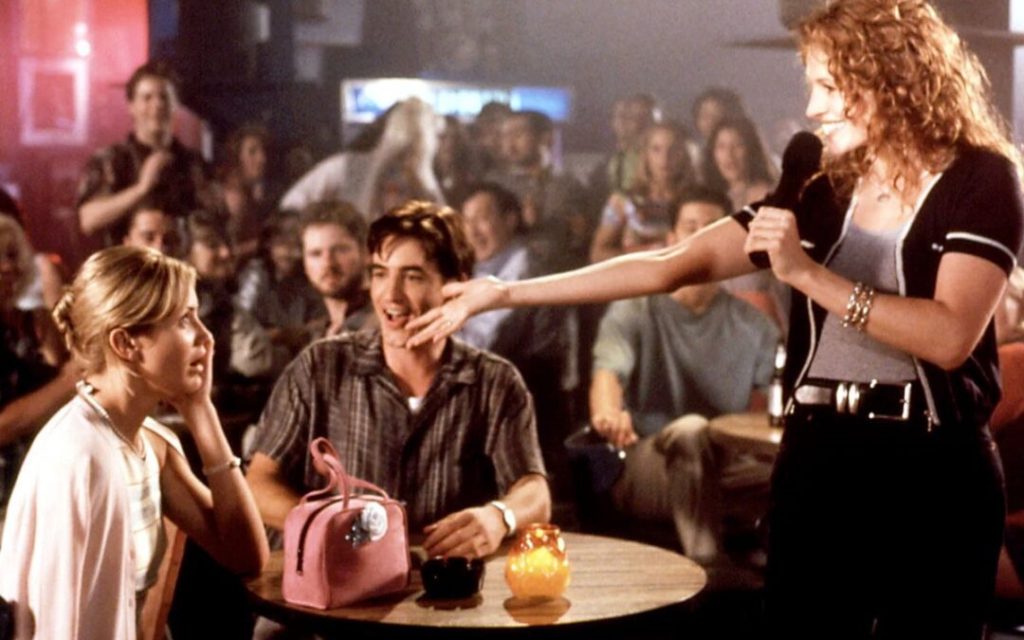
It’s been several years since I last rewatched My Best Friend’s Wedding, so much so that I couldn’t remember going into the film whether Julianne had succeeded in winning Michael over. I opted not to check the plot beforehand so I could be surprised again. There were a few moments when I thought, just maybe, Julianne had a chance. The first was when she and Michael looked so uncomfortable as the entire wedding party broke out in singing “I Say a Little Prayer.” The second was during their afternoon on a boat cruising down the Chicago River, culminating in a dance that revealed sparks still lingered between them.
One of the things that sets My Best Friend’s Wedding apart is that Julianne does not end up with Michael. Typical romantic comedy logic usually dictates that the first two billed characters end up together in the credits, but that’s far from the case here. Perhaps this is why the film has aged so spectacularly well and continues to hold up as one of the better rom-coms of the 1990s.
On the casting and script side, it’s easier to buy Julia Roberts playing a character in her late 20s in My Best Friend’s Wedding because she was in her late 20s during production in Chicago and on the Sony Pictures lot. It’s harder to accept then-in-her-mid-20s Cameron Diaz as a 20-year-old college junior. She carries herself differently than a typical young adult in college—least of all as the daughter of a wealthy executive—and she doesn’t come off as a socialite. This is especially clear in her wardrobe choices, which say adult chic more than student.
While My Best Friend’s Wedding focuses on Julianne, Michael, and the wedding party, one wonders where Kimmy’s closest friends from the University of Chicago are and why none appear in the bridal party. That’s why Kimmy asking Julianne to be her maid of honor is so surprising. Beyond two cousins, there are no college classmates or childhood friends—yet the film asks us to accept this without question.
My Best Friend’s Wedding immediately draws you in with Ani DiFranco’s cover of “Wishin’ and Hopin’” during the opening credits. I was way too young to appreciate the sequence when I first saw it in 7th grade, but years later, I can’t help but want those dresses—though preferably in a blue/green palette. Similarly, I hadn’t realized just how much Burt Bacharach and Hal David contributed to the soundtrack, with five songs including the show-stopper sung by the cast. The film opts for Diana King’s reggae-style cover rather than the Dionne Warwick orignal or Aretha Franklin cover.
Given how much of My Best Friend’s Wedding is set in Chicago and how quickly Julianne and Michael speed down Michigan Avenue, eventually arriving at Union Station, one wonders exactly where Walter and Isabelle Wallace (Susan Sullivan) live. Obviously, the filming location of Cuneo Mansion in Vernon Hills is not in the city itself. That the brunch and wedding reception are located there rather than closer to the wedding itself is one of those moments where the viewer must suspend disbelief.
My Best Friend’s Wedding earned James Newton Howard an Oscar nomination for his score. But if comedies were treated more seriously by the Academy, Rupert Everett should have been nominated for Best Supporting Actor. Obviously was fierce that year, with Titanic, Good Will Hunting, As Good as It Gets, Boogie Nights, and Wag the Dog. Had the Oscars expanded the Best Picture category to ten nominees earlier, Wag the Dog likely would have taken the usual comedy slot, if not Men in Black. Even with Julia Roberts in the mix, it’s still hard to figure out which actress would have been removed to make room.
Ultimately, My Best Friend’s Wedding holds up because it balances humor, heartfelt emotion, and surprising honesty. Julianne’s missteps, Michael’s charm, Kimmy’s sincerity, and the supporting cast all feel authentic, even amidst rom-com exaggeration. The performances, setting, and music continue to make the film a pleasure to revisit, proving that some stories—and some crushes—don’t need a predictable ending to leave a lasting impression.
DIRECTOR: P.J. Hogan
SCREENWRITER: Ronald Bass
CAST: Julia Roberts, Dermot Mulroney, Cameron Diaz, Rupert Everett, Philip Bosco, M. Emmet Walsh, Rachel Griffiths, Carrie Preston, Susan Sullivan
My Best Friend’s Wedding in theaters on June 20, 1997. Grade: 4.5/5
Please subscribe to The Solzy Report and visit Dugout Dirt.