Danielle Solzman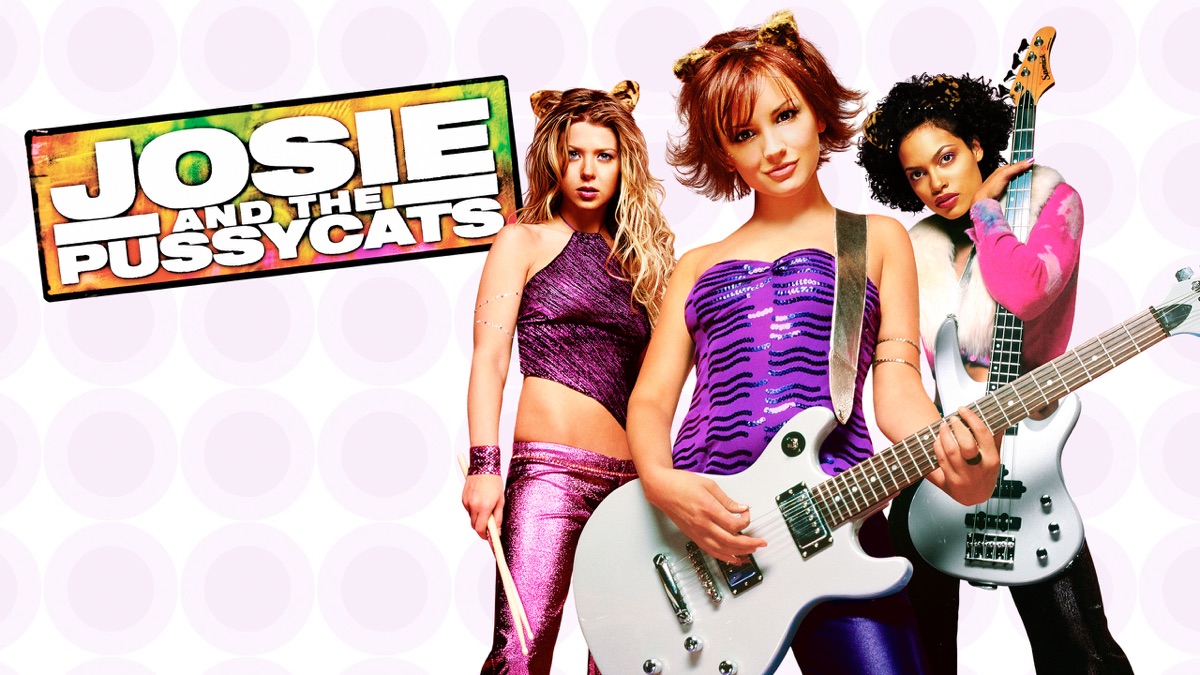
A commercial failure upon its initial theatrical release, Josie and the Pussycats has since developed a devoted cult following and marks its 25th anniversary today as a sharp, satirical take on pop culture and the music industry.
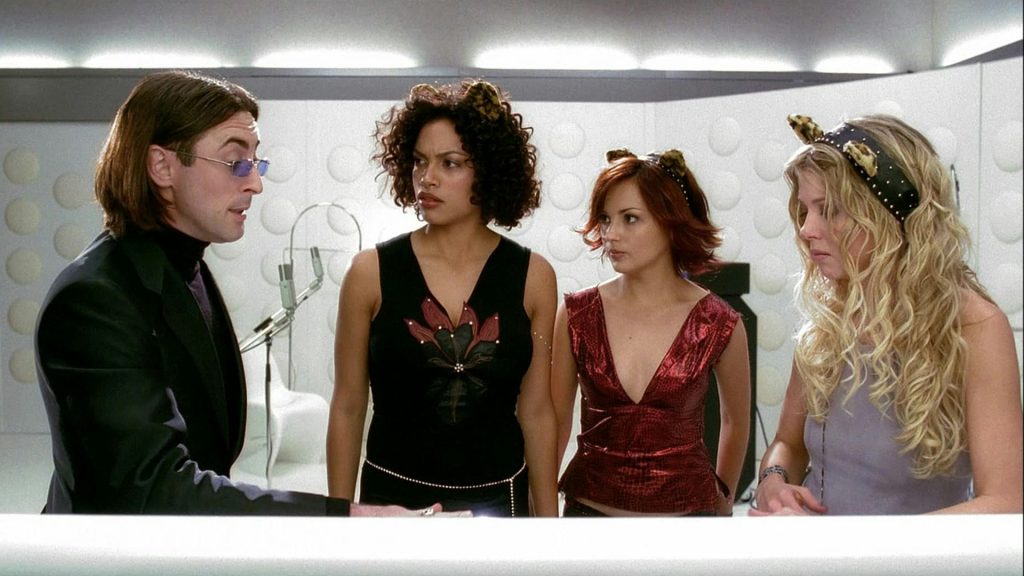
Successful boy band DuJour, signed to MegaRecords, confronts label executive Wyatt Frame (Alan Cumming) about a strange backing track hidden in their single “DuJour Around the World.” The confrontation turns chaotic, and Wyatt parachutes out of their private jet, leaving it to crash and seemingly killing the band. Seeking a replacement, Wyatt travels to Riverdale and discovers The Pussycats: Josie McCoy (Rachael Leigh Cook), Melody Valentine (Tara Reid), and Valerie Brown (Rosario Dawson). The struggling group agrees to a record deal and relocates to New York City, where Wyatt rebrands them as “Josie and the Pussycats,” much to their discomfort.
Unbeknownst to the band, MegaRecords CEO Fiona (Parker Posey) is part of a global conspiracy involving subliminal messaging hidden in pop music to influence teenage consumers. As part of this scheme, musicians who discover the truth are quietly eliminated. Josie and the Pussycats quickly rise to fame with their single “Pretend to Be Nice,” which becomes a hit due to these hidden messages. However, tensions grow within the band as Valerie feels overlooked and Melody grows suspicious of the label’s intentions.
Fiona orders Wyatt to eliminate the band before they uncover the truth, but their attempts fail. Meanwhile, Josie receives a new single containing subliminal messaging designed to push her toward a solo career, causing friction within the group. Realizing something is wrong, she uncovers the hidden track using a mixing board, confirming her suspicions. As MegaRecords prepares a massive pay-per-view concert to distribute a new subliminal message through special headsets, Fiona and Wyatt attempt to force the band apart while holding Valerie and Melody hostage.
During the final confrontation, DuJour—having survived the plane crash—returns and helps thwart the plan. The conspiracy is exposed, and the device used to generate the messages is destroyed, revealing that Fiona’s intended message was one of self-serving popularity. Fiona (Parker Posey) and Wyatt are ultimately arrested, while government officials shift responsibility and abandon the plan in favor of influencing audiences through films instead. Josie, Valerie, and Melody perform together, and with the crowd no longer influenced, they embrace the band on its own merits as Josie finds both personal and professional fulfillment.
Josie, Melody, and Val first debuted in the pages of Archie in 1963, transitioning from comic book to a Hanna-Barbera cartoon series from 1970–72. The 2001 film allowed Josie and the Pussycats to introduce the trio to a new generation of fans, including myself.
Can’t Hardly Wait filmmakers Deborah Kaplan and Harry Elfont had wanted to make a movie about a band, but they also wanted to tell a story that was stylistically different. Even with all the satire going on, it’s still very much a music-driven vehicle. Musically speaking, the songs performed by Josie and the Pussycats feel like they come from a band that first formed in a garage, whereas DuJour’s “Backdoor Lover” feels like it could have come from any of the boy bands performing in the late 1990s or early 2000s.
Most record executives would probably not sign a band before hearing a single demo, yet this is exactly what happens when Wyatt Frame sees a trio of musicians in front of him. The film takes the satire to the next level when a random “#1 Band in the World” sign appears behind them as he views them through a blank CD cover.
Josie and the Pussycats is perfectly cast with Rachael Leigh Cook, Tara Reid, and Rosario Dawson. If you told me that the lead role of Josie went to an actress who couldn’t sing or play guitar, I would never have believed you—Cook pulls off the performance in spectacular fashion. Melody isn’t the smartest person in the world, and Reid plays her very differently from what we see in films like American Pie or Sharknado. Valerie believes in the band, and Dawson is the right actress for the role.
I’ve never read the source material, but some of the lines from the script are just hysterical or pitch-perfect for what the film is trying to do. This exchange shows just how self-aware the film is:
Alexander Cabot: You know what? I still don’t understand why you’re here.
Alexandra Cabot: I’m here because I was in the comic book.
Alexander Cabot: What?
Alexandra Cabot: Nothing.
Then there’s comedy legend Eugene Levy showing up out of the blue in a PSA video explaining what MegaRecords is ultimately trying to do. His appearance in Josie and the Pussycats seems to be rather fitting given his role in American Pie two years prior. The PSA details how the government has turned to rock music to get kids to buy whatever they’re selling, with trends changing daily as new subliminal messaging is placed behind the music.
Most of what is seen on camera features period-inspired costumes from the 1970s despite the film being set in a contemporary world. Costume designer Leesa Evans wanted to create a surreal environment and a distinct new look, and there isn’t a single outfit that doesn’t work.
I cannot say enough good things about the soundtrack. For a film released in 2001, it’s absolutely incredible in terms of what Josie and the Pussycats are performing. On one hand, it qualifies as pop; on the other, it firmly leans into rock. If you think that’s Rachael Leigh Cook singing in the film, she’s actually lip-syncing while Kay Hanley provides Josie’s singing voice. That said, Cook, Reid, and Dawson all contribute backing vocals on the soundtrack.
In watching Josie and the Pussycats in 2026 and beginning to write this review, I was reminded why I struggled with it five years ago during the film’s 20th anniversary. There’s so much happening over the course of 98 minutes: an overload of satire, a tone that’s all over the place, and elements that feel either extremely dated or strangely prescient. Then there’s the emotional throughline, which may explain why I find rom-coms easier to write about—they hit my sweet spot more directly. Even though the film has become a cult classic, it’s still not an easy one to write about after multiple viewings.
The satire overload is especially evident in shots of New York City, where Manhattan is covered in excessive corporate sponsorship and product placement. Every frame is doing something, making it nearly impossible to watch Josie and the Pussycats passively. Thankfully, we haven’t reached this level in real life—although sports arenas and stadiums might be getting uncomfortably close. Years ago, players could be banned or suspended for ties to casinos; now, sportsbooks have closer relationships than ever with professional sports leagues.
In revisiting Josie and the Pussycats in 2026, it’s clear why the film has endured: its bold satire, committed aesthetic, and well-cast performances give it a distinct identity that still resonates today. At the same time, its density—tonally, thematically, and visually—makes it a challenging film to fully settle into. There’s a lot happening across its 98 minutes, which keeps the film consistently engaging while also resisting easy summarization. Still, it remains a fascinating and worthwhile watch, notable for the way it blends music, satire, and early-2000s pop culture into something uniquely its own.
DIRECTORS/SCREENWRITERS: Deborah Kaplan & Harry Elfont
CAST: Rachael Leigh Cook, Tara Reid, Rosario Dawson, Alan Cumming, Gabriel Mann, Paulo Costanzo, Missi Pyle, and Parker Posey
Universal Pictures released Josie and the Pussycats in theaters on April 11, 2025. Grade: 4/5
Please subscribe to The Solzy Report and visit Dugout Dirt.