Danielle Solzman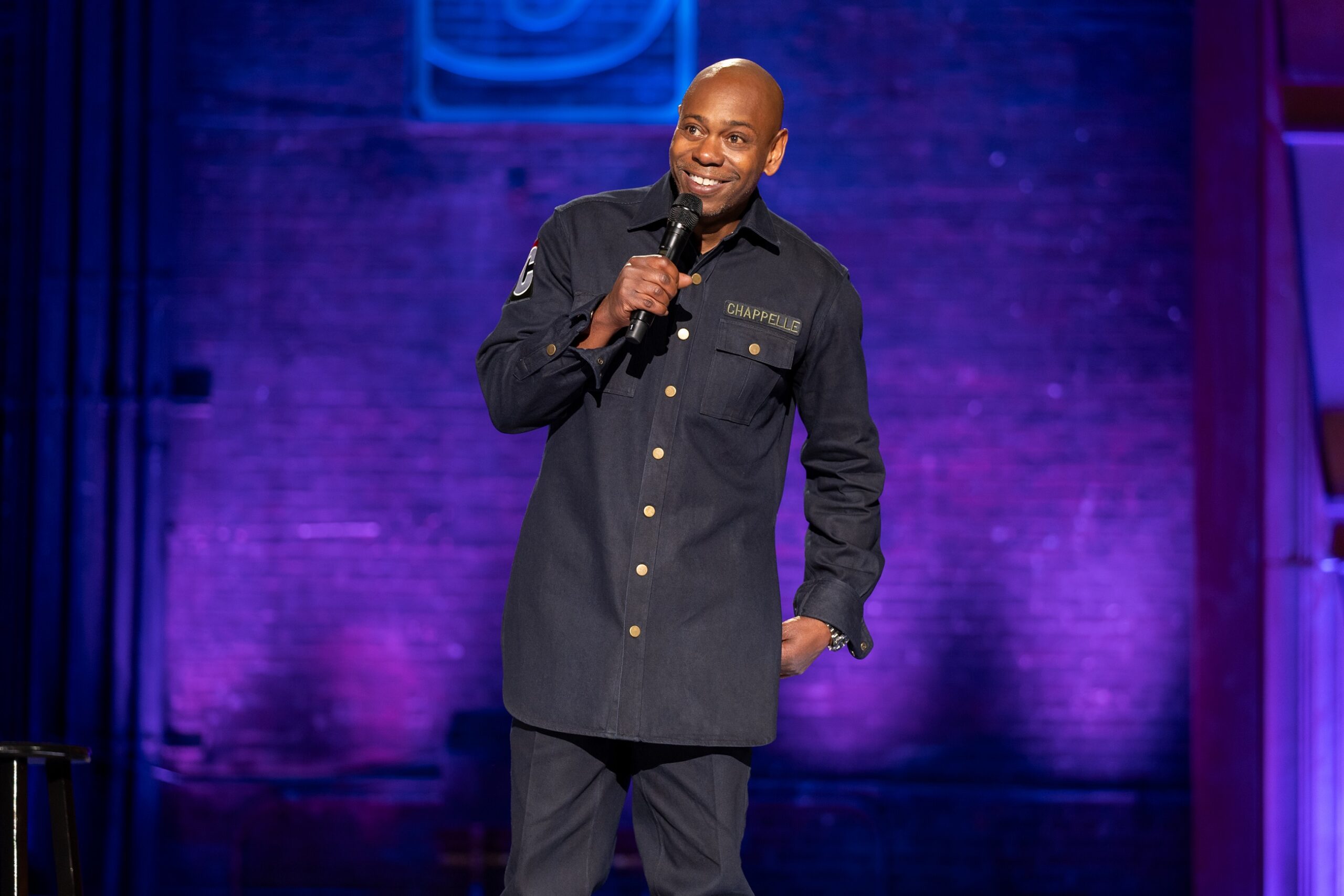
There’s a version of comedy that Dave Chappelle still likes to believe in.
It’s the one he described in a recent NPR interview: a room where “every opinion has a champion,” where no one is silenced because someone else can always grab the mic and fire back. In this version, comedy is a kind of self-regulating ecosystem. Say something wild, someone else will check you. Say something offensive, someone else will top it. The room evens itself out.
It’s a nice idea.
It’s also not the reality he’s operating in—and hasn’t been for a long time.
Because this isn’t about one joke, or one set, or one bad night that got taken the wrong way. Dave Chappelle has spent years returning to transgender people as a recurring subject in his specials—framing us as punchlines, as thought experiments, as cultural shorthand. Not once, not incidentally, but consistently enough that it’s become part of his comedic identity in this phase of his career.
That history matters. It’s the context for everything he’s saying now.
Dave Chappelle talks about comedy like it’s still a club, like it’s still a rotation of comics waiting to go up next. But his “room” is a global audience. His “set” is a streaming special. There is no next comic in the lineup who meaningfully balances that scale—not in reach, not in cultural weight, not in who gets heard and who gets ignored.
“Every opinion has a champion” only works if those champions have anything resembling equal footing.
They don’t.
I’m trans. I’m not in that room.
Not when the conversation is happening in sold-out arenas and algorithmically boosted specials. Not when the punchlines about people like me travel farther than any response ever could. Not when the premise itself—our existence, our legitimacy, our humanity—keeps getting recycled as material instead of engaged as reality.
Dave Chappelle frames this as dialogue. As back-and-forth. As a system where no one is shut out.
But dialogue requires listening, not just returning to the same topic with more confidence each time.
And that’s where his argument collapses—because what he’s describing as an exchange has, in practice, looked a lot like repetition without evolution.
When pressed on whether he’s “punching down,” Dave Chappelle doesn’t really engage the question so much as redirect it. He suggests the backlash was, in part, a “media phenomenon,” that coverage of his material veered into “rage bait,” that people reacting to it weren’t even in the room to hear the jokes as intended.
It’s a convenient argument. It’s also a way of shrinking who’s allowed to respond.
Because the people most affected by those jokes aren’t just the ones sitting in a comedy club. They’re the ones who hear about them after the fact. They’re the ones who see the clips, the headlines, the discourse. They’re the ones who live in a world where those jokes don’t stay contained to a set—they circulate, they linger, they get repeated by people who were in the room and people who weren’t.
I didn’t need to be in the room where Dave Chappelle is on stage to know I was the subject of the joke.
You don’t get to say your work only counts in the room when it benefits from living everywhere else.
And the idea that criticism is just a “media phenomenon” falls apart the second you remember how often Chappelle himself has returned to this topic, across multiple specials, over multiple years. At a certain point, it’s not the media creating a pattern.
It’s the material.
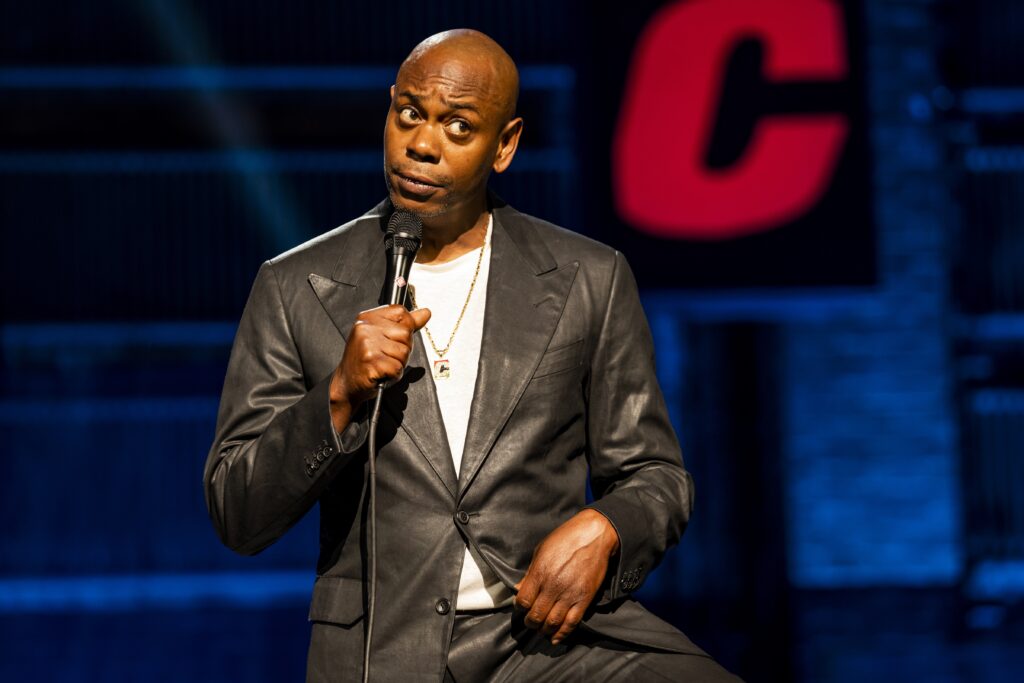
Dave Chappelle Understands Weaponization—Just Not When He’s Holding the Match
What’s striking is that Dave Chappelle almost admits the stakes. In the same interview, he says he resented the Republican Party for “weaponizing” transgender jokes—taking something he was doing onstage and turning it into a political tool. He even tells a story about calling out Lauren Boebert for using him as a prop in that exact way.
Anyone paying attention to what’s happening in Washington and across the country knows how transgender people are being targeted—through legislation, through rhetoric, through policies that make everyday life more precarious. The idea that these jokes exist in some separate, harmless space doesn’t hold up against that reality.
But that acknowledgment doesn’t help his case. It undermines it.
If your material can be so easily “weaponized,” then it’s not existing in some neutral, self-contained comedy ecosystem. It’s feeding a broader cultural narrative—one that doesn’t stay in the club, doesn’t stay in the special, and doesn’t get neatly balanced out by whoever “goes up next.”
You don’t get to separate the joke from what it becomes once it leaves your mouth.
You don’t get to say, “I’m just making space for all opinions,” while also recognizing that those same jokes are being picked up and used to marginalize the very people you’re talking about.
That’s not a misunderstanding. That’s the point.
Dave Chappelle also leans on the idea of community—of comedians with different views who argue, who push each other, who still show up to each other’s lives afterward. It’s meant to sound generous. Inclusive, even.
But that community isn’t the audience.
It’s not the people who have to live with the aftereffects of those jokes once they leave the room. It’s not the people who don’t have the luxury of treating their identity as a recurring bit. And it’s definitely not the people who keep finding themselves talked about, rather than listened to.
No one is saying Dave Chappelle can’t speak. He’s doing just fine on that front.
The question is why he keeps insisting that what he’s doing is part of a balanced exchange, when the scale is so obviously tilted—and why, after years of returning to the same subject, he still frames it as if it’s just one voice among many, rather than one of the loudest voices in the room.
There’s a difference between refusing to be silenced and refusing to grow.
And at this point, it’s getting harder to tell if Dave Chappelle knows the difference—or just doesn’t care.
Please subscribe to The Solzy Report and visit Dugout Dirt.